This article was automatically translated from the original Turkish version.
+2 More
Type(s) | Engraving (etching on copper plate) | ||||||||
|---|---|---|---|---|---|---|---|---|---|
Size(s) | 24 × 18.5 cm | ||||||||
Location | The Metropolitan Museum of Art / New York | ||||||||
Year | 1514 | ||||||||
Artist | Albrecht Dürer | ||||||||
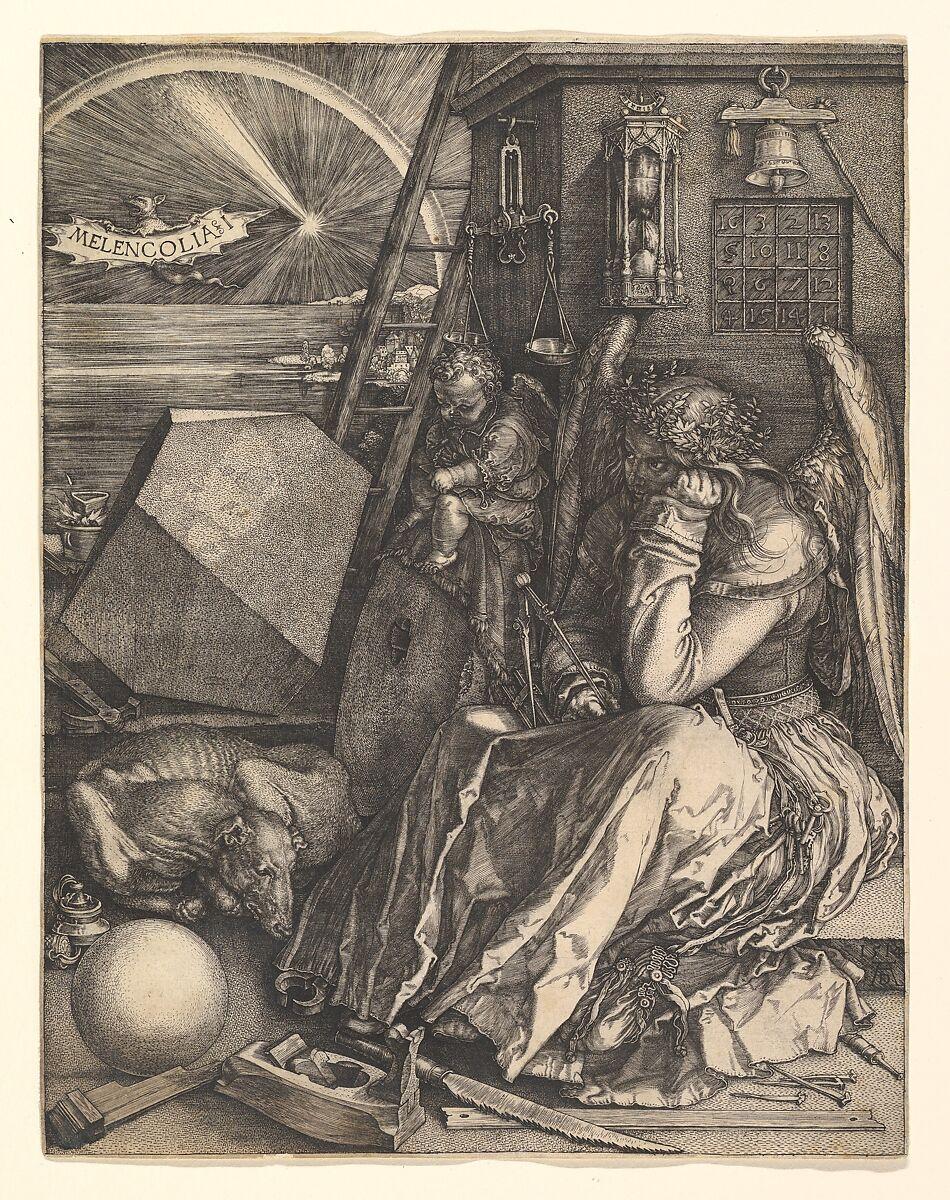
Melencolia I is an artwork created in 1514 by German Renaissance artist Albrecht Dürer using the engraving technique on copper plate. The work explores the concept of melancholy and the creative and intellectual processes of the human mind through an allegorical narrative. Through the figures and objects depicted, themes of intellectual production, mental intensity, and cognitive effort are visualized. The piece presents a complex symbolic structure linked to the intellectual approaches that developed in philosophy, science, and art during the Renaissance.

Melencolia I (The Metropolitan Museum of Art)
Melencolia I is one of the engravings Dürer produced between 1513 and 1514, known in art historical literature as “meisterstich.” The work examines the concept of melancholy in relation to the limits of human reason, intellectual production, and creative processes. In Renaissance thought, melancholy was not viewed merely as a mood but as a concept associated with intellectual intensity, inwardness, and mental exertion. The engraving visually expresses this conceptual framework through an allegorical figure and a system of symbolic objects.
The presence of elements related to mathematics, astronomy, and measurement reflects the era’s emphasis on scientific knowledge and rational thought. In this regard, Melencolia I functions not only as an artistic creation but also as a visual representation of the Renaissance intellectual world.
The “I” in the engraving’s title symbolizes the first of the three levels of creative genius described by Cornelius Agrippa in his work “De Occulta Philosophia,” namely “imaginatio” (the power of imagination).
Melencolia I was executed using the engraving technique on a copper plate. Through fine linear textures and dense hatching, the work creates a sense of depth through subtle transitions of light and shadow. The dimensions of the piece are 24 × 18.5 cm. Geometric and mechanical objects, alongside the figures, are meticulously arranged to enhance the perception of volume and space.
Art Analysis: Dürer’s Melencolia I (KhanAcademyTurkce)
The objects in the engraving are interpreted as visual elements reflecting Dürer’s interest in mathematics and geometry. The compass, measuring instruments, and geometric solids are central components of the composition. These objects symbolically express the period’s scientific knowledge and its mode of thinking grounded in measurement. The relationship between the figure, objects, and space is structured with a balanced and cohesive compositional approach.
At the center of the work stands the figure of Melencolia, depicted with wings and seated in a contemplative posture. Her head resting on her hand and introverted body language evoke intellectual intensity and mental stagnation. The relationship between the figure and the surrounding symbolic objects constructs a narrative that emphasizes the intellectual dimension of melancholy. The use of light and shadow and the spatial arrangement reinforce the sense of stillness and inner concentration within the scene.
Around the figure of Melencolia, symbolic objects include a compass, measuring tools, geometric solids, a closed book, a ladder, an hourglass, a bell, and a dog. The compass held in the figure’s hand represents symbolic order and measurement. The closed book in her lap signifies the suspension of access to knowledge. Her motionless and inactive wings symbolize the temporary paralysis of creative power. The ladder points to the idea of progress and ascent; the hourglass and bell represent the transience of time and the limits of life. The dog is positioned as an element of everyday life within the scene. Together, these objects visualize the layered structure of the creative process and intellectual endeavor.
Melencolia I is among the most significant works in Renaissance art for its visual representation of the concept of melancholy. The engraving addresses themes such as artistic identity, creativity, and mental activity through an allegorical figure and a system of symbolic objects. It has been frequently studied in art historical literature within the context of the possibilities of engraving and symbolic expression, and it continues to serve as a reference in scholarly works examining the relationship between melancholy and intellectual production.
Gökçek, Özge. "Albrecht Dürer’in Melancolia I Gravürünün Sembolik Anlatımdaki Yeri." Master's thesis,Anadolu Üniversitesi, May 2012. Accessed January 3, 2026. https://www.academia.edu/1881325/ALBRECHT_DURER_İN_MELANCOLIA_I_GRAVÜRÜNÜN_SEMBOLİK_ANLATIMDAKİ_YERİ
KhanAcademyTurkce. "Sanat Çözümlemesi: Dürer’in Melencolia I Adlı Eseri." YouTube, 6:21. Accessed January 3, 2026. https://youtu.be/Y32nJ5fTvVk?si=azY6-obvhO4d65WC
The Metropolitan Museum of Art. "Melencolia I." *THE MET*. Accessed January 3, 2026. https://www.metmuseum.org/art/collection/search/336228

Type(s) | Engraving (etching on copper plate) | ||||||||
|---|---|---|---|---|---|---|---|---|---|
Size(s) | 24 × 18.5 cm | ||||||||
Location | The Metropolitan Museum of Art / New York | ||||||||
Year | 1514 | ||||||||
Artist | Albrecht Dürer | ||||||||
No Discussion Added Yet
Start discussion for "Melancholy I (Engraving)" article
Subject
Engraving Technique and Physical Characteristics
Composition Details
Figure and Pose
Objects and Symbols
Artistic Context