

This article was automatically translated from the original Turkish version.
+1 More
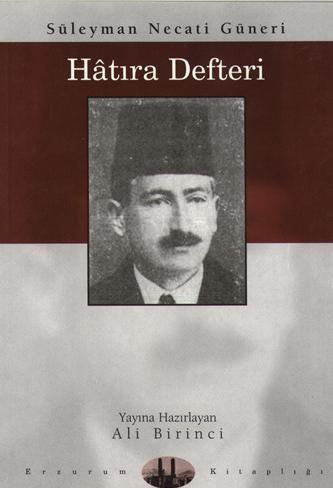
“Hâtıra Defteri” is a memoir written by Süleyman Necati Güneri (1881–1952), one of the leading figures of the National Struggle and especially the Erzurum Congress, and published by Dergâh Yayınları as part of the “Erzurum Kitaplığı” series. The book focuses on a specific period of Güneri’s life and provides firsthand information on the National Struggle and the days of the Erzurum Congress. The preparation of the manuscript for publication was carried out by Ali Birinci, and the first edition was released in November 1999; the book consists of 118 pages.
“Hâtıra Defteri” centers on Süleyman Necati Güneri’s activities during the National Struggle, particularly his roles and observations at the Erzurum Congress. Through his personal initiatives and the newspaper he published, “Albayrak,” Güneri held an active position in the political and social processes of Erzurum. The book highlights the role of this newspaper in the early stages of the National Struggle and presents data on the communication media and public opinion formation efforts of the period.
The memoirs in the work provide historical context regarding the preparation, conduct, and outcomes of the Erzurum Congress, based on Güneri’s personal experiences and observations. Despite its limited length, the narrative includes various details about the era. The book was published on the occasion of the 80th anniversary of the Erzurum Congress with the aim of contributing to the documentation of the period.
These narratives, presented within the framework of the author’s personal testimony, convey the atmosphere of the time, the decisions made, the debates at the congress, and the course of the National Struggle in Eastern Anatolia as primary sources. In this respect, the work serves as an informative resource for both historical research and studies on local developments of the period.
The language of the work is simple and direct, in keeping with the characteristics of the memoir genre, and reflects the expressive forms of the period. While the text contains personal observations, the historical context remains central to the narrative; no exaggeration, praise, or promotional language is employed. This feature provides a suitable foundation for the scholarly examination of the work’s historical content.
Ali Birinci, who prepared the manuscript for publication, is a researcher known for his work on modern Turkish history and archival documents. The careful preparation of the text based on source materials facilitates its evaluation within an academic context.
“Hâtıra Defteri” is among the few sources offering firsthand information on the period of the Erzurum Congress and thus holds significance for historiography. Due to its authorship by a witness of the era, beyond official documents and general historical narratives, the work serves as a valuable reference for researchers working in fields such as the National Struggle, the Erzurum Congress, modern Turkish political history, local history, and memoir literature.

No Discussion Added Yet
Start discussion for "Memory Notebook (Book)" article
Content and Thematic Structure
Language and Style
The Editor’s Position and the Research Value of the Work