


This article was automatically translated from the original Turkish version.
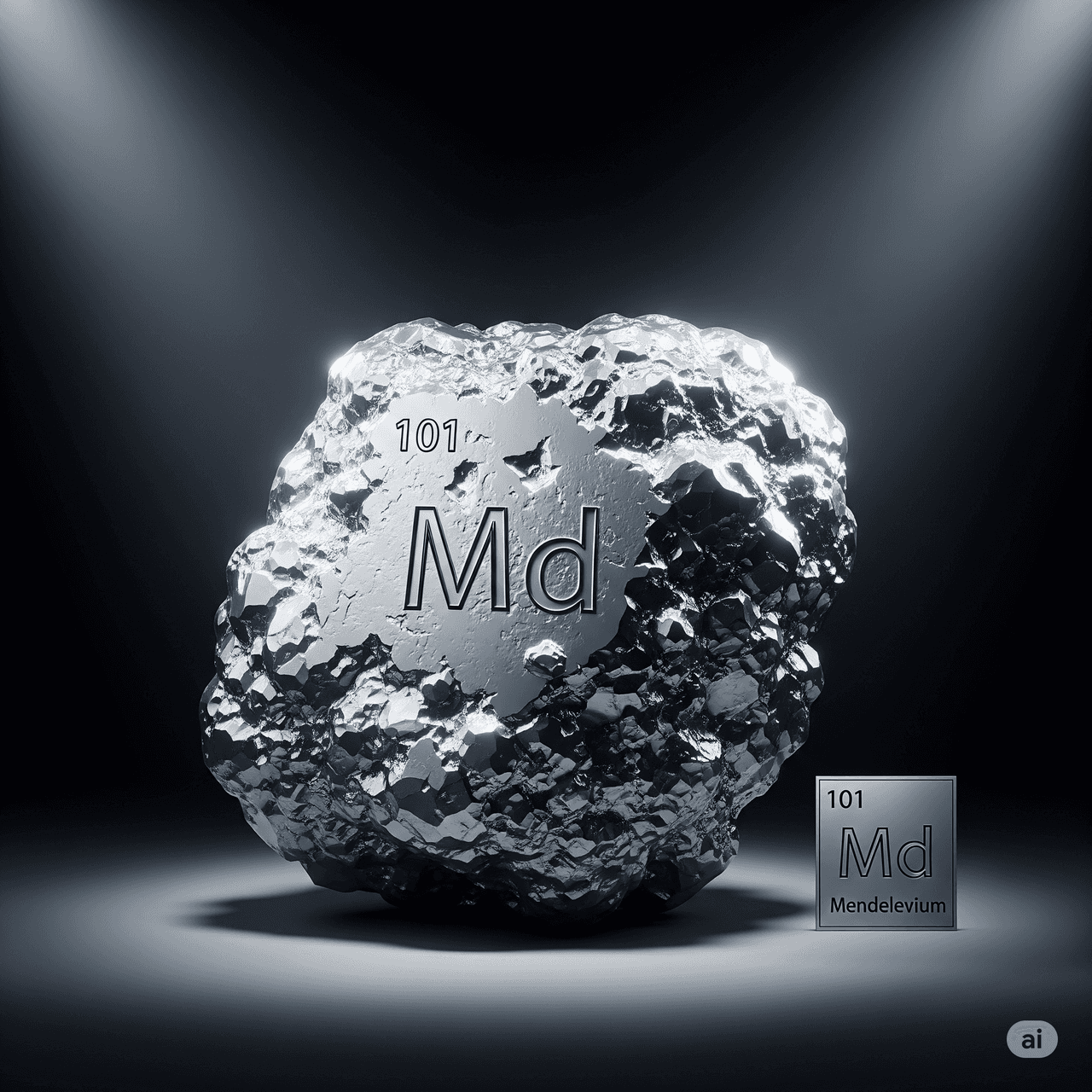
Mendelevium
Periodic Table | 7 | ||||||||
|---|---|---|---|---|---|---|---|---|---|
Chemical Symbol | Md | ||||||||
Atomic Number | 101 | ||||||||
Group | Actinides | ||||||||
Electron Configuration | [Rn]5f¹³7s² | ||||||||
Melting Point (Estimated) | 827 °C | ||||||||
Phase (Room Temperature) | Solid (expected) | ||||||||
Important Isotopes | ²⁵⁸Md, ²⁶⁰Md | ||||||||
Year of Discovery | 1955 | ||||||||
Discoverer(s) | A. Ghiorso and team | ||||||||
Natural Occurrence | Artificial (does not occur in nature) | ||||||||
Mendelevium is a synthetic and radioactive metallic element with atomic number 101 and chemical symbol Md, located in the actinide series of the periodic table. Due to its production in extremely small quantities and high radioactivity, its properties are largely based on theoretical studies and limited experiments.
Mendelevium is classified as the 13th element in the actinide series and is located in the 7th period of the periodic table. Its electron configuration is [Rn]5f¹³7s². This electronic structure is the primary factor influencing its chemical behavior and typically results in the +3 oxidation state, although lower oxidation states such as +2 have been observed or predicted theoretically. As a heavy actinide, relativistic effects—quantum mechanical corrections arising from the high velocities of electrons—may influence its chemical properties. It is expected to be solid at room temperature.
The element mendelevium was first synthesized in 1955 by a team led by Albert Ghiorso at the Radiation Laboratory of the University of California, Berkeley (now known as the Lawrence Berkeley National Laboratory). The team included Glenn T. Seaborg, Bernard G. Harvey, Gregory R. Choppin, and Stanley G. Thompson.
The discovery was achieved through a challenging experiment of its time. A target containing a minute amount (approximately one billion atoms) of einsteinium-253 (²⁵³Es) was bombarded with alpha particles (helium nuclei) using the laboratory’s 60-inch cyclotron. As a result of this nuclear reaction, only a few atoms of mendelevium—primarily the isotope mendelevium-256—could be produced in each bombardment. Mendelevium holds the distinction of being the first element synthesized atom by atom; its chemical properties were studied through experiments conducted on individual atoms.

Mendelevium (Generated by Artificial Intelligence.)
The element was named in honor of the great Russian chemist Dmitri Ivanovich Mendeleev (1834–1907), recognized as the founder of the periodic table. This naming was intended to recognize Mendeleev’s contributions to science, particularly his discovery that the properties of elements recur periodically based on atomic weights and his subsequent development of the periodic table. The name was proposed by the Berkeley team and officially approved by the International Union of Pure and Applied Chemistry (IUPAC).
Since all isotopes of mendelevium are radioactive and can only be produced in trace amounts, its macroscopic physical properties—such as density, boiling point, and electronegativity—have not been experimentally determined. Consequently, these properties are largely based on theoretical predictions or remain unknown.
The electron configuration of mendelevium is [Rn]5f¹³7s². It is expected to be solid at room temperature, with a predicted melting point of approximately 827 °C. Its chemical properties have been studied only through experiments performed with trace (tracer) quantities. As a member of the actinide series, the most stable and prevalent oxidation state of mendelevium is +3 (Md³⁺), which is supported by experimental evidence. However, it has also been observed that mendelevium can adopt the +2 oxidation state (Md²⁺), particularly in aqueous solutions where this state exhibits moderate stability. This behavior shows similarities to the chemical properties of thulium (Tm), its homolog in the lanthanide series.
Mendelevium does not occur naturally and is entirely synthetic. It can only be produced in laboratory conditions through nuclear reactions, by bombarding lighter elements such as einsteinium with charged particles (e.g., alpha particles) in particle accelerators. The quantities produced are extremely small—typically ranging from a few atoms to a few thousand atoms per experiment—and are used exclusively for research purposes.
Mendelevium has numerous known radioactive isotopes with mass numbers ranging from 245 to 262. ²⁵⁸Md and ²⁶⁰Md are notable isotopes. The isotope with the longest half-life is mendelevium-258 (²⁵⁸Md), with a half-life of approximately 51.5 days. Another relatively long-lived isotope, mendelevium-260 (²⁶⁰Md), has a half-life of about 27.8 days. These isotopes typically decay via alpha decay or spontaneous fission.
Mendelevium has no known practical industrial or commercial applications. Due to the extreme difficulty of production, high cost, minuscule yields, and high radioactivity, it is produced and studied solely for fundamental scientific research—for example, to investigate the chemical and nuclear properties of transuranium elements or to better understand nuclear fission and fusion processes.
Mendelevium has no known biological role. All of its isotopes are radioactive and therefore pose a potential radiation hazard to living organisms. However, since it is produced and studied only in specialized nuclear research laboratories under strict safety and radiation protection protocols, it does not constitute a health risk to the general public. All work involving mendelevium is conducted in accordance with the specialized procedures and equipment required for handling ionizing radiation.
National Center for Biotechnology Information. "Mendelevium." *PubChem Compound Database CID 23943*. Accessed May 29, 2025. https://pubchem.ncbi.nlm.nih.gov/compound/23943
TÜBİTAK Bilim Genç. "Mendelevyum." *Bilim Genç*. Accessed May 29, 2025. https://bilimgenc.tubitak.gov.tr/periyodik-tablo/mendelevyum

Mendelevium
Periodic Table | 7 | ||||||||
|---|---|---|---|---|---|---|---|---|---|
Chemical Symbol | Md | ||||||||
Atomic Number | 101 | ||||||||
Group | Actinides | ||||||||
Electron Configuration | [Rn]5f¹³7s² | ||||||||
Melting Point (Estimated) | 827 °C | ||||||||
Phase (Room Temperature) | Solid (expected) | ||||||||
Important Isotopes | ²⁵⁸Md, ²⁶⁰Md | ||||||||
Year of Discovery | 1955 | ||||||||
Discoverer(s) | A. Ghiorso and team | ||||||||
Natural Occurrence | Artificial (does not occur in nature) | ||||||||
Classification and Basic Properties
Discovery
Etiology
Physical and Chemical Properties
Natural Occurrence and Production
Isotopes
Applications
Biological Role and Precautions