

This article was automatically translated from the original Turkish version.
Type of Geographical İndication | Mahreç Signal | ||||||||
|---|---|---|---|---|---|---|---|---|---|
Registration Number | 1167 | ||||||||
Registration Date | 19.07.2022 | ||||||||
Product / Product Group(s) | Meals and soups | ||||||||
Province(s) | Bolu | ||||||||
Applicant/Registrant(s) | Mengen Municipality | ||||||||
Mengen Kaldırık Dolması is a traditional dish unique to the Mengen district of Bolu Province, officially registered with a geographical indication. The product was applied for registration on 10 June 2021 under Law No. 6769 on Industrial Property and was officially registered on 19 July 2022, thereby receiving geographical indication protection. The registered owner is the Mengen Municipality.
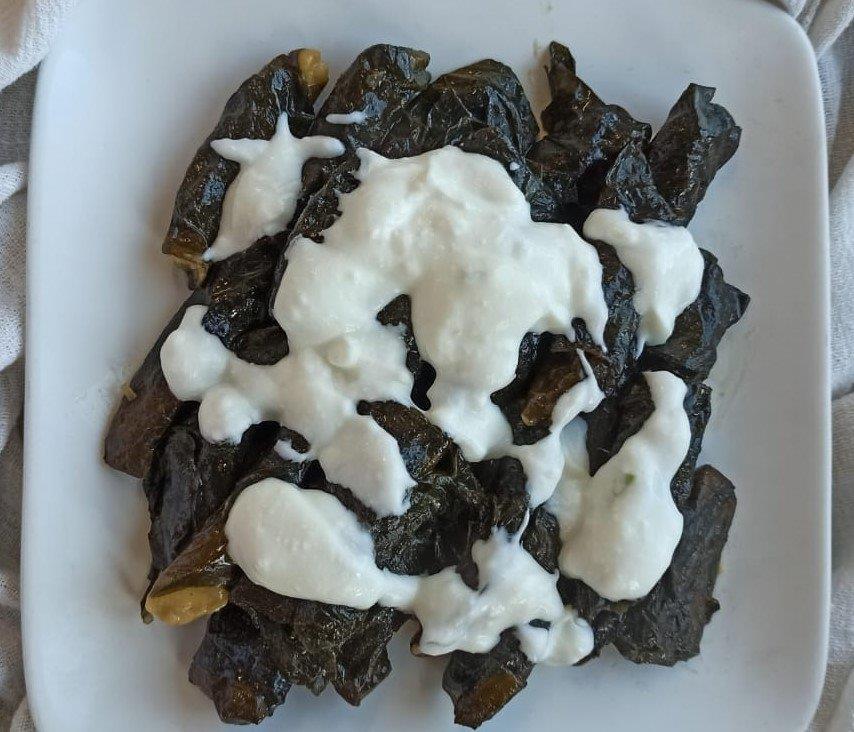
Mengen Kaldırık Dolması is prepared by wrapping a filling made of corn flour, wheat flour, dried onion, milk, sunflower oil, yogurt and salt in the leaves of the kaldırık plant and cooking it. Yogurt is poured over the dish when served; optionally, milk cream or whipped cream may be added during the cooking process.
The foundational ingredient, the kaldırık plant (Trachystemon orientalis L.), is an edible species with blue-purple flowers, harvested in March and April. In the Mengen region, it is also known as “hodan.” The leaves can be used fresh, lightly boiled and frozen, or dried in the shade and stored in a cool environment.
Mengen Kaldırık Dolması has deep roots in the culinary culture of the district and is distinguished by its region-specific production method.
The production process begins with the drying of kaldırık leaves collected from the forested areas of Mengen district in the shade. The recommended ingredients for an eight-serving portion are as follows:
The leaves are boiled to make them pliable for wrapping. The filling is prepared by mixing corn flour, wheat flour, milk, sunflower oil, grated onion and salt. A dessert spoon of filling is placed on each leaf, which is then rolled and arranged in a pot. Water is added to cover the rolls, and the dish is cooked for approximately 40 minutes. Optionally, a sauce made from sautéed onion and tomato paste may be added. Milk cream or whipped cream may be incorporated near the end of cooking.
During serving, yogurt is mixed with salt and, optionally, crushed garlic. This mixture is drizzled over the dolmas before serving.
All stages of production for Mengen Kaldırık Dolması are carried out within the boundaries of Mengen district, Bolu Province. This condition forms the fundamental basis for the product’s geographical indication protection.
Monitoring of the product is conducted by a minimum four-member authority composed of experts from the Mengen District Directorate of Agriculture and Forestry, the Mengen Vocational School of Abant İzzet Baysal University in Bolu, and the Bolu Regional Office of the Chamber of Food Engineers, under the coordination of Mengen Municipality. Monitoring is carried out at least once annually on a regular basis, and additionally as needed or in response to complaints.
The monitoring criteria are as follows:
Expert support may be obtained from public and private institutions during the monitoring process. The registering authority is responsible for managing legal procedures.
Turk Patent and Trademark Office. "No: 1167 – Mahreç Mark of Mengen Kaldırık Dolması." Geographical Indication Registration Certificate. Accessed October 24, 2025. https://ci.turkpatent.gov.tr/Files/GeographicalSigns/a98a4ab4-d0b5-406b-9acb-12b229ad0207.pdf.
Türk Patent ve Marka Kurumu. "Mengen Kaldırık Dolması." Coğrafi İşaretler Portalı. Accessed October 24, 2025. https://ci.turkpatent.gov.tr/cografi-isaretler/detay/4443.

Type of Geographical İndication | Mahreç Signal | ||||||||
|---|---|---|---|---|---|---|---|---|---|
Registration Number | 1167 | ||||||||
Registration Date | 19.07.2022 | ||||||||
Product / Product Group(s) | Meals and soups | ||||||||
Province(s) | Bolu | ||||||||
Applicant/Registrant(s) | Mengen Municipality | ||||||||
No Discussion Added Yet
Start discussion for "Mengen Stuffed Grape Leaves" article
Definition and Distinguishing Characteristics
Production Method
Geographical Boundary and Production Conditions
Monitoring