
This article was automatically translated from the original Turkish version.
+2 More
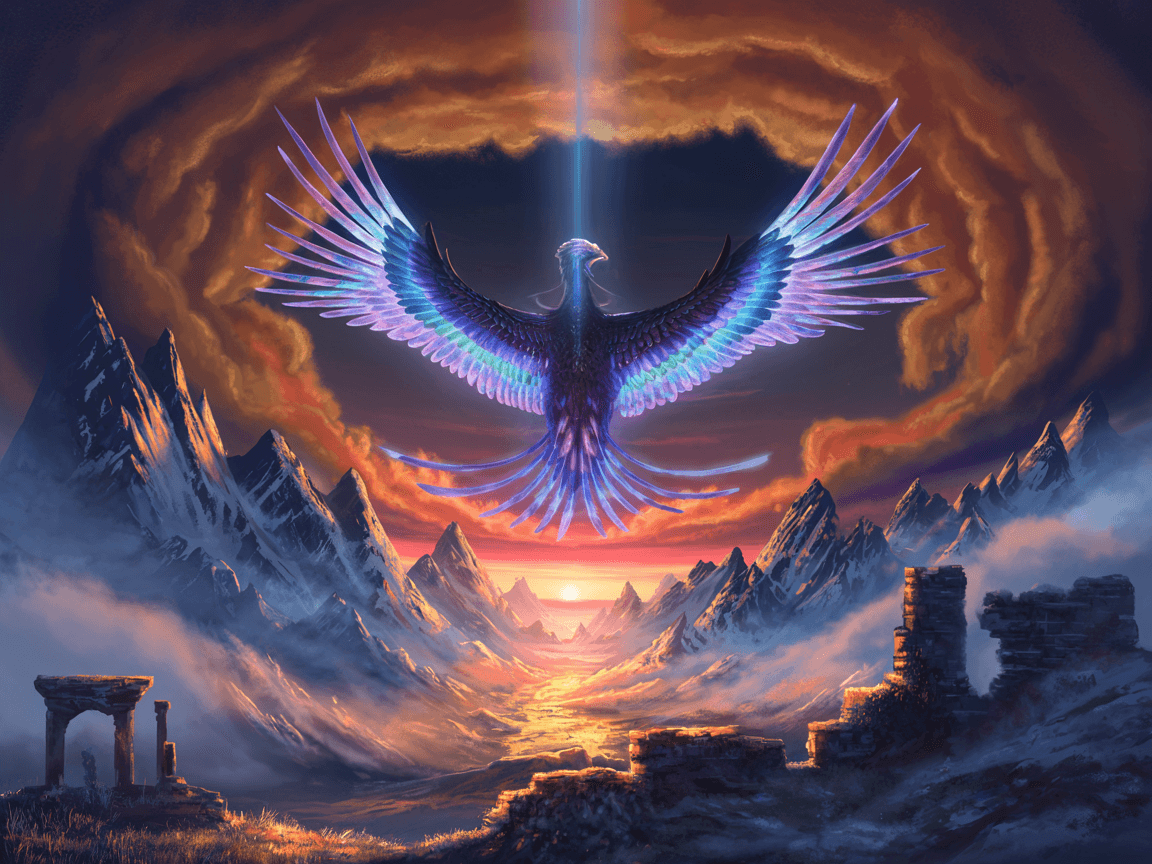
(Generated by artificial intelligence.)
Mercurius (Markut)
Symbols | Fertility Rain Immortality Moon Sun | ||||||||
|---|---|---|---|---|---|---|---|---|---|
Physical Description | its beak of ice its talons of copper its claws made of bronze So massive that with its wings it would cover the Sun and Moon | ||||||||
Role in Shamanism | accompanying the ancestral shaman as 'Burh-Burkut Baba' Protective and guiding spirit of sky journeys | ||||||||
Merküt (also Markut, Burkut) is a sacred sky bird in the mythologies of Turkic peoples, particularly the Altai, Yakut, and Kyrgyz Turks, taking the form of an eagle. It is regarded as both an ancestral spirit and a powerful entity that guides shamans on their celestial journeys. With its immense size and strength, Merküt holds a supernatural status and is an essential symbol in Turkic cosmology, deeply intertwined with beliefs about creation, lineage, and shamanism.
Merküt is not merely a mundane animal figure but a being endowed with divine and cosmic attributes. It is seen as the ruler of the heavens and is commonly associated with the sun and the moon.
Merküt carries the status of an ancestral spirit (ongun) for many Turkic tribes.
These narratives demonstrate that Merküt is not only a mythological figure but also represents the origin of social identity and lineage.
The depiction of Merküt reveals its immense power. According to Altai and Yakut beliefs, it is so vast that the moon can cover only its left wing, while the sun can cover only its right wing.
In a shamanic prayer compiled by Wilhelm Radloff, Merküt is described as follows:
“You, the five Merküt,
Strong bronze-clawed sky birds,
The moon’s claws are of copper,
The moon’s beak is of ice;
Your left wing covers the moon,
Your right wing covers the sun;
O you, mother of the nine eagles,
You fly without losing your path upon the Yayık,
You fly without tiring upon the Edil!”【1】
These lines emphasize that Merküt possesses durable and destructive power through its bronze claws, copper talons, and icy beak; it is so majestic that its wings can enfold celestial bodies; and it is a wise guide who never loses its way.

Merküt Representation (Generated by Artificial Intelligence)
Merküt is one of the central figures in shamanic practices. It is especially invoked as a helper spirit during the shamans’ (kams’) rituals of ascending to the sky. After donning their special attire, the shaman calls upon Merküt along with other helper spirits to draw upon its strength and guidance. The ancestral shaman spirit known by names such as “Burh-Burkut Baba” is also associated with Merküt. This role ensures the shaman’s safe passage and successful arrival at their destination during the arduous journey to the heavens.
Over time, Merküt has persisted within various belief systems. Even after the advent of Islam, it retained its power in popular beliefs, symbolizing resistance to death and immortality as a figure who battles against Allah and Azrail.
Its perception as a “protector of rain” also reflects its association with abundance and fertility. In folk tales, it is sometimes depicted as a wandering dervish or kalender, revealing its syncretic nature that blends shamanic and Sufi elements.

Representation of Merküt’s Relationship with Humans (Generated by Artificial Intelligence)
Beydili, Celal. *Türk Mitolojisi: Ansiklopedik Sözlük*. Ankara: Yurt Kitap-Yayın, 2005. https://www.scribd.com/document/382462654/Turk-Mitolojisi-Ansiklopedik-Sozluk-pdf
Güvenç, Baran. “Eski Türk Mitolojisinde Efsanevi Yaratıklar.” Edited by Zeynep İkefiyeli and Muhammed Bilal Çelik, pp. 481–483, Nobel Akademik Yayıncılık, 2020. Accessed August 16, 2025. https://www.academia.edu/43248767/Eski_T%C3%BCrk_Mitolojisinde_Efsanevi_Yarat%C4%B1klar.
[1]
Baran Güvenç. “Eski Türk Mitolojisinde Efsanevi Yaratıklar.” Editörler: Zeynep İkefiyeli ve Muhammed Bilal Çelik, 481, Nobel Akademik Yayıncılık, 2020. Erişim Tarihi: 16 Ağustos 2025 https://www.academia.edu/43248767/Eski_T%C3%BCrk_Mitolojisinde_Efsanevi_Yarat%C4%B1klar.

(Generated by artificial intelligence.)
Mercurius (Markut)
Symbols | Fertility Rain Immortality Moon Sun | ||||||||
|---|---|---|---|---|---|---|---|---|---|
Physical Description | its beak of ice its talons of copper its claws made of bronze So massive that with its wings it would cover the Sun and Moon | ||||||||
Role in Shamanism | accompanying the ancestral shaman as 'Burh-Burkut Baba' Protective and guiding spirit of sky journeys | ||||||||
Its Place and Significance in Mythology
Origin and Ancestral Spirit
Physical Depiction and Power
Its Role in Shamanism
Its Place in Symbolism and Beliefs