


This article was automatically translated from the original Turkish version.
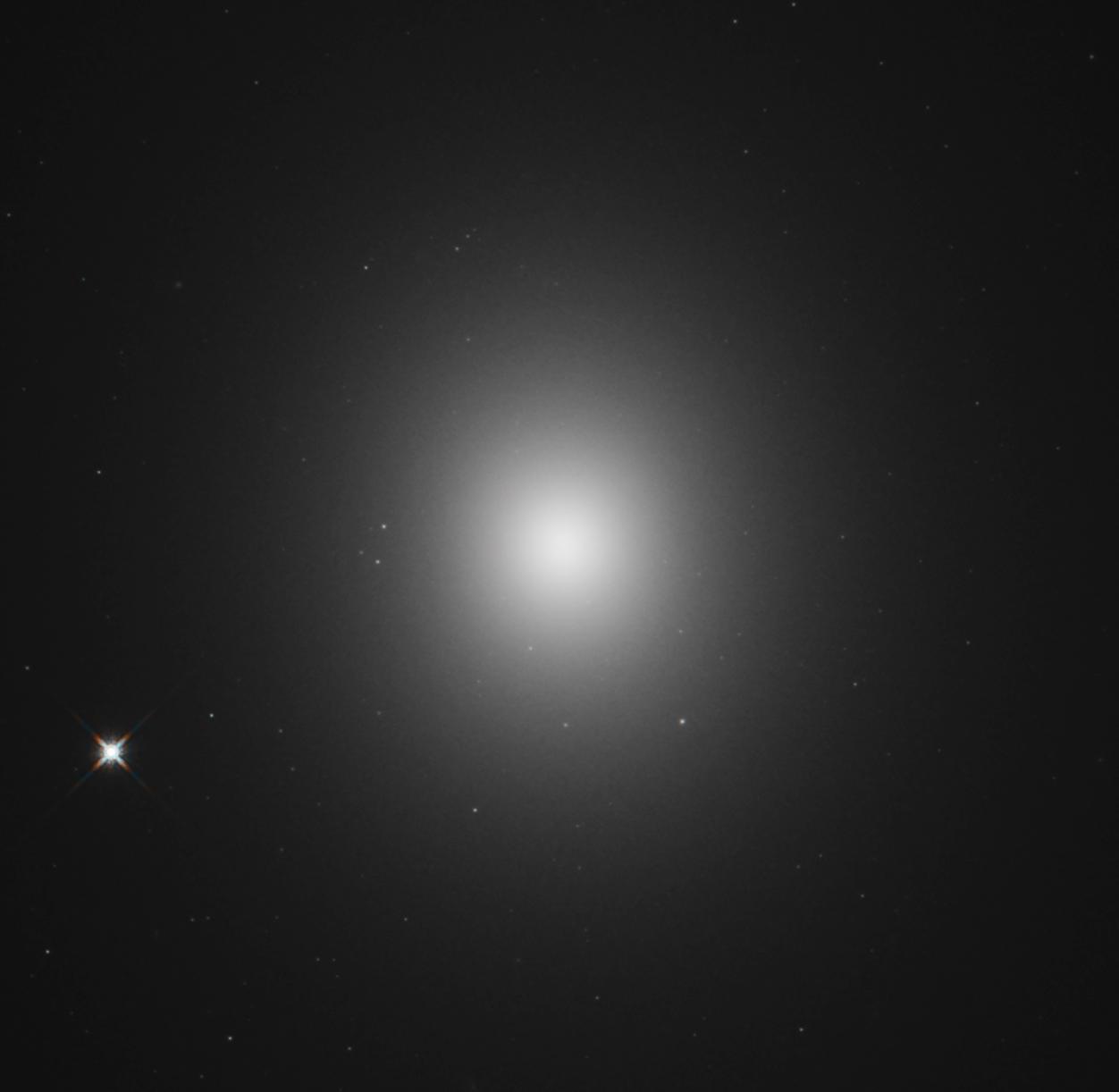
Messier 49 Galaxy is a massive elliptical galaxy located in the direction of the Virgo constellation. It was discovered on February 19, 1771, by French astronomer Charles Messier and is the first elliptical galaxy to be included in the Messier Catalogue. M49 is situated approximately 55.9 million light-years from Earth and is classified as one of the brightest galaxies within the Virgo Cluster.
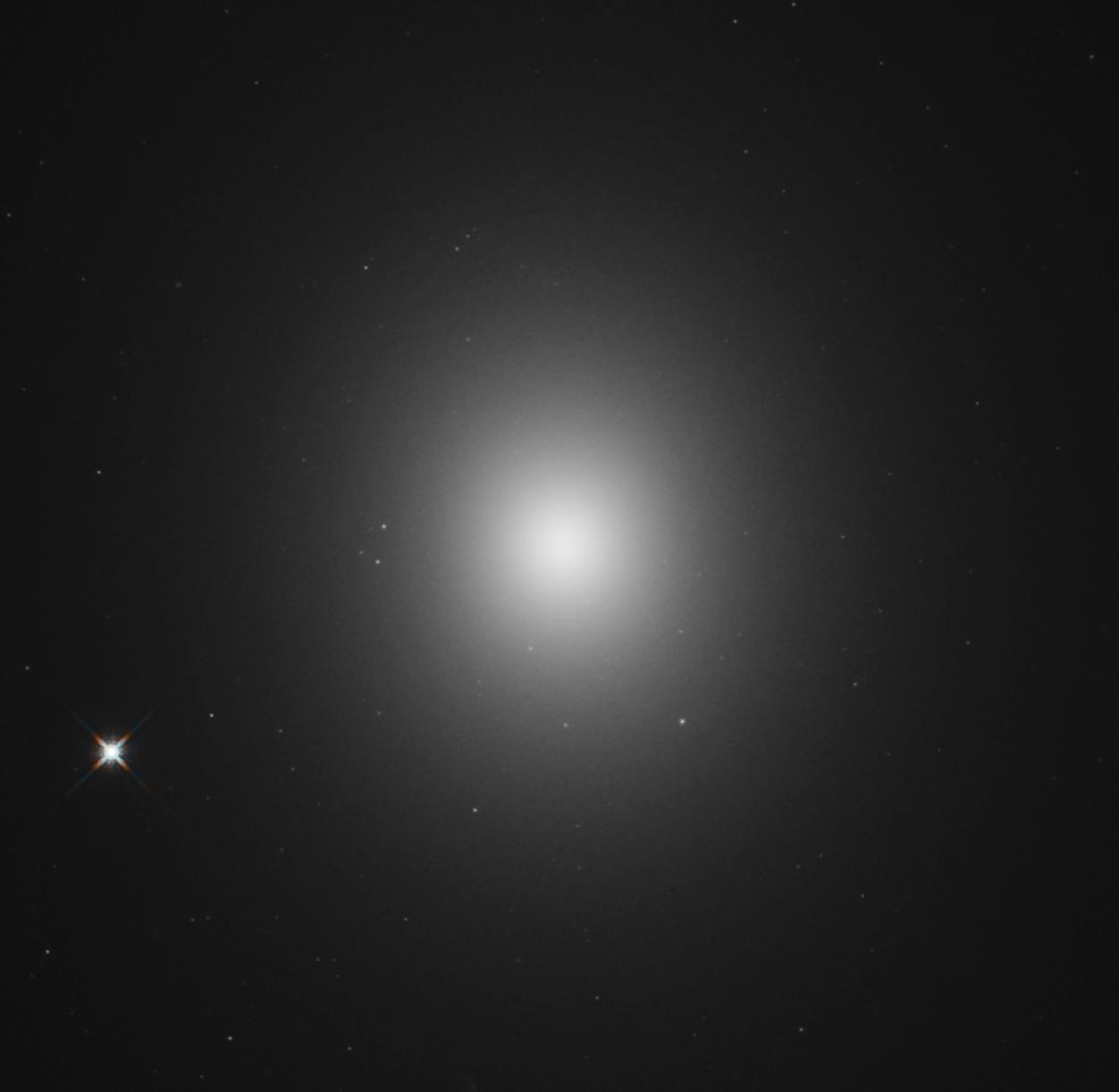
Messier 49 (NASA)
Messier 49 is classified as an E2 elliptical galaxy. Elliptical galaxies are relatively quiescent systems in terms of star formation. M49 exhibits no prominent spiral structure or bar. In such galaxies, stars move in a random distribution of directions. Images obtained in visible light show a smooth decline in brightness from the center outward. A dense region of stars is present at the galaxy’s center.
Messier 49 is believed to host a supermassive black hole at its center, with a mass estimated at approximately (5 ± 1) × 10⁸ solar masses. The presence of this black hole is indirectly supported by X-ray and radio observations. However, active galactic nucleus (AGN) activity is at a low level; M49 does not possess a strong radio-loud active galactic nucleus.
M49 hosts more than 5,900 globular star clusters. This number is approximately ten times greater than the number of globular clusters in the Milky Way. These clusters are widely distributed throughout both the central and outer regions of the galaxy, indicating that M49 possesses a gravitationally strong central structure.
Messier 49 is located slightly offset from the center of the Virgo Cluster and is one of its brightest galaxies. The Virgo Cluster is a structure composed of approximately 1,300 galaxies. M49 exhibits gravitational interactions with other galaxies within the cluster, which are thought to be related to past galaxy mergers. Additionally, small satellite galaxies have been detected around M49, with UGC 7636 being particularly notable.
Messier 49 is a bright target in the visible spectrum and can be observed with amateur telescopes. However, due to the absence of prominent spiral arms, detailed structural features remain limited even in high-resolution images.
X-ray observations, particularly those made by the Chandra Space Telescope and ROSAT, reveal that M49 is surrounded by an extensive halo of hot gas. This halo has a temperature of several million Kelvin, indicating that the galaxy resides in a deep gravitational potential well. Such gases are typically composed of material expelled from the galaxy during past mergers or supernova explosions.
Messier 49 is a weak radio source. Although it harbors an active galactic nucleus, this region exhibits radio silence. Nevertheless, some faint radio signals detected in the vicinity of the galaxy may represent traces of past galactic interactions.
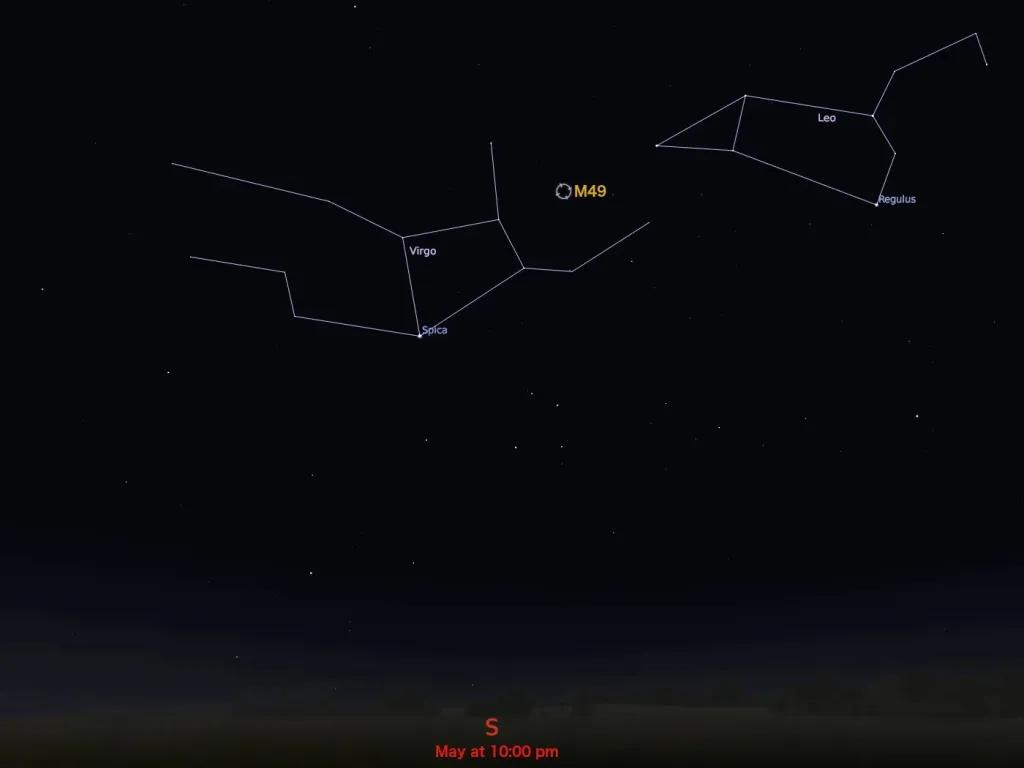
Position of Messier 49 (NASA)
Elliptical galaxies are generally formed through galaxy mergers. Evidence suggests that M49 has merged with one or more galaxies in its past. During these mergers, the gas content was largely consumed, star formation declined, and stars adopted a randomly distributed motion. This history is consistent with the galaxy’s current dense yet quiescent structure.
Messier 49 has been the subject of numerous scientific studies on gravitational lensing, redshift measurements, galaxy evolution modeling, and globular cluster dynamics. In particular, M49 serves as a critical example for understanding the dynamical structure of elliptical galaxies and the behavior of supermassive black holes at their centers. With its morphological structure, rich population of globular clusters, position within the Virgo Cluster, and multi-wavelength observational data, Messier 49 remains a prominent subject of study in modern astrophysics.
NASA. “Hubble Captures the Brilliant Heart of a Massive Galaxy.” *NASA Science – Hubble Missions*. Accessed May 31, 2025. https://science.nasa.gov/missions/hubble/hubble-captures-the-brilliant-heart-of-a-massive-galaxy/.
NASA. “Messier 49.” *NASA Science – Hubble Messier Catalog*. Accessed May 31, 2025. https://science.nasa.gov/mission/hubble/science/explore-the-night-sky/hubble-messier-catalog/messier-49/.
“Galaxy Messier 49” Deep Sky Corner. Accessed May 31, 2025. https://www.deepskycorner.ch/obj/m49.en.php.

Structural and Morphological Properties
Central Region
Global Star Clusters
Position and Interactions within the Virgo Cluster
Electromagnetic Observations
Visible Light
X-Rays
Radio Waves
Evolutionary History and Structural Formation
Scientific Significance