

This article was automatically translated from the original Turkish version.
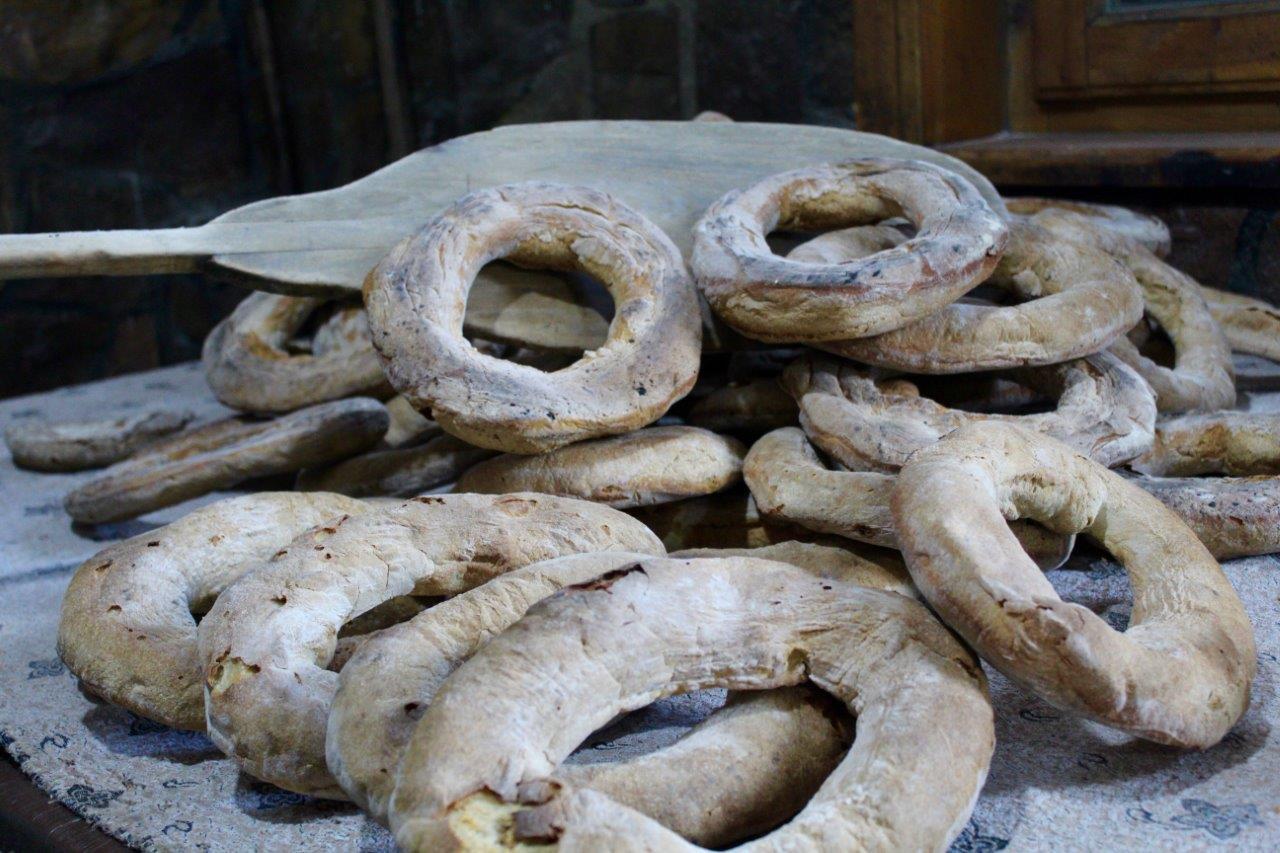
Mesudiye dry bread is a traditional baked product unique to the Mesudiye district of Ordu province and is also known as “Mesudiye goliti.” Registered under the Industrial Property Law No. 6769 as a certification mark, this product has been granted geographical indication protection since 22 November 2022. The registration process was carried out by the Ordu Metropolitan Municipality. The bread has a slightly cracked and matte surface and maintains its durability over long periods due to its dried structure.
Mesudiye dry bread is produced in a ring shape. Its outer diameter ranges from 25 to 30 cm and its inner diameter from 15 to 20 cm. Depending on preference, it can be divided into pieces 10 to 15 cm in length for complete drying. Each bread weighs between 100 and 150 grams. The product can be consumed either dry or after being moistened.
Its physicochemical properties include:
The product contains no preservatives to prevent staling (such as benzoic acid or sorbic acid).
Mesudiye dry bread is produced exclusively within the boundaries of the Mesudiye district. The ingredients used for approximately 25 kg of bread production are:
The dough is kneaded by hand or machine for 25 minutes. It is then fermented for 15 to 20 minutes. Subsequently, it is divided into 300 g portions and allowed to rest for 10 minutes. The portions are shaped into rings and baked in a stone oven using a three-stage process at 170°C: first baking (15 minutes), second baking (15 minutes), and toasting (15 minutes). In the final stage, the breads are dried at 50°C for 4 to 5 hours. The cooling period lasts 30 to 60 minutes.
The product is sold in sealed, food-safe packaging in 1 to 2 kg units. When stored in a cool and dry environment, its shelf life is 3 to 5 years.
Mesudiye dry bread holds a deep-rooted place in the regional culinary culture. Its reputation is directly linked to the geographical area where it is produced. Accordingly, all stages of production must take place within the boundaries of the Mesudiye district.
Monitoring is conducted under the coordination of the Ordu Metropolitan Municipality, with the participation of experts from the Mesudiye Municipality and the Ordu Provincial Directorate of Agriculture and Forestry. At least one regular inspection is carried out annually. The suitability of production ingredients, adherence to production methods, and correct use of the certification mark are verified. Any non-compliance and required corrective measures are communicated to the relevant individuals or institutions. Inspection reports are submitted to the Turkish Patent and Trademark Office.
Turk Patent and Trademark Office. "Mesudiye Kuru Ekmeği / Mesudiye Goliti Coğrafi İşaret Tescil Belgesi." *Coğrafi İşaretler Portalı.* Accessed October 19, 2025. https://ci.turkpatent.gov.tr/Files/GeographicalSigns/127654f3-eab9-4d0f-992d-ce2b18776e62.pdf
Turk Patent and Trademark Office. "Mesudiye Kuru Ekmeği / Mesudiye Goliti." *Coğrafi İşaretler Portalı.* Accessed October 19, 2025. https://ci.turkpatent.gov.tr/cografi-isaretler/detay/5386

No Discussion Added Yet
Start discussion for "Mesudiye Dry Bread / Mesudiye Goliti" article
Physical Characteristics and Structure
Preparation
Packaging and Shelf Life
Cultural and Geographical Connection
Monitoring Process