

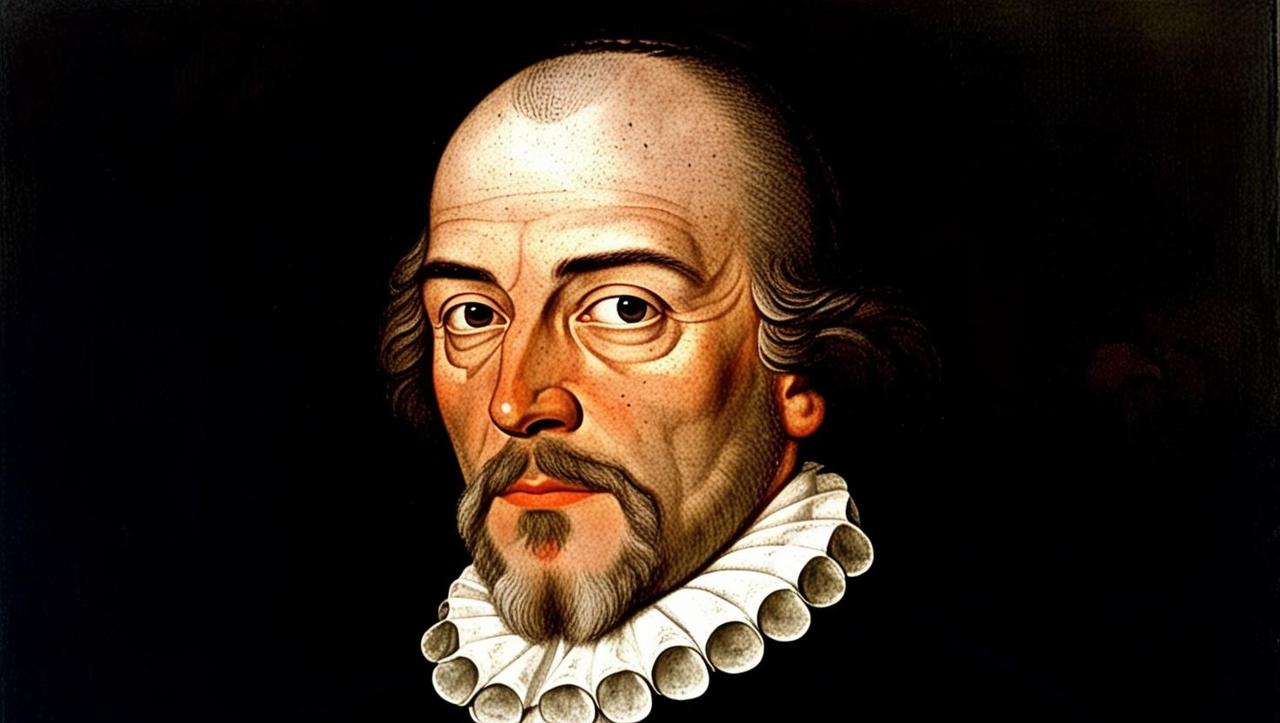
+1 More

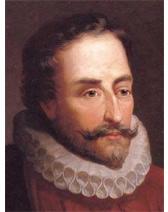
Miguel de Cervantes Saavedra is a Spanish novelist, poet, playwright, and soldier. Cervantes is regarded as one of the most prominent figures in Spanish literature. He achieved worldwide fame through his work Don Quijote, which many critics consider the first modern novel and is regarded as one of the greatest works in world literature.【1】 Don Quijote has become one of the most printed and translated books after the Bible. Cervantes is also known by the title "El Príncipe de los Ingenios" (The Prince of Wits).【2】
The place of Miguel de Cervantes’ birth is generally accepted as Alcalá de Henares. He was baptized on 9 October 1547 at Santa María la Mayor Church.【3】 The baptismal record states:
"On Sunday, the ninth of October in the year one thousand five hundred forty-seven, Miguel, son of Rodrigo Cervantes and his wife Doña Leonor, was baptized. The baptism was performed by Reverendo Bartolomé Serrano, with witnesses Baltasar Vázquez and the sacristan. I, Bachiller Serrano, performed and signed the baptism."【4】
His father, Rodrigo de Cervantes (1509–1585), and his mother, Leonor de Cortinas, were both from Arganda del Rey. Cervantes’ siblings included Andrea (1544), Luisa (1546), Rodrigo (1550), Magdalena (1554), and Juan, mentioned in a will.【5】
There are differing views on the origin of Cervantes’ use of the surname "Saavedra." According to Luce López-Baralt, it derives from the Arabic word "shaibedraa," meaning "crippled arm," possibly referring to an injury sustained during his captivity in Algiers.【6】 On the other hand, Hispanist María Antonia Garcés argues that Cervantes adopted this surname as part of a process of constructing a new identity.【7】
Although speculative, biographers Américo Castro and Daniel Eisenberg suggest that both of Cervantes’ parents may have been of Jewish descent. However, Jean Canavaggio has noted that these claims lack definitive documentation.【8】
While there is no definitive evidence regarding Cervantes’ early education, it is believed he received basic schooling in Valladolid, Córdoba, or Sevilla.【9】 In 1566 he moved to Madrid and studied at the Estudio de la Villa under Juan López de Hoyos.【10】 López de Hoyos referred to Cervantes as "our beloved and valued student" in a work published in 1569.【11】 Cervantes’ interest in theater also emerged during this period. In the prologue to Ocho comedias y ocho entremeses (1615), he stated that he had watched and been influenced by the plays of playwright Lope de Rueda.【12】
Hints of his views on theater can also be found in the second part of Don Quijote, where the protagonist says:
"In my youth my eyes were fixed on the theater stage."【13】
Thus, Cervantes’ life and early development significantly influenced his later literary career.
In 1569, Cervantes traveled to Italy. During his stay in Rome, he read the poetry of Ludovico Ariosto and León Hebreo’s Diálogos de amor, works that deeply influenced his literary perspective.【14】 In 1570 he entered the service of Cardinal Giulio Acquaviva and traveled to Palermo, Milan, Florence, Venice, Parma, and Ferrara.【15】 In 1571 he joined the Spanish army and fought in the Battle of Lepanto against the Ottoman Empire. After the battle, Cervantes received six months of medical treatment in a hospital in Messina. From 1572 he participated in campaigns in Navarino, Corfu, Bizerte, and Tunis. Until 1575 he resided in Sicily, Sardinia, Genoa, Lombardy, and Naples.【16】
In 1571, Cervantes fought as a member of the Holy League against the Ottoman Navy in the Battle of Lepanto. During the battle, he was wounded in his left hand and sustained a permanent disability. Although not captured by the Ottomans, he earned the title "Manco de Lepanto" (The Lame of Lepanto) due to the injury sustained in the battle.【17】
In 1575, while returning to Spain across the Mediterranean, Cervantes was captured by Algerian pirates and taken to Algiers. However, these pirates were not directly under the Ottoman state but belonged to semi-autonomous groups loyal to the Bey of Algiers. Although Algiers was an Ottoman province at the time, the pirates’ activities were largely under the control of local authorities.【18】
During his captivity, Cervantes attempted to escape four times, all unsuccessfully. He was eventually freed through a ransom raised by the Trinitarian Order. His experiences in captivity inspired several of his works, including the plays Los Baños de Argel and El trato de Argel.【19】
Although it is often said that Cervantes died on the same day as William Shakespeare, this is inaccurate due to differences in calendars. Shakespeare’s date of death is recorded as 23 April 1616, but at that time England still used the Julian calendar. Spain had already adopted the Gregorian calendar, so when Shakespeare died, the date in Spain was 3 May. In 1995, UNESCO declared 23 April as World Book Day to honor both Cervantes and Shakespeare.【20】
It is known that Shakespeare was influenced by Cervantes’ works. Shakespeare and John Fletcher wrote a play based on the character Cardenio from Don Quijote, but this play was lost over time and has not survived to the present day.【21】
In his own time, Cervantes lived in the same Madrid neighborhood as important literary figures such as Francisco Quevedo and Lope de Vega and maintained close ties with literary circles. It is known that he had a rivalry with Lope de Vega.【22】
Orson Welles sought to adapt Don Quijote for the cinema but never completed the film. In 1992, the project was reimagined and released by Spanish filmmaker Jesús Franco.【23】
Israel’s first prime minister, David Ben-Gurion, learned Spanish to read Don Quijote in its original language. Similarly, Russian poet Aleksandr Pushkin was influenced by Cervantes’ works.【24】
Social criticism plays a significant role in Cervantes’ works. Historian Emilio Sola notes that Cervantes adopted a critical stance toward structures of power and social inequality. Cervantes openly expressed distrust of politicians, describing them as "time-serving opportunists concerned only with their own interests."【25】
The character of "Marcela" in Don Quijote may reflect Cervantes’ feminist views. Marcela rejects being held responsible for the death of a man who loved her and defends women’s freedom.【26】
Cervantes’ views on religion are also debated. In his work El curioso impertinente, he argued that theological disputes between Christianity and Islam were "unsolvable and meaningless." For this reason, some scholars suggest that Cervantes embraced an approach based on religious tolerance and rational thought.【27】

1. Festival Internacional Cervantino: Held annually in Guanajuato, Mexico, this festival welcomes artists from around the world.
2. Semana Cervantina: A festival featuring literary events held in various cities across Spain.

[1]
(Riley, 1992, p. 3)
[2]
(Murillo, 1987, p. 12)
[3]
(Canavaggio, 1997, p. 5)
[4]
(Murillo, 1987, p. 13)
[5]
(Canavaggio, 1997, p. 14)
[6]
(López-Baralt, 2000, p. 27)
[7]
(Garcés, 2002, p. 46)
[8]
(Canavaggio, 1997, p. 22)
[9]
(Murillo, 1987, p. 20)
[10]
(Canavaggio, 1997, p. 28)
[11]
(López de Hoyos, 1569, p. 4)
[12]
(Murillo, 1987, p. 33)
[13]
(Cervantes, 1615, p. 12)
[14]
(Canavaggio, 1997, p. 35)
[15]
(Murillo, 1987, p. 42)
[16]
(Canavaggio, 1997, p. 50)
[17]
(Garcés, 2002, p. 56)
[18]
(Murillo, 1987, p. 112)
[19]
(Garcés, 2002, p. 74)
[20]
(Canavaggio, 1997, p. 95)
[21]
(Riley, 1992, p. 112)
[22]
(Canavaggio, 1997, p. 98)
[23]
(Garcés, 2002, p. 134)
[24]
(Murillo, 1987, p. 143)
[25]
(Sola, 2005, p. 72)
[26]
(Garcés, 2002, p. 150)
[27]
(Murillo, 1987, p. 156)

No Discussion Added Yet
Start discussion for "Miguel de Cervantes Saavedra" article
Life
Early Years and Youth
Education and Youth
Travel to Italy and the Battle of Lepanto
Cervantes and the Ottomans
Relationships with Others and Cultural Legacy
Cervantes’ Philosophical and Intellectual Views
Monuments, Institutions, and Cultural Influences Dedicated to Cervantes
Monuments and Statues
Educational and Cultural Institutions
Cervantes in Art and Popular Culture
Cervantes in Astronomy
Weeks and Festivals