Geographical Indication Type(s) | Protected Geographical Indication | ||||||||
|---|---|---|---|---|---|---|---|---|---|
Registration Number | 1379 | ||||||||
Registration Date | 07.06.2023 | ||||||||
Product / Product Group(s) | Other Products | ||||||||
Province(s) | Muğla | ||||||||
Applicant/Registrant(s) | Milas Chamber of Commerce and Industry | ||||||||
Milas Olive Oil Soap is an additive-free soap traditionally produced in the Milas district of Muğla province, containing only olive oil and caustic soda (sodium hydroxide). Registered as a Protected Geographical Indication on June 7, 2023, this product is protected under geographical indication by the Milas Chamber of Commerce and Industry.
Milas Olive Oil Soap is made by boiling high-acidity olive oils (≥6 degrees) — which are not suitable for culinary use — together with caustic soda over an olive or pine wood fire. It also uses residues known locally as “olive oil sludge” (zeytinyağı çamuru), which accumulate at the bottom of oil containers during production. Additionally, low-acidity oils that have become contaminated for various reasons, called “murdar” oils in the region, can be used. Only olive oil and/or olive oil sludge are used; no other oils are added.
The distinctive qualities of this soap include its lack of additives, formulation using only olive oil and caustic soda, non-irritating effect on the skin, and resistance provided by unsaponified monounsaturated fatty acids found in olive oil. These features make it suitable for hand, hair, and laundry cleaning.
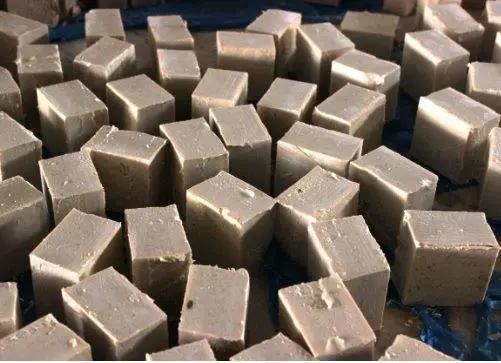
Freshly made Milas Olive Oil Soap ranges in color from white to pale yellow and gradually turns bone white as it dries. It should have a mild olive oil scent without an intense or unpleasant sludge odor.
Soap production in Milas has a history spanning centuries. According to the Aydın Province Yearbook (1889), Milas had 11 oil mills and 1 soap factory, producing 30,000–40,000 kıyye (approx. 38–50 tons) of soap annually. Sources from 1954 indicate that soaps were exported to Mersin and İzmir, while in the 1990s, shipments were sent to Kahramanmaraş, Kayseri, and Malatya, regions where olive oil production was not common.
Milas Olive Oil Soap is produced using hot or cold methods. In both, only olive oil and/or olive oil sludge derived from Memecik olives grown in the Milas region are used.
In both methods, the soap is poured into flat surfaces or molds to shape it. The drying period varies depending on environmental conditions and can last 2–3 months in winter. Soaps are sold either with their natural surface or smoothed by scraping — no polishing or coloring is applied.
All production stages must take place within the Milas district boundaries. The reputation of Milas Olive Oil Soap is directly linked to the unique characteristics of local olives and traditional production methods.
Production of Milas Olive Oil Soap is inspected at least once a year by a three-member inspection committee coordinated by the Milas Chamber of Commerce and Industry. The inspection covers production, marketing, and sales stages. When necessary, analyses may be conducted in accredited laboratories.
Inspection criteria include soap hardness, color, scent, foaming capacity, and the balance between olive oil and caustic soda. Soap bars should not collapse under finger pressure, must have a bone-white color, and carry a light olive oil fragrance.
Türk Patent ve Marka Kurumu. Milas Zeytinyağı Sabunu Coğrafi İşaret Sicil Belgesi. Accessed October 25, 2025. https://ci.turkpatent.gov.tr/Files/GeographicalSigns/7df76794-781c-4715-86ae-01cbbe64d0e7.pdf
Türk Patent ve Marka Kurumu. “Milas Zeytinyağı Sabunu.” Coğrafi İşaretler Portalı. Accessed October 25, 2025. https://ci.turkpatent.gov.tr/cografi-isaretler/detay/7343

Geographical Indication Type(s) | Protected Geographical Indication | ||||||||
|---|---|---|---|---|---|---|---|---|---|
Registration Number | 1379 | ||||||||
Registration Date | 07.06.2023 | ||||||||
Product / Product Group(s) | Other Products | ||||||||
Province(s) | Muğla | ||||||||
Applicant/Registrant(s) | Milas Chamber of Commerce and Industry | ||||||||
No Discussion Added Yet
Start discussion for "Milas Olive Oil Soap " article
Product Characteristics
Historical Background
Production Methods
Hot Method
Cold Method
Geographical Boundaries and Production Conditions
Inspection Process
This article was created with the support of artificial intelligence.