This article was automatically translated from the original Turkish version.
+1 More
Type of Geographical İndication | Mahreç Sign | ||||||||
|---|---|---|---|---|---|---|---|---|---|
Registration Number | 1379 | ||||||||
Registration Date | 07.06.2023 | ||||||||
Product / Product Group(s) | Other products | ||||||||
Province(s) | Muğla | ||||||||
Applicant/Registrant(s) | Milas Chamber of Commerce and Industry | ||||||||
Milas Olive Oil Soap is a pure soap variety produced in the Milas district of Muğla Province using traditional methods and containing only olive oil and caustic (sodium hydroxide), with no additives. This product was officially registered with a geographical indication on 7 June 2023 and is protected under geographical indication status by the Milas Chamber of Commerce and Industry.
Milas Olive Oil Soap is produced by boiling high-acidity olive oil (≥6 degrees), unsuitable for culinary use, along with the sediment that accumulates at the bottom of containers during oil extraction and is locally known as “olive oil sludge,” using caustic and heat from olive or oak wood fires. Additionally, low-acidity olive oils that have become contaminated for various reasons and are locally termed “murdar” may also be used in soap production. Only olive oil and/or olive oil sludge are used in the manufacturing process; no other types of oil are permitted.
The distinguishing features of this soap include the absence of additives, production using only olive oil and caustic, a non-irritating structure for the skin, and resistance derived from the monounsaturated fatty acids in olive oil that do not undergo saponification. These properties support its widespread use in hand washing, hair washing, and laundry cleaning.
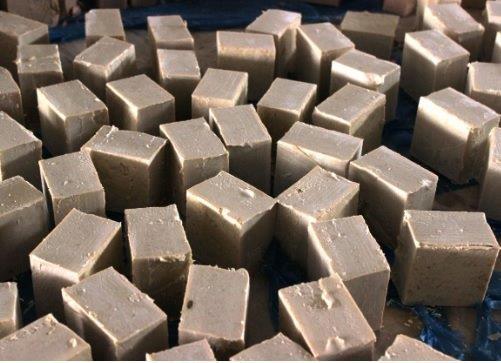
Milas Olive Oil Soap has a color ranging from white to pale yellow when freshly produced; as it dries, it approaches bone white. It must carry a mild olive oil scent and must not have the strong, unpleasant odor of olive oil sludge.
Olive oil soap production in Milas has a history spanning several centuries. According to the 1889 Aydın Vilayeti Salnamesi, there were 11 oil mills and 1 soap factory in the Milas district, producing 30,000 to 40,000 kıyye of soap annually. Sources from 1954 note that the soap was shipped to Mersin and İzmir, while records from the 1990s indicate it was sent to provinces such as Kahramanmaraş, Kayseri, and Malatya, which do not produce olive oil.
Milas Olive Oil Soap is produced using two methods: hot and cold. In both methods, only olive oil and/or olive oil sludge derived from Memecik olives grown in the Milas region are used.
In both methods, the soap is poured onto flat surfaces or into molds to shape it. The drying period varies depending on environmental conditions and may last 2–3 months during winter. The soaps are sold either with their natural surface or smoothed by scraping; no polishing or coloring is applied.
All stages of production must be carried out within the boundaries of the Milas district. The reputation of the soap is directly linked to the characteristics of the olives grown in the region and the traditional production techniques employed.
The production of Milas Olive Oil Soap is inspected at least once annually by a three-member monitoring body established under the coordination of the Milas Chamber of Commerce and Industry. The inspection covers production, marketing, and sales stages. Analysis may be conducted at accredited laboratories if deemed necessary.
Inspection criteria include the soap’s hardness, color, odor, foaming level, and the balance between olive oil and caustic. When pressed with a finger, the soap bars must not deform and must be bone white in color with a mild olive oil scent.
Turk Patent and Trademark Office. "Milas Zeytinyağı Sabunu Mahreç İşareti Tescil Belgesi." Turk Patent and Trademark Office. Accessed October 19, 2025. https://ci.turkpatent.gov.tr/Files/GeographicalSigns/7df76794-781c-4715-86ae-01cbbe64d0e7.pdf.
Turk Patent and Trademark Office. "Milas Zeytinyağı Sabunu." *Coğrafi İşaretler Portalı*. Accessed October 19, 2025. https://ci.turkpatent.gov.tr/cografi-isaretler/detay/7343.

Type of Geographical İndication | Mahreç Sign | ||||||||
|---|---|---|---|---|---|---|---|---|---|
Registration Number | 1379 | ||||||||
Registration Date | 07.06.2023 | ||||||||
Product / Product Group(s) | Other products | ||||||||
Province(s) | Muğla | ||||||||
Applicant/Registrant(s) | Milas Chamber of Commerce and Industry | ||||||||
No Discussion Added Yet
Start discussion for "Milas Olive Oil Soap" article
Product Characteristics
Historical Background
Production Methods
Hot Method
Cold Method
Geographical Boundary and Production Conditions
Monitoring Process