


This article was automatically translated from the original Turkish version.
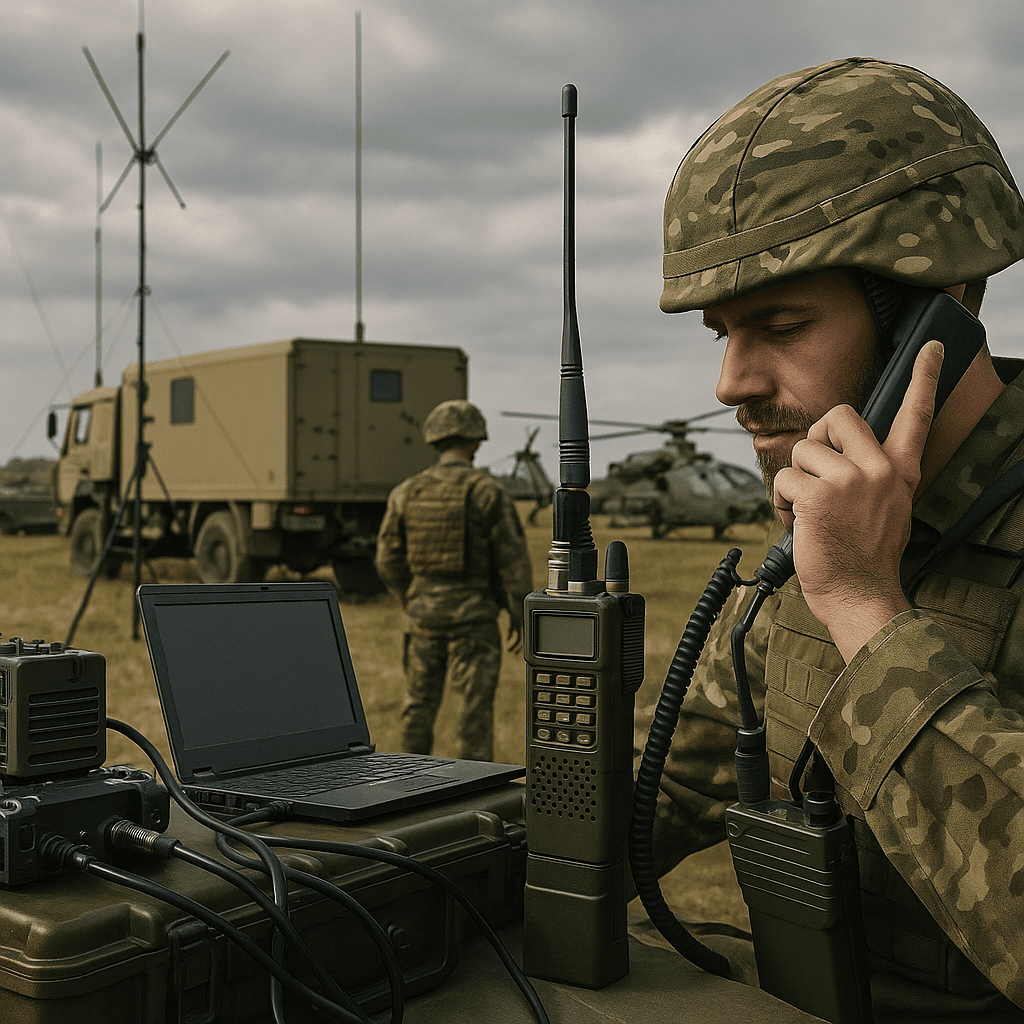
Military Tactical Communication Systems (generated with artificial intelligence)
Primary Objective | Ensure secure and uninterrupted voice, data, and video communication between land, sea, and air platforms. | ||||||||
|---|---|---|---|---|---|---|---|---|---|
Core Technologies | IP-based networks, Tactical Data Links (TDL), Software-Defined Radios (SDR), Satellite Communication (SATCOM), Mobile Ad Hoc Networks (MANET). | ||||||||
Important Protocols | SIP, H.323, Link-16, Link-22, QSIG. | ||||||||
Security Measures | End-to-end encryption, frequency hopping, electronic warfare protection measures. | ||||||||
Durability Standards | MIL-STD-810 (Environmental), MIL-STD-461 (Electromagnetic Compatibility). | ||||||||
Application Area(s) | Command and Control Reconnaissance and Surveillance. Air Defense Interoperability Situational Awareness | ||||||||
Military tactical communication systems are integrated technological infrastructures that enable secure, uninterrupted, and simultaneous exchange of voice, data, and video between land, sea, and air platforms and command centers on the modern battlefield. These systems play a critical role in operational success by enhancing coordination between units, maximizing situational awareness, and streamlining command and control processes. Equipped with features such as advanced encryption, electronic warfare protection measures, and resilience under harsh field conditions, these systems form the foundation of the network-centric warfare concept. With technological advancement, they have evolved from traditional radio-based communication toward IP-based, multi-layered, and hybrid network architectures.
Military tactical communication systems consist of various hardware and software components working together to perform distinct functions. This architecture provides a modular and scalable structure that adapts to diverse mission requirements and platforms.
Tactical field switches are central switching units deployed at the heart of battlefield communication networks. They act as gateways between wired and wireless communication devices, enabling integration of units using different protocols and technologies. For example, portable military field switches such as the Karel DS200T can operate compatibly with both modern and legacy systems using IP-based technology. These systems support a wide range of interfaces including analog, ISDN, magneto telephones, IP telephones, and radio networks (HF/VHF). Thanks to their modular design, they can scale up to 186 ports and offer high reliability through features such as 1+1 redundancy for CPU (Central Processing Unit) and PSU (Power Supply Unit). Additionally, they incorporate modern capabilities such as encrypted communication, video calling support, and user-friendly management interfaces.
Radios are the most fundamental and widespread component of tactical communication. Modern military radios, thanks to software-defined radio (SDR) architectures, can support multiple waveforms and frequency bands on a single hardware platform. Radios such as the ARTCom series developed by ASELSAN operate in HF and V/UHF bands and provide advanced electronic warfare protection measures including frequency hopping and encrypted voice/data communication. These radios are configured specifically for land units (platoon, squad), armored vehicles, air platforms (UAVs, aircraft), and naval elements. For instance, systems like the ARTCom 5712 Manga-P enable full-duplex communication within squads, while avionics radios such as the ARTCom 9681 V/UHF-A are used for air-to-ground and air-to-air communication.

(Generated by Artificial Intelligence)
With the proliferation of IP-based networks, military routers and switches have become indispensable components of tactical communication infrastructure. Devices such as the INTERAS 6534, developed to meet military standards, fulfill routing and switching requirements for IP-capable equipment in challenging environments such as shelters. Communication security is ensured by cryptographic devices such as the a-CRYPT series, which provide end-to-end encryption of IP network or Ethernet data traffic to safeguard sensitive information. Additionally, devices like the a-CRYPT FillGun are used for the secure transport and loading of cryptographic keys onto cryptographic units.
The reliability of tactical systems depends on the durability of their physical-layer components. Military RF connectors are designed to withstand harsh environmental conditions including extreme temperatures, humidity, shock, and vibration. Connectors compliant with military standards such as MIL-DTL-38999 and MIL-C-39012, supplied by manufacturers like Amphenol, Glenair, and TE Connectivity, ensure secure and robust connections that preserve signal integrity. These connectors serve as critical interface points between radios, antennas, and other communication equipment.
Modern military operations rely on a network-centric approach in which diverse platforms and units operate in an integrated manner. This approach necessitates the combined use of various network technologies.
Tactical Data Links (TDL) are network architectures that enable real-time exchange of tactical information between land, sea, and air platforms and command centers using standardized message formats. TDLs such as Link-11, Link-16, and Link-22 create a common tactical picture, ensuring all units share the same situational awareness. Link-16 is one of the most widely used TDLs and demonstrates high resistance to detection and jamming by changing frequency 77,800 times per second in the 969–1206 MHz band (frequency hopping). These networks allow air defense systems, fighter aircraft, ships, and ground units to share target data, threat warnings, and commands instantaneously.
Traditional military communication systems are increasingly being replaced by IP-based architectures. Standards such as SIP (Session Initiation Protocol) and H.323 enable the convergence of voice, data, and video communication over a single network. This enhances interoperability between disparate communication systems and enables more flexible network structures. Modern systems adopt a hybrid approach that simultaneously utilizes different networks such as LTE, 5G, and SATCOM. This ensures seamless connectivity by automatically rerouting communications through alternative networks in the event of a failure. Tactical Field Network Solutions developed by companies such as Netaş and ASELSAN provide this integrated communication network using domestic capabilities.
MANETs are self-configuring, decentralized networks of critical importance in dynamic operational environments lacking fixed infrastructure. In these networks, each node—whether a soldier, vehicle, or UAV—functions as both a terminal and a router. As nodes move or leave the network, the system automatically recalculates optimal routes to maintain continuous communication. This flexible structure is ideal for establishing uninterrupted coverage in mountainous terrain or urban combat environments.

(Generated by Artificial Intelligence)
SATCOM provides global coverage in remote areas where terrestrial communication infrastructure is unavailable or insufficient. Military SATCOM systems support strategic-level transmission of voice, data, and video over high-bandwidth encrypted channels. This technology is indispensable for maintaining continuous communication between deployed forces across vast geographic areas and their command centers during overseas operations.
Tactical communication systems provide modern armed forces with a range of operational advantages.
The primary benefit of these systems is the provision of enhanced situational awareness to command elements and frontline units. Platforms such as the Android Team Awareness Kit (ATAK) integrate real-time data including the locations of friendly and enemy forces, sensor outputs, and imagery from UAVs onto a tactical map. This common operational picture enables commanders to make faster and more accurate decisions while improving coordination and effectiveness among units in the field.
The ability of elements from different service branches (Land, Sea, Air) and coalition forces to conduct joint operations depends on the interoperability of communication systems. Modern systems ensure compatibility between switches and legacy systems from different manufacturers through standard protocols such as QSIG. Software-defined radios enable seamless communication in coalition operations by allowing users to load waveform formats used by different nations.
Military communication equipment must operate reliably under the harsh conditions of the battlefield. Therefore, they are designed and manufactured to comply with stringent military standards such as MIL-STD-810 (environmental testing) and MIL-STD-461 (electromagnetic compatibility). These standards guarantee that devices are resistant to high and low temperatures, humidity, dust, shock, and vibration. For example, the Karel DS200T switch operates between -20°C and +50°C and can withstand shocks and vibrations up to 22g.
41Telekom. "KAREL DS200T Askeri Taktik IP İletişim Sistemi." 41Telekom. Accessed July 16, 2025. https://www.41telekom.com/urun-karel-ds200t-askeri-taktik-ip-iletisim-sistemi-144-978
ASELSAN. "Askeri Haberleşme ve Bilgi Teknolojileri." ASELSAN. Accessed July 16, 2025. https://www.aselsan.com/tr/cozumlerimiz/16/askeri-haberlesme-ve-bilgi-teknolojileri
Anadolu Ajansı. "ASELSAN’dan Türk Silahlı Kuvvetlerine Yeni Haberleşme Altyapısı." AA, June 20, 2022. Accessed July 16, 2025. https://www.aa.com.tr/tr/ekonomi/aselsandan-turk-silahli-kuvvetlerine-yeni-haberlesme-altyapisi/2052950.
Editverse. "Radyo Ötesi: Ağ Merkezli Savaşta Entegre Taktik İletişim Sistemleri." Editverse. Accessed July 16, 2025. https://editverse.com/tr/radyonun-%C3%B6tesinde-a%C4%9F-merkezli-sava%C5%9Fta-entegre-taktik-ileti%C5%9Fim-sistemleri/
Havelsan. "Ağ Merkezli Taktik Veri İletişim Sistemleri." *5. Deniz Sistemleri Semineri*, 2012. https://www.navalsystemsseminar.com/extras/abstract/HVL_Ag_Destekli_Ozet_5NSS.pdf
Karel. "DS200T Askeri IP Telefon Santralı." Karel. Accessed July 16, 2025. https://www.karel.com.tr/savunma-sanayi/kara-sistemleri/askeri-anahtarlama-sistemleri/ds200t
MOCO Connectors. "Taktik İletişim Sistemleri için En İyi 5 Askeri RF Konnektörü." MOCO Connectors, Accessed July 16, 2025. https://www.mococonnectors.com/tr/a-news-top-5-military-rf-connectors-for-tactical-communication-systems
MSS Defence. "Savaş Alanı Bağlantısı: Askeri Üstünlük için Gelişmiş İletişim Teknolojisinden Yararlanma." MSS Defence Blog, Accessed July 16, 2025. https://mssdefence.com/tr/blog/savas-alani-baglantilari-askeri%CC%87-ustunluk-i%CC%87ci%CC%87n-geli%CC%87smi%CC%87s-i%CC%87leti%CC%87si%CC%87m-teknoloji%CC%87si%CC%87nden-yararlanma/
Netaş. "Yerli ve İleri Haberleşme Sistemleri Tasarımı." Netaş. Accessed July 16, 2025. https://netas.com.tr/stratejik-iletisim-cozumleri
Polis Sepeti. "Askeri Taktik Ekipmanlarla Donanmış Olmak İçin İhtiyacınız Olanlar." Polis Sepeti Blog, Accessed July 16, 2025. https://blog.polissepeti.com/askeri-taktik-ekipmanlarla-donanmis-olmak-icin-ihtiyaciniz-olanlar
RSS Savunma. "Askeri Haberleşme ve Bilgi Teknolojileri." RSS Defense. Accessed July 16, 2025. https://rsssavunma.com/faaliyetler/haberlesme-ve-bilgi-teknolojileri
Yumak, Müjdat. “Taktik Data Link Askeri Harekatlarda Nasıl Kullanılıyor?” Stratejik Araştırmalar Merkezi - STRASAM.ORG, Accessed July 16, 2025. https://strasam.org/savunma/teknoloji/taktik-data-link-askeri-harekatlarda-nasil-kullaniliyor-2291

Military Tactical Communication Systems (generated with artificial intelligence)
Primary Objective | Ensure secure and uninterrupted voice, data, and video communication between land, sea, and air platforms. | ||||||||
|---|---|---|---|---|---|---|---|---|---|
Core Technologies | IP-based networks, Tactical Data Links (TDL), Software-Defined Radios (SDR), Satellite Communication (SATCOM), Mobile Ad Hoc Networks (MANET). | ||||||||
Important Protocols | SIP, H.323, Link-16, Link-22, QSIG. | ||||||||
Security Measures | End-to-end encryption, frequency hopping, electronic warfare protection measures. | ||||||||
Durability Standards | MIL-STD-810 (Environmental), MIL-STD-461 (Electromagnetic Compatibility). | ||||||||
Application Area(s) | Command and Control Reconnaissance and Surveillance. Air Defense Interoperability Situational Awareness | ||||||||
No Discussion Added Yet
Start discussion for "Military Tactical Communication Systems" article
System Components and Architecture
Tactical Field Switches
Radio Systems and Terminals
Network Devices and Cryptographic Systems
Physical Infrastructure and Connectors
Network Architectures and Technologies
Tactical Data Links (TDL)
IP-Based Networks and Hybrid Architectures
Military Ad Hoc Networks (MANETs)
Satellite Communication (SATCOM)
Operational Use and Capabilities
Command and Control and Situational Awareness
Interoperability
Robustness and Military Standards