


This article was automatically translated from the original Turkish version.
+2 More
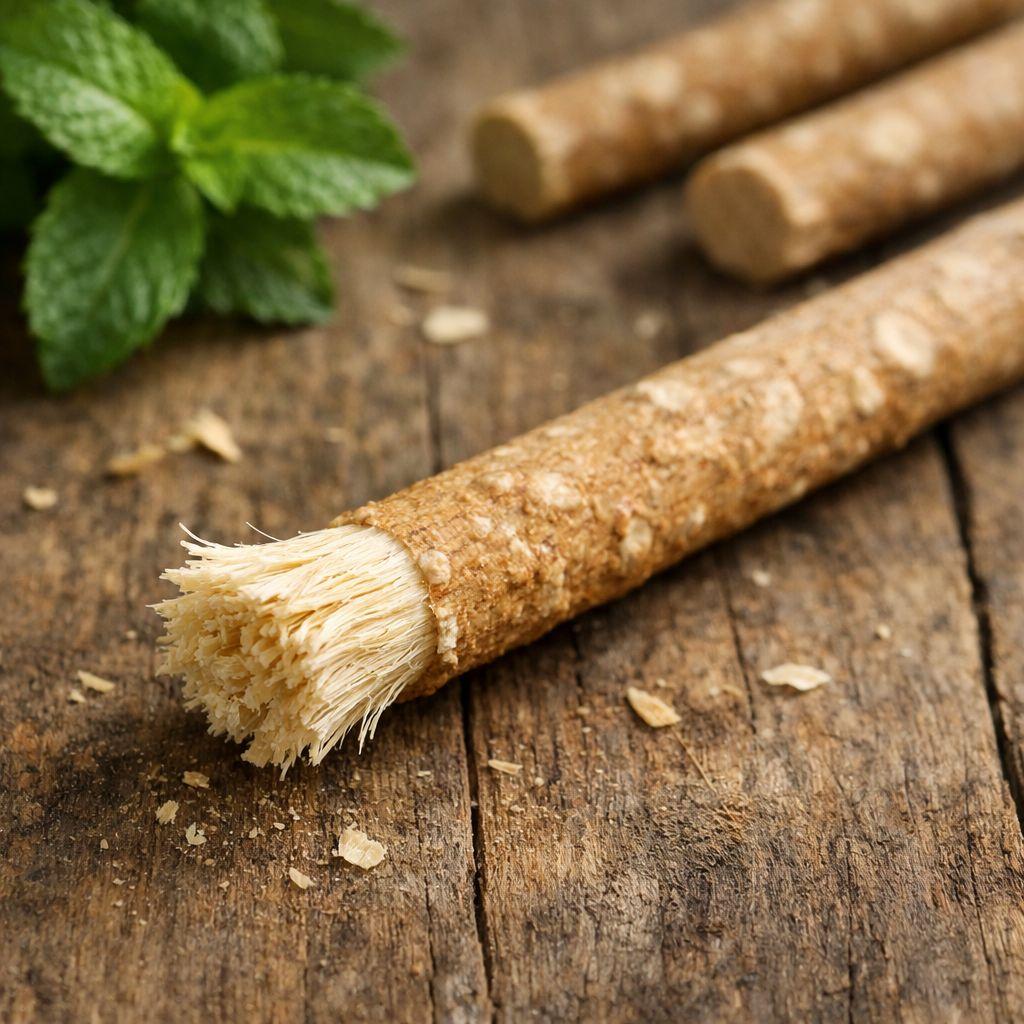
(Yapay Zekâ ile Oluşturulmuştur)
Miswak is a plant-based cleaning tool used for oral and dental hygiene. The term derives from the root sevk (sivâk), meaning “to rub or scrape” in dictionaries. It is shaped as a stick and prepared directly from the branches, trunk, or roots of the plant. Although known since ancient times, its use acquired religious significance with the emergence of Islam and became a regular and consistent practice within daily hygiene routines.

Erak (Salvadora Persica) Tree (Flickr)
Muslim medical and botanical scholars documented the morphological characteristics and varieties of the plant from which miswak is obtained in their works, while jurists provided detailed analyses of its timing, legal status, and method of application. In this respect, miswak occupies a place in Islamic culture both as a physical cleaning tool and as a practice within the framework of the sunnah.
The erak tree (Salvadora persica) is most commonly used in the production of miswak. Erak grows in North Africa, Sudan, the Sa‘id region of Egypt, the Arabian Peninsula, Iran, and the equatorial regions of India. This distribution indicates the plant’s adaptation to hot and arid climatic conditions.
Erak is a shrub or small tree reaching 1–2 meters in height, with a smooth and thornless appearance. Its trunk and branches are suitable for making miswak. Its leaves are 3–7 cm long, oppositely arranged, hairless, and leathery. The flowers are four-parted, small, and greenish-yellow. The fruit is slightly smaller than a chickpea, spherical, and grows in clusters resembling grape bunches. Initially red, the fruit turns black as it ripens.
Miswak is typically found in cylindrical sticks about the thickness of a finger. Its outer surface has a silvery-brown color. There are differences in color and taste between miswak made from the trunk and branches versus that made from the roots. Root-derived miswak is light brown and has a flavor similar to fenugreek.
The dried parts of the plant are used in its preparation. The tip of the stick is peeled to expose fibrous material, which serves to clean tooth surfaces. When the fibers wear down, the tip is cut off and renewed.
In Abu al-Hayr al-Ishbili’s work ʿUmdetü’ṭ-ṭabîb, it is recorded that the erak plant has varieties such as merd, kebâs, berîr, berm, and hedâl. The same work also notes that erak is among the most favored plants for grazing animals and imparts a pleasant fragrance and taste to milk. These records provide information on both the botanical diversity and natural properties of erak.【1】

Miswak (Generated by Artificial Intelligence)
Oral hygiene practices using miswak and similar tools existed in civilizations predating the Ottoman era. These practices were not only associated with cleanliness but also with spiritual preparation. Thus, oral hygiene acquired a spiritual dimension beyond mere physical hygiene.
With the advent of Islam, the use of miswak became a systematic practice within the framework of the sunnah. Numerous hadiths reference the use of miswak. The Prophet Muhammad ﷺ verbally recommended its use to his community and exemplified it through his own conduct.【2】
From a jurisprudential perspective, cleaning teeth with miswak is considered sunnah according to the four Sunni schools as well as the Ja‘fari and Zaydi schools. Due to the Prophet’s consistent practice and recommendation, miswak is regarded as a emphasized sunnah.
Although some sources mention differing opinions, the general consensus is that miswak is sunnah. Jurists considered miswak made from the erak tree more virtuous, yet still recognized cleaning tools made from other plants as valid. Some reports indicate that cleaning teeth with the finger is also permissible.【3】
Reports concerning the use of miswak emphasize specific times. It is recommended to use miswak before prayer. Cleansing the mouth before prayer is considered important as part of preparing for worship. Its use during ablution is also mentioned, thereby integrating miswak into the overall ritual of ablution.

Components of Miswak (Generated by Artificial Intelligence)
Miswak is prepared as a stick about the thickness of a finger. The tip is peeled to expose the fibrous part, which is then used to scrub the tooth surfaces. When the fibers wear down, the tip is cut and renewed. After use, it is cleaned and stored.
It is also recommended to use miswak upon waking from sleep. This practice aims to eliminate bad breath accumulated overnight and restore oral cleanliness.
It is further recommended to use miswak before reciting the Qur’an, establishing a connection between oral hygiene and the recitation of sacred scripture. Its use is also advised when bad breath occurs, reflecting its role as a daily hygiene practice.
Qāḍī Iyāż records that the Prophet Muhammad ﷺ used miswak frequently and did not limit himself to once a day. This report highlights the continuity of miswak use. Abū Shāma notes that some people did not consider it appropriate to use miswak in the mosque before every prayer. Literature on education and etiquette mentions that cleaning teeth in public was not considered proper.【4】
The health effects of miswak are evaluated in terms of its natural components and its mechanical cleaning properties. Substances found in its structure — salvadorin, chloride, fluoride, silica, sulfur, mustard oil, resin, calcium, phosphorus, flavonoids, and sterols — are recognized as functionally beneficial for oral and dental health. These components demonstrate that miswak is not merely a mechanical cleaning tool but also a natural product that contributes to oral hygiene through its chemical content.

Erak Tree Fruit (Flickr)
Silica acts as a natural abrasive that aids in cleaning tooth surfaces, while fluoride and chloride are noted for contributing to enamel protection. Minerals such as calcium and phosphorus are associated with supporting tooth structure. Sulfur and mustard oil are among the components that affect the oral environment. Resin content may contribute to forming a protective layer on tooth surfaces. Flavonoids and sterols, as plant-derived biological compounds, are integral to miswak’s structural composition.
The fibrous structure of miswak enables mechanical cleaning of tooth surfaces and interdental spaces. This mechanical action helps eliminate bad breath and sustain oral cleanliness. Its recommendation upon the occurrence of bad breath underscores its hygienic function.
When considered together, these features confirm that miswak is regarded as a traditional tool for preserving oral and dental health, owing both to its natural constituents and its physical cleaning properties.
Classical Turkish poetry possesses an aesthetic structure that addresses elements of mythology, Sufism, politics, and daily life in an imaginative realm. Within this framework, miswak appears in poetry both as an ordinary object of daily life and as an element imbued with symbolic meaning. Poets regarded miswak not merely as a physical cleaning tool but as an image rich in associative power.

Original Miswak Image (Pixabay)
The ways miswak is depicted in poetry vary. Primarily, it is described through metaphor, drawing comparisons with other objects based on its shape and texture. Its physical characteristics are incorporated into imaginative expression and serve as subjects of aesthetic analogy.
Within Sufi typology, miswak is portrayed as one of the physical attributes of figures such as the zāhid, abdal, and rint. In this context, miswak is sometimes interpreted as a sign of piety and asceticism, and at other times associated with hypocrisy and ostentation. Thus, it could function as a symbol opposite to its apparent meaning, reflecting the tension between outward religiosity and inner sincerity.
“To gnash one’s teeth”, an idiom implying greed, avarice, and hostility, has been poetically transferred through the image of scraping teeth with miswak. In this usage, miswak becomes a vehicle of metaphorical expression, transforming a routine hygiene practice into an image representing human weaknesses.
At the same time, miswak in poetry is not limited to these symbolic representations; it also serves as a reminder of the relationship between daily life and religious devotion. The imagery of purification and adherence to the sunnah has acquired multiple interpretive layers in poetic contexts, functioning as a symbol representing the transition from physical cleanliness to spiritual purification.
The content presented here is intended solely for general encyclopedic information. These details must not be used for diagnosis, treatment, or medical advice. Before making any decisions regarding health, you must consult a physician or qualified healthcare professional. The author of this article and KÜRE Encyclopedia assume no responsibility for any consequences arising from the use of this information for diagnostic or therapeutic purposes.
[1]
Türkiye Diyanet Vakfı İslam Ansiklopedisi. “Misvak.” Erişim 22 Şubat 2026. https://islamansiklopedisi.org.tr/misvak
[2]
Yılmaz, Zeynep Şura ve Hakan Temir. "Ağız-Diş Sağlığı Açısından Misvakın Konumu ve Misvak Literatürü." Yakın Doğu Üniversitesi İslam Tetkileri Merkezi Dergisi 11, no. 2 (2025): 340. Erişim 22 Şubat 2026. https://dergipark.org.tr/en/pub/yaduitmed/article/1747686
[3]
Türkiye Diyanet Vakfı İslam Ansiklopedisi. “Misvak.” Erişim 22 Şubat 2026. https://islamansiklopedisi.org.tr/misvak
[4]
Türkiye Diyanet Vakfı İslam Ansiklopedisi. “Misvak.” Erişim 22 Şubat 2026. https://islamansiklopedisi.org.tr/misvak


(Yapay Zekâ ile Oluşturulmuştur)
Botanical Characteristics
Physical Properties and Varieties
Historical Development and Religious Context
Method and Timing of Use
Health Effects
Miswak in Classical Turkish Literature