


This article was automatically translated from the original Turkish version.
The Montessori educational philosophy is an approach to education developed by Italian medical doctor and educator Maria Montessori, placing the child’s individuality, freedom, and intrinsic potential at its core. This system is a method designed to enable the child to develop independently through specially designed materials within a pre-arranged environment, guided by their own interests and learning pace. At its foundation lies the belief that education is not a process transmitted by the teacher but a natural development achieved through the individual’s own experiences.
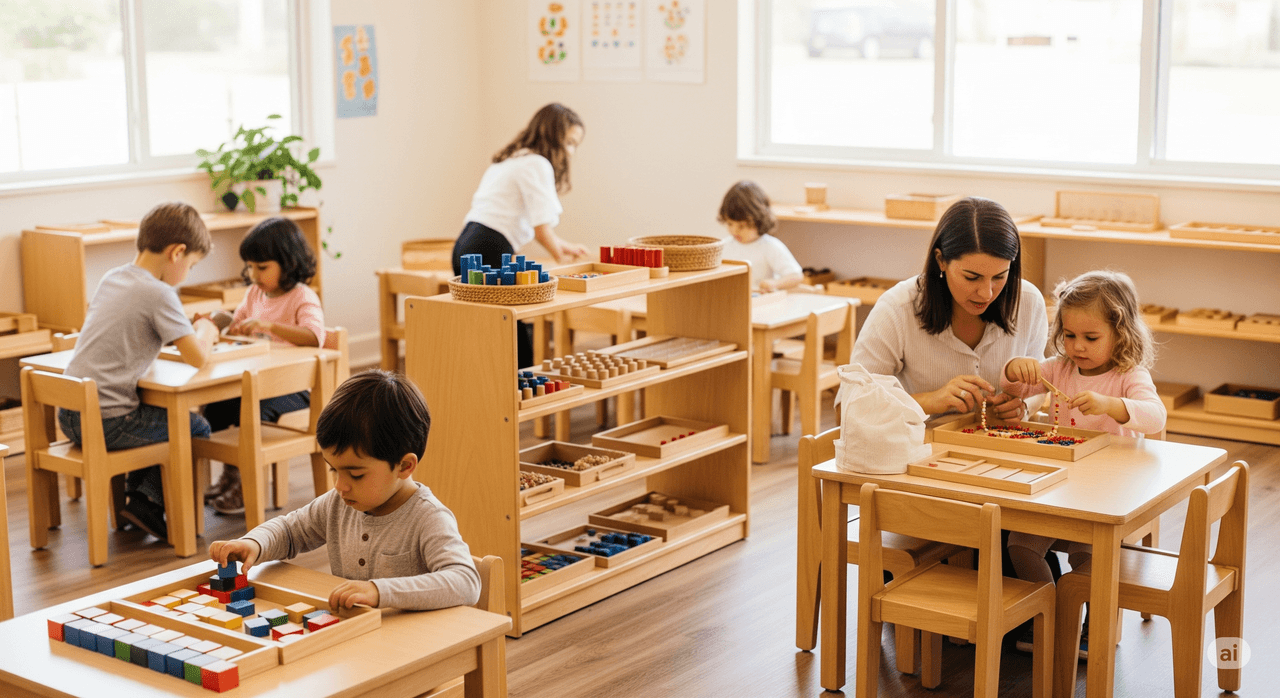
Child-Centered Discovery and Learning (Generated by Artificial Intelligence)
The origins of the Montessori approach date back to the early years of its founder, Maria Montessori (1870–1952). As Italy’s first female medical doctor, Montessori encountered children classified as intellectually disabled during her work at the Psychiatry Clinic of the University of Rome. She observed that their learning difficulties stemmed not from medical conditions but from a lack of appropriate stimulation and concluded that these challenges could be addressed through educational intervention. During this period, she studied the work of figures such as Dr. Jean-Marc Itard and Dr. Édouard Séguin with children with disabilities and drew inspiration from their methods to develop her own educational materials.
The progress she achieved with children with intellectual disabilities enabled them to perform successfully on standardized tests designed for typically developing children. This outcome led Montessori to apply her method to the education of typically developing children. To this end, in 1907 she established the first "Casa dei Bambini" (Children’s House) in Rome, intended for children of working families. This school functioned as a laboratory where she systematically refined her educational philosophy and materials through observation. To promote the widespread adoption and preservation of standardized practices, the International Montessori Association (Association Montessori Internationale – AMI) was founded.
The Montessori philosophy is grounded in specific theoretical principles regarding child development.
The approach asserts that every child is unique and singular. The child is viewed as a “builder” who carries within them the potential of the person they will become and actively constructs their own personality. Therefore, the child is placed at the center of education, and all processes are shaped with respect for their inner developmental plan.
According to Montessori, children between the ages of 0 and 6 possess a unique capacity known as the “absorbent mind.” This refers to the child’s ability to effortlessly and without fatigue absorb information, language, and cultural norms from their environment, much like a sponge. For example, a child’s acquisition of their native language occurs far more effortlessly than it would for an adult, thanks to the absorbent mind.
During development, children experience temporary phases during which they exhibit intense interest in acquiring specific skills or knowledge. During these “sensitive periods,” the child learns the related skill with minimal effort and great enthusiasm. Examples include sensitive periods for small objects, order, language, or social behavior. The educator’s role is to observe these periods and provide the appropriate environment and materials to meet the child’s needs.
One of the foundational pillars of Montessori education. This refers to a carefully arranged environment designed to support the child’s independence, freedom of movement, and self-directed learning. Furniture and materials are proportioned to the child’s size, accessible, and systematically organized. The prepared environment facilitates the child’s cognitive and emotional development.
In the Montessori approach, freedom means the child’s ability to choose activities within the prepared environment based on their own interests. However, this freedom is not unlimited; it is grounded in the principle that the child must not harm themselves, others, or the environment. This understanding of “responsible freedom” aims to foster the child’s internal discipline without reliance on external authority.
In contrast to the traditional teacher role, the Montessori educator acts as a “guide” or “facilitator.” The educator’s primary task is not to directly impart knowledge but to create the prepared environment, carefully observe the child, and enable the child’s interaction with materials. The educator establishes a dynamic connection between the child and the environment and intervenes only when necessary.
Montessori classrooms are typically organized into three-year age groups (for example, 3–6 years, 6–9 years). This practice is based on the idea that younger children learn by modeling older children, while older children reinforce their own learning and develop leadership skills by helping younger peers.
Montessori materials are the concrete applications of the philosophy. Developed based on scientific observation, they possess specific characteristics:
Materials are generally grouped into five main areas:
Although the Montessori philosophy was initially developed for children with special needs, today it is widely applied worldwide in preschools, elementary schools, and in some countries even at the secondary level for typically developing children.
The approach’s core principles—individualized instruction, progression at the child’s own pace, and sensory-based materials—make it suitable for special education. Research has demonstrated its use across various groups including autism, attention deficit hyperactivity disorder (ADHD), learning disabilities, and physical, hearing, and visual impairments. The progression from concrete to abstract and the breakdown of tasks into small components cater to diverse learning styles.
Studies have shown that Montessori education positively influences children’s psychosocial development, social problem-solving skills, self-regulation, peer relationships, and psychological resilience. The presence of only one copy of each material in the classroom allows children to experience social skills such as waiting their turn, sharing, and negotiating.
Some criticisms have been directed at the Montessori educational program. One criticism is that the structured nature of the materials and their focus on specific tasks may limit children’s creativity and imagination. Another commonly cited criticism is that the program does not provide sufficient space for imaginative play, dramatic play, or certain physical activities.
Danişman, Şahin. “Montessori yaklaşımına genel bir bakış ve eğitim ortamının düzenlenmesi.” *Eğitimde Politika Analizi* 1, no. 2 (October 2012): 85–113. Accessed June 28, 2025. https://dergipark.org.tr/en/pub/epa/issue/48308/611611.
Dereli, Esra. "Montessori eğitim programının çocukların psikososyal gelişimlerine ve sosyal problem çözme becerilerine etkisinin incelenmesi." *Ahi Evran Üniversitesi Kırşehir Eğitim Fakültesi Dergisi* 18, no. 2 (2017): 135–153. Accessed June 28, 2025. https://dergipark.org.tr/en/pub/kefad/issue/59416/853307.
Saki, Hacer. “Montessori felsefesi ile eğitim alan 24-72 ay arası çocukların psikolojik dayanıklılıklarının incelenmesi.” *İstanbul Kent Üniversitesi İnsan ve Toplum Bilimleri Dergisi* 1, no. 1 (February 2020): 15–33. Accessed June 28, 2025. https://dergipark.org.tr/tr/pub/itbfkent/issue/53101/677189.
Zakir, Nurəliyeva Mehriban. "Maria Montessori eğitim metodu." *Avrasya Sosyal ve Ekonomi Araştırmaları Dergisi* 6, no. 12 (2019): 59–62. Accessed June 28, 2025. https://dergipark.org.tr/tr/pub/asead/issue/51619/669129
İlhan Ildız, Gökçen, and Yeşim Fazlıoğlu. “Özel eğitimde Montessori metodunun kullanımı.” *Trakya Üniversitesi Sosyal Bilimler Dergisi* 22, no. 2 (December 2020): 869–884. Accessed June 28, 2025. https://doi.org/10.26468/trakyasobed.627014.

No Discussion Added Yet
Start discussion for "Montessori Educational Philosophy" article
Historical Development
Theoretical and Philosophical Foundations
The Child’s Role and Potential
Absorbent Mind
Sensitive Periods
Prepared Environment
Freedom and Discipline
The Role of the Educator
Mixed-Age Groups
Montessori Materials
Applications and Effects
Special Education
Psychosocial Development and Skills
Criticisms