This article was automatically translated from the original Turkish version.
Type of Geographical İndication | Signpost | ||||||||
|---|---|---|---|---|---|---|---|---|---|
Registration Number | 458 | ||||||||
Registration Date | 18.09.2019 | ||||||||
Product / Product Group(s) | Meals and soups | ||||||||
Province(s) | Muğla | ||||||||
Applicant/Registrant(s) | Muğla Chamber of Commerce and Industry | ||||||||
Muğla Göce Tarhana is a traditional variety of tarhana produced using conventional methods in the province of Muğla and its districts, and registered with a geographical indication. It was registered on 18 September 2019 by the Turkish Patent and Trademark Office under Law No. 6769 on Industrial Property, effective from 16 March 2016. The registration application was submitted by the Muğla Chamber of Commerce and Industry.
Muğla Göce Tarhana is made with medium-thickness cracked durum wheat (göce), traditionally prepared strained yogurt (kese yoğurdu), and tarhana herb (Echinophora tenuifolia L. subsp. sibthorpiana). The tarhana herb is a shrub-like plant belonging to the Apiaceae family, characterized by yellow flowers and a sharp aroma. This herb imparts its distinctive fragrance and flavor to the tarhana.
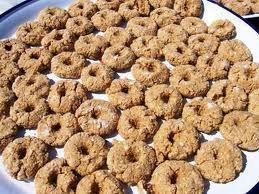
Kese yoğurdu is obtained by traditionally fermenting yogurt and allowing it to rest in cloth bags for two days. The tarhana is dried in circular shapes with a central hole, known locally as “külür” or “topan”. Muğla Göce Tarhana is recognized for its soup, prepared with dried broad beans, dried red pepper, and bone-in beef or lamb ribs. This method of production and presentation distinguishes it from other tarhana varieties in Türkiye.
The basic ingredients used in the production of tarhana are:
The production process begins by boiling salted water. The tarhana herb is washed and wrapped in a muslin cloth before being added to the water, then removed after a short time. The göce is then added and cooked for approximately 20–25 minutes. After steeping, the mixture is cooled and mixed with kese yoğurdu, then left to ferment for one day. The dough is kneaded again, shaped into külür form, and dried in the shade. The final product must have a moisture content of no more than 10%. The tarhana is stored in glass jars or cloth bags.
Muğla Göce Tarhana is a traditional food intrinsically linked to the region, long known and shaped by local cultural heritage. Due to the skill required in its production, all stages of manufacturing must be carried out within the boundaries of Muğla province.
Monitoring activities are conducted by a supervisory body composed of representatives from the Muğla Provincial Directorate of Culture and Tourism, the Muğla Provincial Directorate of Agriculture and Forestry, and Muğla Sıtkı Koçman University, under the coordination of the Muğla Chamber of Commerce and Industry. Inspections are carried out at least once a year; additional inspections may be conducted as needed or upon complaint.
The product’s compliance with Turkish Standard TS 2282 for tarhana is verified. Under this standard:
The supervisory body may obtain expert support from public or private institutions and holds the authority to initiate legal proceedings.
Turk Patent and Trademark Office. "Muğla Göce Tarhanası." *Coğrafi İşaretler Portalı*. Accessed October 19, 2025. https://ci.turkpatent.gov.tr/cografi-isaretler/detay/38190.
Turk Patent and Trademark Office. *Muğla Göce Tarhanası Mahreç İşareti Tescil Belgesi*. Accessed October 19, 2025. https://ci.turkpatent.gov.tr/Files/GeographicalSigns/d5156580-0753-443a-a661-4de9cb7787d0.pdf.

Type of Geographical İndication | Signpost | ||||||||
|---|---|---|---|---|---|---|---|---|---|
Registration Number | 458 | ||||||||
Registration Date | 18.09.2019 | ||||||||
Product / Product Group(s) | Meals and soups | ||||||||
Province(s) | Muğla | ||||||||
Applicant/Registrant(s) | Muğla Chamber of Commerce and Industry | ||||||||
No Discussion Added Yet
Start discussion for "Muğla Göce Tarhanası" article
Product Characteristics
Production Process
Geographical Boundary and Cultural Context
Monitoring and Standards