This article was automatically translated from the original Turkish version.
+1 More
Date of Establishment | 11 June 1933 | ||||||||
|---|---|---|---|---|---|---|---|---|---|
Original Name(s) | Municipalities Bank | ||||||||
Transformed Institution | İller Bankası (1945), İller Bankası A.Ş. (2011) | ||||||||
Establishment Law | Law No. 2301 | ||||||||
Purpose of Establishment | Provide infrastructure and zoning credit to municipalities | ||||||||
Transformed Structure | Development and investment bank (Anonymous Company) | ||||||||
Headquarters | Ankara | ||||||||
Last Legal Amendment | Law No. 6107, 26 January 2011 | ||||||||
In the Republican era, the İller Bankası (originally established as the Belediyeler Bankası) was founded in 1933 as a public bank to support urbanization and the construction of modern cities. This institution provided a public funding solution to meet the need for long-term, low-interest credit, thereby establishing the financial infrastructure for planned urbanization processes in Türkiye. In 1945, the institution adopted the name İller Bankası and was transformed into a joint-stock company in 2011, thereby distancing itself from its public character.

İller Bankası Building (AA)
Following the 1929 Global Economic Crisis, the insufficiency of private financing sources created serious difficulties for municipalities in their urbanization efforts. Municipalities were forced to obtain high-interest loans from private banks to deliver infrastructure services, which hindered local development goals. In this context, a need emerged for low-interest, long-term public credit; to address this need, Article 131 of the 1930 Belediye Kanunu (Municipalities Law No. 1580) provided for the establishment of a bank owned by municipalities.
Article 131 of Law No. 1580 mandated that 5 percent of municipal revenues be accumulated and transferred to a newly established bank. Based on this provision, municipalities began collecting this fund as of 1931, accumulating a capital base of 1.5 million liras. As a result, on 11 June 1933, the Belediyeler Bankası was established by Law No. 2301.
According to Law No. 2301, the Belediyeler Bankası was authorized to provide credit to municipalities for infrastructure and urban development projects, grant short- and long-term advances, conduct current account operations, and require necessary collateral. Its capital base consisted of the mandatory 5 percent contribution from all municipalities. Additionally, the bank had the right to take a portion of the borrowers’ municipal revenues as collateral for loans and advances.
The bank’s administration was managed by a board of directors composed of a president appointed upon the recommendation of the Ministry of the Interior and three members. A General Assembly, composed of representatives from the Court of Accounts and the Ministry of the Interior, along with auditors, carried out financial oversight. The bank was prohibited from providing credit for municipal salaries and personnel expenses.
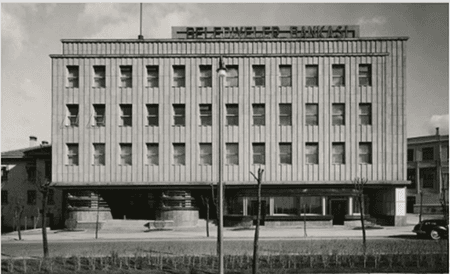
The Belediyeler Bankası had not only a financial but also a symbolic dimension. The architectural competition held in 1935 was won by Mimar Seyfi Arkan, a close associate of Atatürk, who took charge of designing the bank’s building in Ankara. Arkan used the name “Sur,” given by Atatürk, as a symbolic reference in the project. The building became one of the rare examples reflecting the original and indigenous architectural sensibility of the period; however, it was later demolished and erased from the urban memory.
Due to the Belediyeler Bankası’s limited ability to serve only municipalities and its inability to meet the growing financial demands of expanding cities, a new regulatory framework was introduced in 1944. On 29 July 1944, a bill was presented to the Turkish Grand National Assembly, proposing that the bank be renamed the İller Bankası and be re-established as a new legal entity under Law No. 4759 on 13 June 1945.
Under the new arrangement, Provincial Special Administrations and villages also became eligible to benefit from the bank’s services, expanding its operational scope. The İller Bankası supported numerous major infrastructure and urban development projects across Türkiye, playing an active role in areas such as village roads, drinking water, sewage systems, and land-use planning.
On 26 January 2011, the Turkish Grand National Assembly adopted, and on 8 February 2011, published in the Official Gazette, Law No. 6107, which transformed the İller Bankası into İller Bankası A.Ş. With this change, its status as a public institution was weakened, and it was restructured as an investment and development bank subject to private law regulations.
Following this transformation, İller Bankası largely discontinued its technical service activities and shifted its focus toward providing financial resources and generating income through land valuation. This development has been interpreted as a departure from the institution’s original social development mission during the Republican era.
Ministry of Environment, Urbanization and Climate Change, Republic of Turkey, İller Bankası. "Tarihçe." Accessed July 10, 2025. https://www.ilbank.gov.tr/sayfa/tarihce
Serter, Gencay. “Belediyeler Bankası.” *Atatürk Ansiklopedisi*, January 6, 2021. Accessed July 10, 2025. https://ataturkansiklopedisi.gov.tr/detay/712/Belediyeler-Bankas%C4%B1
Türkiye Büyük National Assembly. "Law on Municipalities Bank (June 11, 1933 – Law No: 2301)." Resmî Gazete, June 24, 1933, no. 2435. Accessed July 10, 2025. https://www5.tbmm.gov.tr/tutanaklar/KANUNLAR_KARARLAR/kanuntbmmc012/kanuntbmmc012/kanuntbmmc01202301.pdf

Date of Establishment | 11 June 1933 | ||||||||
|---|---|---|---|---|---|---|---|---|---|
Original Name(s) | Municipalities Bank | ||||||||
Transformed Institution | İller Bankası (1945), İller Bankası A.Ş. (2011) | ||||||||
Establishment Law | Law No. 2301 | ||||||||
Purpose of Establishment | Provide infrastructure and zoning credit to municipalities | ||||||||
Transformed Structure | Development and investment bank (Anonymous Company) | ||||||||
Headquarters | Ankara | ||||||||
Last Legal Amendment | Law No. 6107, 26 January 2011 | ||||||||
No Discussion Added Yet
Start discussion for "Municipalities Bank" article
Establishment of the Belediyeler Bankası
Institutional Structure and Functions
Architectural and Symbolic Significance
Transformation into the İller Bankası
2011 Reform: Transformation into a Joint-Stock Company