

This article was automatically translated from the original Turkish version.
+2 More
Protection Status | First Degree Natural Protected Area and National Park | ||||||||
|---|---|---|---|---|---|---|---|---|---|
Location | Ovacık Tunceli (Ziyaret Village) | ||||||||
Cultural Significance | Sacred pilgrimage site and center of 'Water Culture' | ||||||||
Important Species | Munzur Trout | ||||||||
River Length | 144 km | ||||||||
Discharge | Average 87 m³ per second | ||||||||
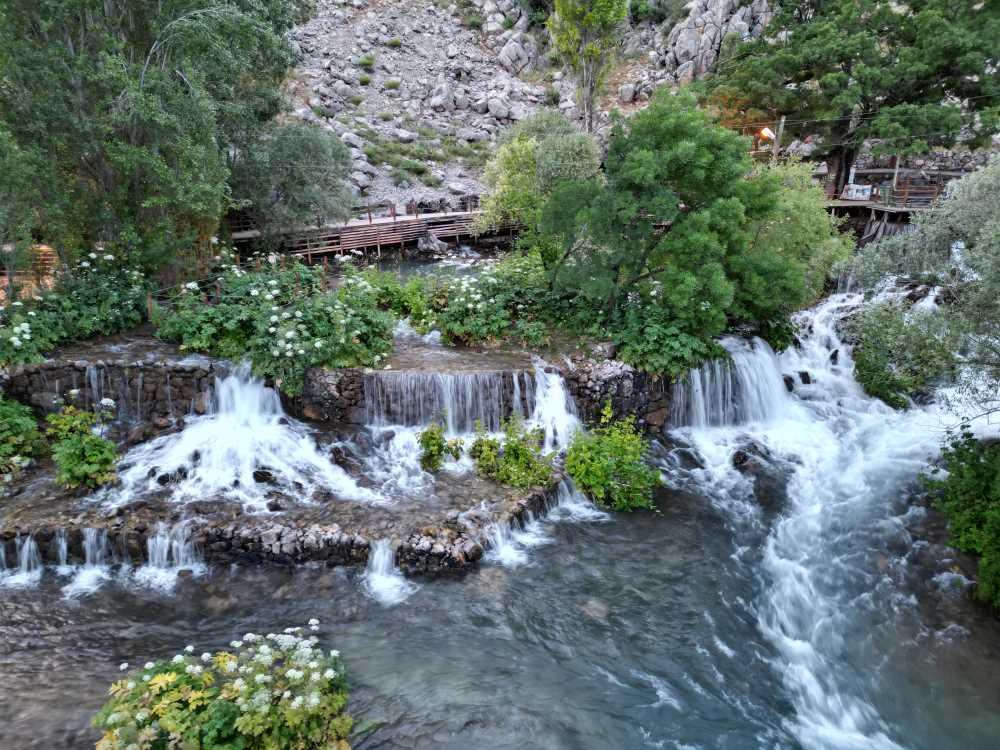
Munzur Springs are a natural water source and recreational area located at the foot of the Munzur Mountains in the Ovacık district of Tunceli province. Notable for their ecological features as well as their cultural and spiritual significance, the springs form the main source of the Munzur River. Situated approximately 15–17 km from the Ovacık district center near Ziyaret village, the area was designated a "National Park" in 1971 due to its endemic species, rich vegetation, and diverse wildlife. The Munzur Springs are not only a natural asset but also one of the revered pilgrimage sites in the local community’s belief system.

Munzur Springs Source Outflow (Culture Portal)
The Munzur River is formed by the convergence of numerous springs emerging from the rocky southern slopes of the Munzur Mountains. This river, approximately 144 km in length, joins the Pülümür River at the center of Tunceli province before flowing into the Keban Dam Lake. The river’s average discharge of 87 cubic meters per second reaches its highest level in April due to winter snowfall and spring melt.【1】The waters emerging from the springs are very cold and have a clear, transparent structure.
The region is recognized as one of Türkiye’s areas of significant natural and ecological value. Oak forests dominate the vegetation around the Munzur Valley and Springs, while a rich diversity of flora and fauna is observed throughout the valley.

Munzur Springs Ritual Practice (Culture Portal)
The Munzur Springs hold a central position in the collective memory and belief system of the local population, particularly the Alevi/Kızılbaş community. The sacredness attributed to these water sources is supported by ancient beliefs and legends.
The water cult in the Tunceli region is regarded as a reflection of the Old Turkic concept of “yer-su” (iduk yer-sub), which holds that waters possess a spirit or guardian (iye).【2】 Rituals still practiced today at the Munzur Springs—including animal sacrifice, candle lighting, and hair offering—are continuations of this deep-rooted belief system.
Various folk legends explain the origin of the springs:

Munzur Springs (Culture Portal)
The Munzur Springs and their surroundings are designated as a “First-Degree Natural Site.” However, in recent years, the region has come under scrutiny due to planned dam and Hydroelectric Power Plant (HPP) projects. Local communities and environmental organizations have launched legal and social resistance against the proposed six dams and eight HPPs on the Munzur River, arguing that these projects would alter the region’s climate, threaten the survival of endemic species, and damage sacred sites. Additionally, environmental development initiatives such as the “Munzur Springs Recreation Project” have sparked debates concerning the preservation of the site’s original structure.
Karakılçık, Yusuf and Ferda Dağ. "Munzur Suyu Projelerinin Bölgesel Kalkınma Açısından İrdelenmesi." Accessed February 6, 2026. https://www.academia.edu/3410491/Munzur_Suyu_Projelerinin_B%C3%B6lgesel_Kalk%C4%B1nma_A%C3%A7%C4%B1s%C4%B1ndan_%C4%A0rdelenmesi
Köse, Onur. "Munzur ve Ana Fatma Örnekleri Üzerinden Tunceli’de Su Kültü." *Selçuk Üniversitesi Türkiyat Araştırmaları Dergisi*, no. 55 (2022): 151-176. Accessed June 6, 2026. https://dergipark.org.tr/en/download/article-file/2601173
Tosun, Mehtap. "Ovacık’ta Ermeni Hafızasının İzini Sürmek." dedef.org. Accessed February 6, 2026. https://www.dedef.org.tr/wp-content/uploads/2024/10/111-aa-ovacik-mehtap-tosun_.pdf
Tunceli Kültür and Tourism Provincial Directorate. "Munzur (Ovacık) Gözeleri." T.C. Kültür veTurizm Bakanlığı. Accessed February 6, 2026. https://tunceli.ktb.gov.tr/TR-57314/munzur-ovacik-gozeleri.html
Tunceli Ovacık District Governorship. "Munzur Gözeleri." Accessed February 6, 2026. https://www.tunceliovacik.gov.tr/munzur-gozeleri
Türkiye Kültür Portalı. "Munzur Gözeleri - Tunceli." T.C. Kültür ve Turizm Bakanlığı. Accessed February 6, 2026. https://kulturportali.gov.tr/turkiye/tunceli/gezilecekyer/munzur-gozeleri
[1]
Yusuf Karakılçık and Ferda Koç, “An Analysis of Munzur River Projects from the Perspective of Regional Development,” Turgut Özal International Economics and Politics Congress-II, İnönü University, 2012, p 1266, https://www.academia.edu/3410491/Munzur_Suyu_Projelerinin_B%C3%B6lgesel_Kalk%C4%B1nma_A%C3%A7%C4%B1s%C4%B1ndan_%C4%A0rdelenmesi
[2]
Onur Köse, “Water Cult in Tunceli Through the Examples of Munzur and Ana Fatma,” Selçuk University Journal of Turkic Studies 55 (August 2022): p 156, https://dergipark.org.tr/en/download/article-file/2601173
[3]
Onur Köse, “Water Cult in Tunceli Through the Examples of Munzur and Ana Fatma,” Selçuk University Journal of Turkic Studies 55 (August 2022): p 159, https://dergipark.org.tr/en/download/article-file/2601173
[4]
Onur Köse, “Water Cult in Tunceli Through the Examples of Munzur and Ana Fatma,” Selçuk University Journal of Turkic Studies 55 (August 2022): p 154–155, https://dergipark.org.tr/en/download/article-file/2601173

Protection Status | First Degree Natural Protected Area and National Park | ||||||||
|---|---|---|---|---|---|---|---|---|---|
Location | Ovacık Tunceli (Ziyaret Village) | ||||||||
Cultural Significance | Sacred pilgrimage site and center of 'Water Culture' | ||||||||
Important Species | Munzur Trout | ||||||||
River Length | 144 km | ||||||||
Discharge | Average 87 m³ per second | ||||||||
Geographical Structure and Hydrological Characteristics
Ecological Importance and Biodiversity
Cultural and Spiritual Significance
Water Cult and Traditions
Mythological Narratives
Conservation Status and Environmental Threats