


This article was automatically translated from the original Turkish version.
+2 More
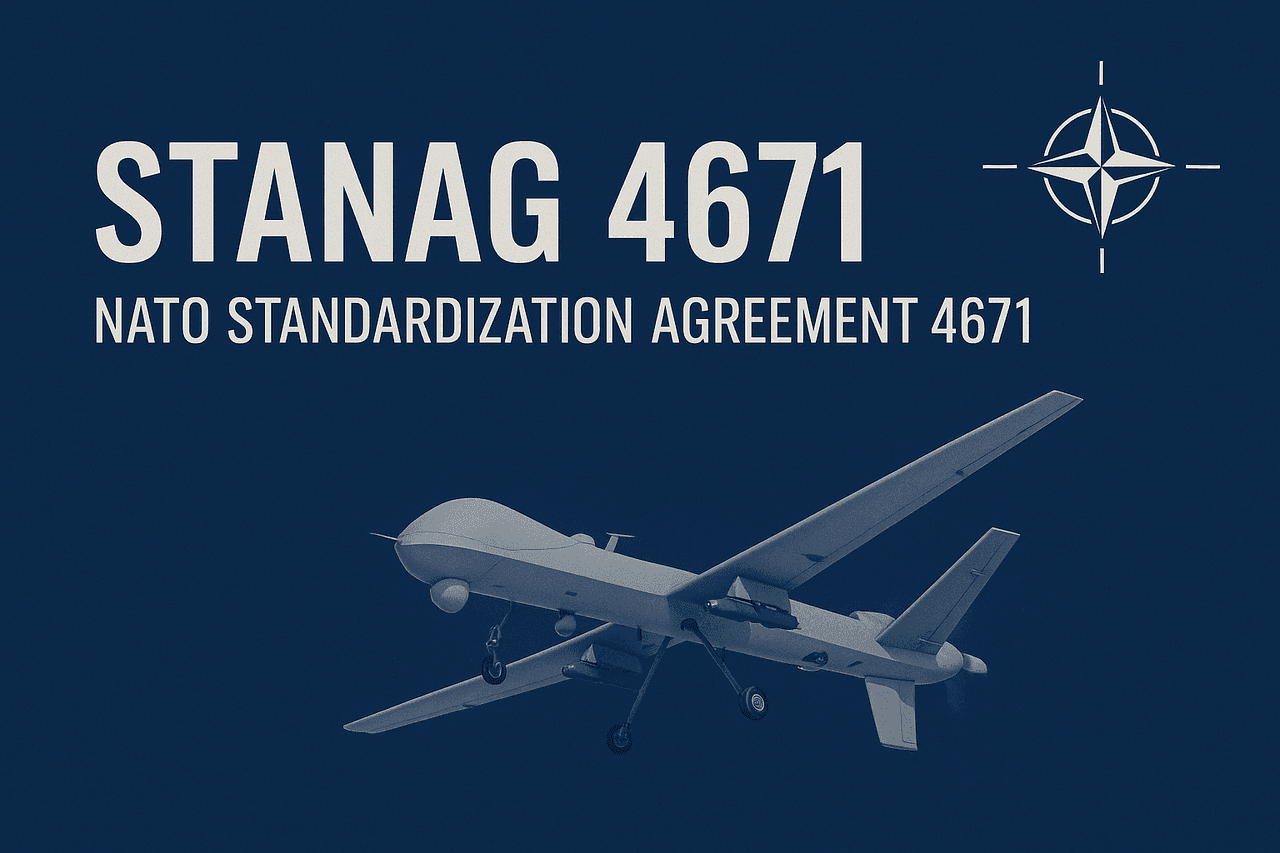
STANAG 4671: Standard for Flight Worthiness of Military Unmanned Aerial Vehicles
Publishing Institution | NATO Standardization Office | ||||||||
|---|---|---|---|---|---|---|---|---|---|
Publication Year | First Edition 2005, Final Edition 3 (2022) | ||||||||
Scope(s) | Fixed-wing UAVs of 150 kg and above | ||||||||
Standard Name | STANAG 4671 – Unmanned Aerial Vehicle (UAV) Systems Airworthiness Requirements | ||||||||
STANAG 4671 ("NATO Standardization Agreement 4671") is a technical and operational standard published by NATO that defines requirements for the airworthiness of fixed-wing unmanned aerial vehicles (UAVs) with a maximum takeoff weight exceeding 150 kg. Its primary objective is to ensure that military UAVs operate safely, controllably and in compliance with standards both nationally and internationally within airspace. The standard was developed based on the European Aviation Safety Agency’s (EASA) CS-23 civil aviation standard, thereby adapting civil aviation safety principles to military systems engineering. STANAG 4671 was first published in 2005 and revised in 2011 and 2022 to respond to changes in technology threat perception and operational concepts. It plays a critical role in establishing a common engineering approach and interoperability among NATO member countries. It also provides a regulatory framework for the defense industry throughout the entire lifecycle from supply chain management to system integration. Although the standard primarily covers fixed-wing UAVs with a takeoff weight exceeding 150 kg the engineering requirements it contains also serve as a technical foundation for the design and certification processes of rotary-wing hybrid or VTOL (vertical takeoff and landing) systems. Compliance with this standard is mandatory for all UAV systems intended for use in NATO operations.
The field implementation of STANAG 4671 requires interdisciplinary collaboration among systems engineers safety engineers test specialists software development teams and certification units. Software lifecycle management hardware development processes environmental testing flight testing and system safety analyses are core components of this collaboration. Additionally tools such as JIRA BigPicture IBM DOORS and Confluence are used to support requirement traceability and project documentation.
The first version of STANAG 4671 was published in 2005 and has since been revised in response to advancing technology operational needs and integration requirements with civil aviation. The latest edition Edition 3 (2022) has been formally adopted. The standard is actively used by numerous defense organizations in Europe and North America for both the development of new systems and the certification of existing ones.
For UAVs to operate safely in both civil and military airspace they must comply with specific technical and operational requirements. STANAG 4671 ensures these requirements by:
In this regard the standard serves as a common reference document for both system designers and certification authorities.
STANAG 4671 typically applies to fixed-wing UAV systems with a maximum takeoff weight exceeding 150 kg. Although rotary-wing and VTOL systems are not directly within its scope STANAG 4671 can still serve as a foundational reference for these platforms. Compliance with this standard has become mandatory in the defense industry particularly for systems designed to integrate into NATO operations. In practice the standard is actively used by systems engineers test engineers safety experts and certification teams. During the certification process each system component (aircraft ground control station communication systems etc.) is evaluated against the relevant subparts of the standard.
STANAG 4671 is structured into subparts in accordance with aerospace engineering principles. Each subpart covers a specific technical or operational domain. The structure is detailed below:
Scope definitions and application principles. Compliance conditions and certification framework.
Structural integrity weight and balance control vibration and acoustic limits.
Stability effect of control surfaces stall characteristics.
Flight control systems electrical systems and GCS communication protocols.
Engine reliability fire safety and redundancy systems.
Safety analyses such as FHA (Functional Hazard Assessment) FMEA and FTA. Failure probabilities and acceptance criteria.
Maintenance planning record management and material traceability.
C2 (command and control) link security lost link procedures. Sense-and-avoid systems and operator licensing requirements.
Submission of compliance evidence review processes. Requirement traceability matrices and documentation requirements.
Some key international aviation standards used alongside or referenced by STANAG 4671 include:
These standards play a supportive role in the implementation of STANAG 4671 and are typically applied in conjunction with systems engineering and project management practices.
Some challenges encountered in implementing STANAG 4671 include:
In a MALE-class UAV project developed by Türkiye’s defense industry electronic hardware compliant with DO-254 was developed for the flight control system. Requirement traceability was ensured through JIRA project scheduling and resource management were conducted using BigPicture and project documentation was centrally managed via Confluence. Additionally requirements under Subparts B and C were verified through pre-flight ground test systems and DO-178C-based configuration management was applied for software safety.
STANAG 4671 is a comprehensive technical document designed to ensure the airworthiness and operational safety of unmanned aerial vehicle systems. It not only guarantees interoperability within NATO’s multinational military operations but also introduces high safety standards for military systems engineering. Its structure inspired by civil aviation facilitates the integration of military UAVs into the modern airspace environment.
Cengiz, Hakan. 2021. "STANAG Test Standartlarının Sivil ve Askeri Alandaki Önemi." Savunma ve Strateji Dergisi 13, no. 4: 42–56.
Kaya, Mustafa. 2020. "NATO Standartlarının Uluslararası İşbirliği Üzerindeki Etkileri." Uluslararası Güvenlik ve Savunma 18, no. 3: 34–49.
NATO Standardization Office. 2021. STANAG 4231 Electromagnetic Compatibility Standards. NATO.
NATO Standardization Office. 2021. STANAG 4370 Environmental Testing Standards. NATO.
NATO Standardization Office. 2021. STANAG Standardization Agreements. NATO. https://www.nato.int/cps/en/natohq/topics_69269.htm
Savunma Sanayii Başkanlığı. 2019. "NATO Balistik Koruma Seviyeleri ve Test Uygulamaları." SSB Teknik Raporlar Serisi 15, no. 2: 55–78.
Savunma Sanayii Başkanlığı. 2019. "NATO ve STANAG Test Standartlarının Uygulanması." SSB Teknik Raporlar Serisi 12, no. 5: 23–35.
Savunma Sanayii Başkanlığı. 2019. "NATO Çevresel Test Standartlarının Uygulanması." SSB Teknik Raporlar Serisi 14, no. 3: 34–47.
Savunma Sanayii Başkanlığı. 2020. "NATO Elektromanyetik Dayanıklılık Test Standartları." SSB Teknik Raporlar Serisi 16, no. 1: 25–41.
Savunma Sanayii Dergilik. "DO-178C Temelli Yazılım Konfigürasyon Yönetimi." Accessed May 30, 2025. https://www.savunmasanayiidergilik.com/tr/HaberDergilik/DO-178C-temelli-yazilim-konfigurasyon-yonetimi
U.S. Army. 2019. The Role of Standardization in NATO and Its Impact on Global Defense Strategies. https://www.army.mil
Özkan, Burak. 2020. "NATO Standardizasyon Süreçleri ve STANAG’ın Önemi." Savunma ve Strateji Dergisi 7, no. 3: 45–58.

STANAG 4671: Standard for Flight Worthiness of Military Unmanned Aerial Vehicles
Publishing Institution | NATO Standardization Office | ||||||||
|---|---|---|---|---|---|---|---|---|---|
Publication Year | First Edition 2005, Final Edition 3 (2022) | ||||||||
Scope(s) | Fixed-wing UAVs of 150 kg and above | ||||||||
Standard Name | STANAG 4671 – Unmanned Aerial Vehicle (UAV) Systems Airworthiness Requirements | ||||||||
Technical Implementation and Stakeholders
History and Development
Purpose and Strategic Importance
Application Areas and Implementation
Structure and Technical Subparts of STANAG 4671
Subpart A – General Provisions
Subpart B – Airworthiness Requirements
Subpart C – Flight Performance and Controllability
Subpart D – Flight Systems
Subpart E – Propulsion Systems
Subpart F – Operational Safety and System Safety
Subpart G – Maintenance and Traceability
Subpart H – Unmanned System-Specific Requirements
Subpart I – Certification Process
Related Standards and References
Implementation Challenges
Example Implementation