


This article was automatically translated from the original Turkish version.
+2 More
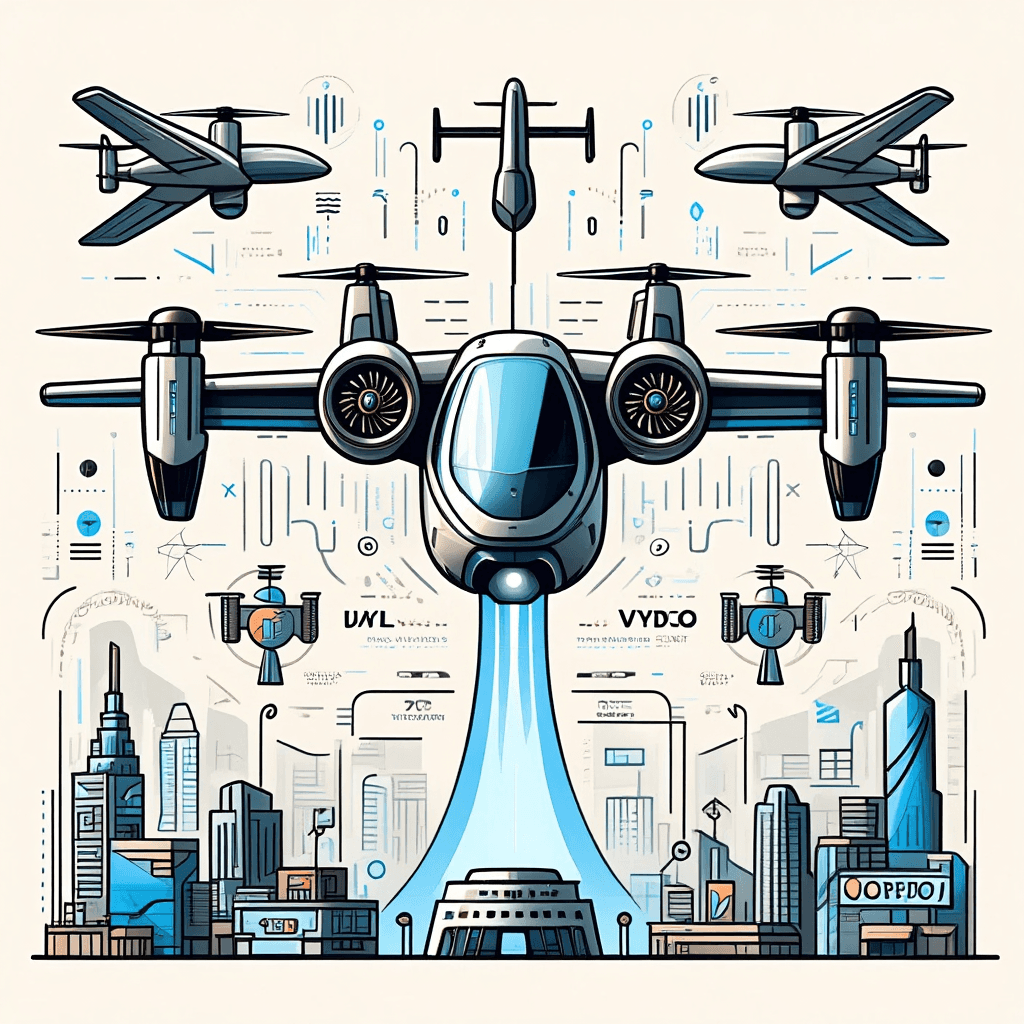
e-VTOL (Generated by Artificial Intelligence)
Scope(s) | Electric vertical takeoff and landing vehicles (eVTOL) are short- to medium-range aircraft that operate entirely or partially on electricity and can perform vertical takeoff and landing. | ||||||||
|---|---|---|---|---|---|---|---|---|---|
Main Configurations | Vector thrust (tilt-rotor / tilt-wing), Lift plus cruise, Multicopter, Single-copter | ||||||||
Application Area(s) | Urban air taxi Cargo and package delivery Regional corporate transport Disaster logistics Emergency medical transport | ||||||||
Electric vertical takeoff and landing vehicles (eVTOLs) are a new generation of aircraft that operate using fully or partially electric propulsion systems and can take off and land vertically. These vehicles are a fundamental component of advanced air mobility systems designed to alleviate road traffic congestion in urban and short-range transportation, reduce travel time, and lower carbon emissions. eVTOLs combine the maneuverability of helicopters with the aerodynamic efficiency of fixed-wing aircraft, offering environmentally friendly transportation solutions through low noise levels and zero exhaust emissions.
By the early 2020s, over 500 eVTOL concepts had been developed worldwide, with approximately 30% of them reaching the first flight stage. This growth has been driven by improvements in battery energy density, the development of electric motors with high torque-to-weight ratios, and advances in autonomous flight control algorithms.
The engineering infrastructure of eVTOL systems is based on a distributed electric propulsion architecture, in which multiple small electric motors are arranged around the airframe. This design provides balanced thrust generation during takeoff, cruise, and landing phases while offering high fault tolerance. Replacing the complex mechanical systems of traditional helicopters, this architecture reduces maintenance requirements and enhances energy efficiency.
Motors with high torque density and low weight are the primary determinants of eVTOL performance. Current motor systems deliver average efficiencies above 90%, with torque density reaching 45–50 Nm/kg. These motors are typically supported by integrated controllers, advanced electromagnetic topologies, and lightweight composite materials.
Battery technology is the most significant limiting factor for eVTOL performance. The energy density of lithium-ion batteries averages between 200 and 300 Wh/kg[^1]. This capacity enables vehicles to operate over ranges of 20–50 km. Solid-state batteries and fuel cells are among the emerging technologies expected to increase range and payload capacity.【1】
Electric vertical takeoff and landing vehicles are classified into four main aerodynamic categories based on their flight principles:
These configurations offer distinct advantages depending on mission profiles. Multirotor systems are more efficient for short-range urban transport, while tilt-wing and lift+cruise configurations perform better on longer routes.
The key parameters determining eVTOL performance are energy storage capacity and specific thrust. Limitations in battery energy density directly affect range and useful payload capacity. Vehicles equipped with batteries averaging 300 Wh/kg can achieve ranges of 30 to 50 km and carry 3 to 6 passengers.【2】
Techno-economic modeling indicates that economic sustainability is linked to flight distance and cost per unit distance. For flights with a maximum range of 50 km, positive investment returns can be achieved with operating costs of $1–2 per kilometer. A 20% increase in battery capacity can raise the return on investment by approximately 15–18%.
The concept of urban air mobility aims to integrate eVTOL systems into urban transportation infrastructure, creating an alternative aerial layer to ground traffic. In this system, vertiports—vertical takeoff and landing facilities—form short-distance, high-frequency transportation networks between city centers.
Transportation research recommends utilizing the urban airspace to address challenges such as traffic congestion, air pollution, and temporal inefficiency in cities. The low noise and zero direct emissions of eVTOLs reduce environmental impacts in densely populated areas. However, the safe management of airspace, adaptation of air traffic control systems, and public trust in this new mode of transport are critical to the technology’s success.
Integrating eVTOL systems into existing airspace presents a new engineering challenge for regulatory authorities and urban planners. Safe integration requires the coordinated evaluation of vertiport location strategies, route planning, altitude management, collision avoidance algorithms, and electric charging infrastructure.
Scenario studies have determined that vertiports can operate safely within operational areas with a radius of approximately 75 nautical miles (about 139 km). Locating vertiports near public transit hubs and away from dense residential zones reduces noise and safety impacts while improving accessibility. Additionally, standardization of high-voltage charging systems is essential to reduce operational downtime.
The global eVTOL ecosystem is concentrated in three primary hubs: the United States, Europe, and China. Approximately 70% of concepts introduced between 2014 and 2022 were developed in these regions. Most vehicles feature a capacity of 3–6 passengers, cruise speeds of 200–300 km/h, and a useful payload of 200–500 kg.
New-generation motor systems generate power between 50 kW and 1 MW, achieving power densities of up to 13 kW/kg to enhance energy efficiency. The eVTOL industry is projected to exceed $80 billion in size by 2035.
Completion of certification processes, development of battery recycling infrastructure, and standardization of airspace management protocols are prerequisites for the integration of these vehicles into mass transit systems.
The widespread adoption of electric vertical takeoff and landing systems will generate multidimensional changes in urban transportation economics and social structures. Initially expected to be offered as “air taxis” for high-income users, these vehicles are anticipated to eventually serve public services such as emergency medical transport, disaster logistics, and short-haul regional routes.
For social acceptance, the reliability of the energy infrastructure, noise control systems, and operational safety are critical. Decarbonizing energy systems and supporting the electric propulsion infrastructure with renewable energy sources will enhance the sustainability of this technology.
With increasing battery energy density and maturing regulatory frameworks, eVTOL systems have the potential to establish a new dimension of urban mobility after 2030. This development is creating a new intersection between aerospace engineering, energy technologies, and urban planning.
Bridgelall, Raj, Shawn White, and Denver Tolliver. “Integrating Electric Vertical Takeoff and Landing Aircraft into Public Airspace: A Scenario Study.” *Future Transportation* 3, no. 3 (2023): 1029–1045. Accessed October 30, 2025. https://doi.org/10.3390/futuretransp3030057.
Garrow, Laurie A., Brian J. German, and Caroline E. Leonard. “Urban Air Mobility: A Comprehensive Review and Comparative Analysis with Autonomous and Electric Ground Transportation for Informing Future Research.” *Transportation Research Part C: Emerging Technologies* 132 (2021): 103377. Accessed October 30, 2025. https://doi.org/10.1016/j.trc.2021.103377.
Liu, Yinfei, and Chao Gao. “Assessing Electric Vertical Take-Off and Landing for Urban Air Taxi Services: Key Parameters and Future Transportation Impact.” *Sustainability* 16, no. 11 (2024): 4732. Accessed October 30, 2025. https://doi.org/10.3390/su16114732.
Su, Jiangcheng, Hailong Huang, Hong Zhang, and Yutong Wang. “eVTOL Performance Analysis: A Review from Control Perspectives.” *IEEE Transactions on Intelligent Vehicles* (2024): 1–13. Accessed October 30, 2025. https://doi.org/10.1109/TIV.2024.3387405.
Ugwueze, Osita, Thomas Statheros, Mike Bromfield, and Nadjim Horri. *Trends in eVTOL Aircraft Development: The Concepts, Enablers and Challenges.* 2023. Accessed October 30, 2025. https://doi.org/10.2514/6.2023-2096.
Xiang, Senwei, Anhuan Xie, Minxiang Ye, Xufei Yan, Xiaojia Han, Hongjiao Niu, Qiang Li, and Haishan Huang. “Autonomous eVTOL: A Summary of Researches and Challenges.” *Green Energy and Intelligent Transportation* 3, no. 1 (2024): 100140. Accessed October 30, 2025. https://doi.org/10.1016/j.geits.2023.100140.
Zhao, Xiaopeng, Weiping Yang, Zhangjun Sun, Ying Liu, and Wenyang Liu. “Overview of Electric Propulsion Motor Research for eVTOL.” *Engineering Proceedings* 80, no. 1 (2024): 46. Accessed October 30, 2025. https://doi.org/10.3390/engproc2024080046.
[1]
Garrow, Laurie A., Brian J. German ve Caroline E. Leonard. “Urban Air Mobility: A Comprehensive Review and Comparative Analysis with Autonomous and Electric Ground Transportation for Informing Future Research.” Transportation Research Part C: Emerging Technologies 132 (2021): 103377. Erişim Tarihi: 30 Ekim 2025. https://doi.org/10.1016/j.trc.2021.103377.
[2]
Zhao, Xiaopeng, Weiping Yang, Zhangjun Sun, Ying Liu ve Wenyang Liu. “Overview of Electric Propulsion Motor Research for eVTOL.” Engineering Proceedings 80, no. 1 (2024): 46. Erişim Tarihi: 30 Ekim 2025. https://doi.org/10.3390/engproc2024080046.

e-VTOL (Generated by Artificial Intelligence)
Scope(s) | Electric vertical takeoff and landing vehicles (eVTOL) are short- to medium-range aircraft that operate entirely or partially on electricity and can perform vertical takeoff and landing. | ||||||||
|---|---|---|---|---|---|---|---|---|---|
Main Configurations | Vector thrust (tilt-rotor / tilt-wing), Lift plus cruise, Multicopter, Single-copter | ||||||||
Application Area(s) | Urban air taxi Cargo and package delivery Regional corporate transport Disaster logistics Emergency medical transport | ||||||||
No Discussion Added Yet
Start discussion for "Electric Vertical Takeoff and Landing Vehicles (eVTOL)" article
Technological Foundations
Aerodynamic Configurations
Energy and Performance Constraints
Urban Air Mobility
Infrastructure, Airspace and Integration
Global Development Trends
Economic and Social Impacts