


This article was automatically translated from the original Turkish version.
+3 More
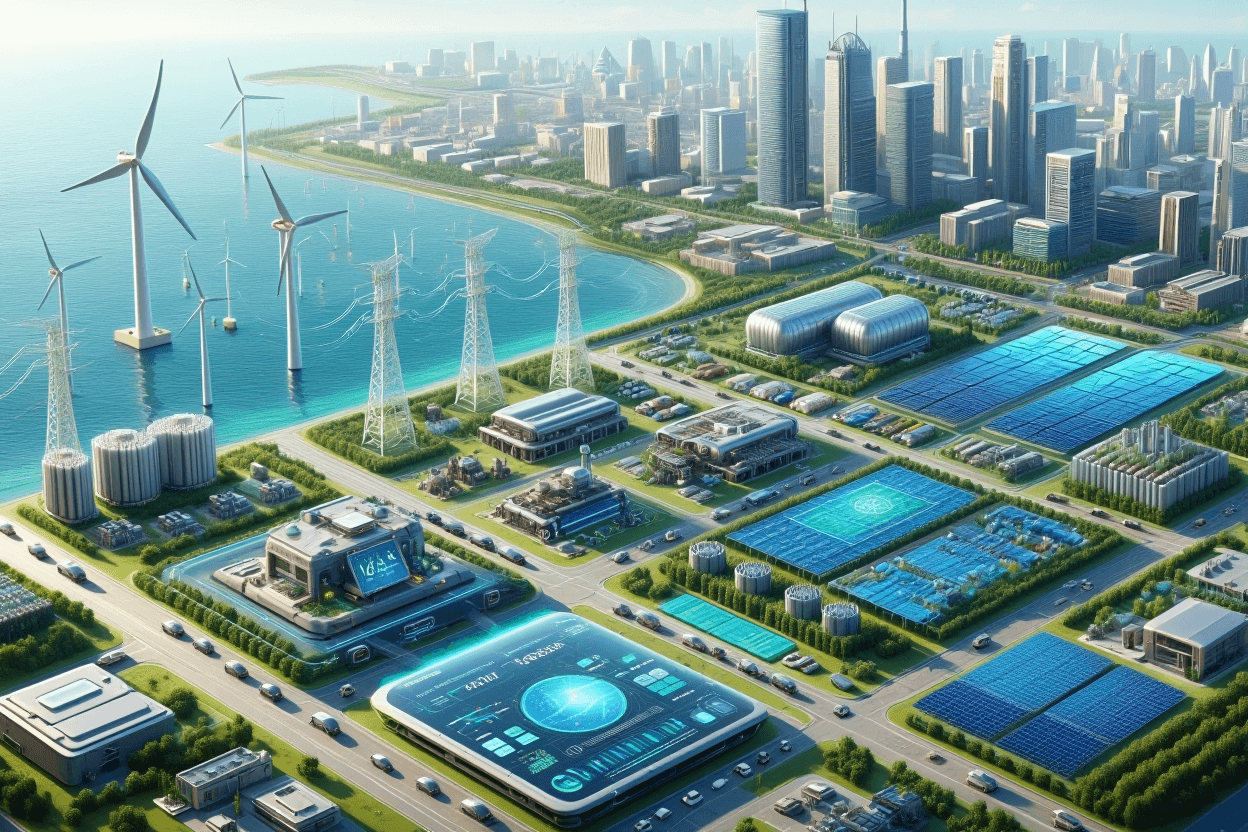
Generated with artificial intelligence.
Future Energy Systems and Technologies
Main Concept | Decarbonization, Digitalization, Decentralization | ||||||||
|---|---|---|---|---|---|---|---|---|---|
Core Technologies | Solar (Perovskite), Wind (Floating Turbines), Battery Storage, Green Hydrogen | ||||||||
System Management | Smart Grids and Internet of Things (IoT) | ||||||||
Primary Objective | Reduce dependence on fossil fuels and combat climate change | ||||||||
Emerging Fields | Hybrid Systems, Small Modular Reactors (SMR), Carbon Capture (CCUS) | ||||||||
The energy systems of the future represent a fundamental transformation from traditional centralized structures based on fossil fuels toward sustainable and innovative solutions, guided by the need to combat climate change and advances in technology. This transformation is shaped around four core principles: decarbonization, digitalization, decentralization, and democratization. Rising global energy demand, the limited nature of conventional resources, and their environmental impacts are increasing the need for clean energy sources such as solar, wind, and hydrogen, as well as intelligent technologies capable of managing these resources efficiently. This process is redefining not only how energy is produced but also how it is stored, distributed, and consumed.
Renewable energy technologies form the foundation of future energy portfolios. Declining costs and improved efficiency are accelerating their adoption. Innovations in solar and wind energy are particularly noteworthy.
Solar energy has become one of the most competitive energy sources due to significant cost reductions. Key technological innovations in this field include:
Wind energy is another major renewable source gaining in cost-effectiveness and efficiency. Key innovations in wind technology include:

Future Energy Systems and Technologies (Generated by Artificial Intelligence)
The inherently variable and intermittent nature of renewable energy sources poses significant challenges in balancing supply and demand within energy systems. This has elevated energy storage technologies to a strategic component, particularly in systems with high penetration of solar and wind power. Storage systems enhance grid reliability and system flexibility by storing excess energy for later use. Below are the main categories of energy storage technologies, classified and explained:
Electrochemical battery systems store electrical energy by converting it into chemical energy. The most widespread technology in this category is lithium-ion (Li-ion) batteries, which are preferred in both portable electronics and stationary energy systems due to their high energy density, fast charge/discharge capability, and long cycle life. In recent years, intensive research has focused on developing next-generation technologies aimed at improving battery safety and environmental sustainability. Solid-state batteries, which replace flammable liquid electrolytes with solid electrolytes, offer higher energy density and longer lifespan potential. Additionally, lithium-free alternatives such as sodium-sulfur (Na–S), sodium-ion, and flow battery systems are being evaluated, especially for grid-scale applications.
Pumped hydroelectric systems are the most widely deployed energy storage method globally in terms of installed capacity. In these systems, surplus electricity is used to pump water from a lower reservoir to a higher one. During periods of high electricity demand, the stored water is released through turbines to regenerate electricity. PHS systems contribute to base-load balancing due to their high efficiency (typically 70–85%) and large-scale storage capacity. However, their applicability is limited by topographical and environmental constraints, making them unsuitable for all geographic regions.
Hydrogen-based energy storage systems operate on the principle of electrolysis, which splits water into hydrogen and oxygen. Excess electricity generated from renewable sources can be converted into green hydrogen via water electrolysis. The resulting hydrogen can be stored in pressurized tanks or metal hydrides and later used in fuel cells to generate electricity. It can also be utilized directly in industrial applications, the transportation sector, or for synthetic fuel production. The use of hydrogen as a chemical energy carrier is particularly valuable in long-duration and seasonal energy storage scenarios.
In addition to electrochemical and hydroelectric solutions, various mechanical and thermal energy storage technologies are being developed. In compressed air energy storage (CAES) systems, surplus electricity is used to compress air, which is stored in underground caverns or tanks; when energy is needed, the air is expanded to drive turbines. Flywheels operate on the principle of kinetic energy, storing energy briefly through a high-speed rotating rotor. Thermal energy storage involves storing energy in the form of heat. This technology can be applied in solar thermal power plants by storing high-temperature heat in materials such as molten salts, thereby extending the duration of electricity generation.
The shift toward decentralized energy systems is placing significant pressure on traditional electricity grids. Smart grids are modern networks equipped with digital communication technologies designed to adapt to this new structure. These systems enhance efficiency, reduce losses, and optimize supply-demand balance by monitoring and managing energy production and consumption in real time. Key components of smart grids include smart meters, sensors, data analytics, and AI-based management systems. Through Internet of Things (IoT) integration, energy devices and systems—such as smart thermostats and smart lighting—can communicate with each other to automatically optimize energy consumption. This digitalization process not only improves energy efficiency but also empowers consumers to manage their own energy usage.
In the transformation of future energy systems, not only mainstream renewable sources but also various complementary technologies and strategic approaches play decisive roles. These systems aim to enhance energy supply security, minimize environmental impacts, and support economic sustainability. Key innovative applications are outlined below:
Hybrid energy systems are based on the integrated use of multiple renewable energy sources—for example, combining solar and wind energy within a single system. These systems allow one source to compensate for temporary reductions in output from another, ensuring a continuous and more stable energy supply. When integrated with energy storage units, hybrid systems further enhance grid flexibility and operational efficiency.
Green hydrogen is an energy carrier produced exclusively through electrolysis of water using renewable energy sources. When the electricity used in this process comes from solar or wind farms, hydrogen production becomes a zero-emission process. Green hydrogen is considered a low-carbon alternative to fossil fuels in high-temperature and long-distance industrial sectors such as steel manufacturing, chemical production, and heavy transport. Additionally, since hydrogen fuel cells emit only water vapor during electricity generation, this technology qualifies as a clean energy solution.
Carbon capture, utilization, and storage (CCUS) technology is being adopted as a transitional solution to reduce emissions from high-carbon sectors such as fossil fuel-based power generation and heavy industry. Within this technology, carbon dioxide (CO₂) emitted from power plants and industrial facilities is first separated from flue gases and captured. The captured gas is then either permanently stored in suitable underground geological formations or reused in industrial processes such as synthetic fuel or construction material production. CCUS systems provide a critical interim solution for reducing the environmental impact of existing fossil fuel infrastructure.
Small Modular Reactors (Small Modular Reactors – SMRs) are a new generation of nuclear energy technology designed with compact dimensions compared to traditional large-scale reactors and typically manufactured in modular fashion within factories. Key objectives in their development include lower initial investment costs, enhanced safety systems, shorter construction timelines, and scalability to meet diverse energy needs.
SMRs are generally designed with a capacity of 300 megawatts electric (MWe) or less. Their multi-module architecture allows multiple reactors to be deployed incrementally at the same site, enabling flexible adaptation of energy production to local requirements.
In terms of safety, many SMR designs incorporate passive safety systems that automatically provide cooling without requiring external power sources. This feature is regarded as a critical advantage in enhancing reactor safety during extraordinary events such as natural disasters or grid outages.
The applications of SMRs extend beyond electricity generation. These reactors also hold potential for providing industrial process heat, desalination of seawater, hydrogen production, and supporting energy infrastructure in remote areas. They are viewed as an attractive solution for countries and regions with limited settlement areas or isolated energy systems.
Due to their ability to provide carbon-free and reliable base-load power, SMRs have become one of the most notable technologies in the global energy transition. However, overcoming various technical and socio-political barriers—including licensing, regulatory frameworks, waste management, and public acceptance—is necessary for widespread commercial deployment.
The energy transition is not merely a technological change but a process with profound economic and social consequences. Economically, it creates new industries and employment opportunities in renewable energy and energy efficiency sectors. Lowering energy costs and enhancing energy security contribute to economic stability. Environmentally, reducing greenhouse gas emissions directly supports the fight against climate change. Socially, the transition aims to be fair and inclusive, ensuring universal access to energy and reducing energy poverty. This process reflects a collective societal effort toward a healthier and more sustainable future.
Aydin, Muhammed Iberia, and Ibrahim Dincer. “An Assessment Study on Various Clean Hydrogen Production Methods.” *Energy* 245 (2022): 123090. Accessed August 4, 2025. https://doi.org/10.1016/j.energy.2021.123090.
Ingersoll, Daniel. “Deliberately Small Reactors and the Second Nuclear Era.” *Progress in Nuclear Energy* 51 (2009): 589–603. Accessed August 4, 2025. https://doi.org/10.1016/j.pnucene.2009.01.003.
Mathiesen, Brian, Henrik Lund, D. Connolly, Henrik Wenzel, Poul Østergaard, Bernd Möller, Steffen Nielsen, Iva Skov, Peter Karnøe, Karl Sperling, and Frede Hvelplund. “Smart Energy Systems for Coherent 100% Renewable Energy and Transport Solutions.” *Applied Energy* 145 (2015): 139–154. Accessed August 4, 2025. https://doi.org/10.1016/j.apenergy.2015.01.075.
Pujari, Rajendra, Jhansi Ganapa, K. Makanyadevi, P. Venkata, Venkata Hari Prasad, Saket Rusia, and Samala Nagaraju. “Artificial Intelligence in Smart Grids: Enhancing Energy Management and Optimization through Machine Learning.” *International Journal of Advanced Research* 20 (2024): 1086–1103. Accessed August 4, 2025. https://www.researchgate.net/profile/Rajendra-Pujari-2/publication/385298180_Artificial_Intelligence_In_Smart_Grids_Enhancing_Energy_Management_And_Optimization_Through_Machine_Learning/links/67caa7cf32265243f5835177/Artificial-Intelligence-In-Smart-Grids-Enhancing-Energy-Management-And-Optimization-Through-Machine-Learning.pdf
Taşkesen, E., H. Alahmad, and E. N. Bilen. “Geleceğin Enerji Depolama Teknolojileri, Sürdürülebilirlik ve Enerji Dönüşümü.” *Mühendis ve Makina* 65, no. 714 (2024): 1–26. Accessed August 4, 2025. https://dergipark.org.tr/tr/download/article-file/3829348
Wang, Ronglu, Lu Zhang, Chenyang Shi, and Chunqiu Zhao. “A Review of Gravity Energy Storage.” *Energies* 18 (2025): 1812. Accessed August 4, 2025. https://doi.org/10.3390/en18071812
Zhang, Shilin, Ye Liu, Qining Fan, Chaofeng Zhang, Tengfei Zhou, Kourosh Kalantar-zadeh, and Zaiping Guo. “Liquid Metal Batteries for Future Energy Storage.” *Energy & Environmental Science* (2021). Accessed August 4, 2025. https://doi.org/10.1039/D1EE00531F

Generated with artificial intelligence.
Future Energy Systems and Technologies
Main Concept | Decarbonization, Digitalization, Decentralization | ||||||||
|---|---|---|---|---|---|---|---|---|---|
Core Technologies | Solar (Perovskite), Wind (Floating Turbines), Battery Storage, Green Hydrogen | ||||||||
System Management | Smart Grids and Internet of Things (IoT) | ||||||||
Primary Objective | Reduce dependence on fossil fuels and combat climate change | ||||||||
Emerging Fields | Hybrid Systems, Small Modular Reactors (SMR), Carbon Capture (CCUS) | ||||||||
No Discussion Added Yet
Start discussion for "Future Energy Systems and Technologies" article
Advancements in Renewable Energy Sources
Solar Energy Technologies
Wind Energy Technologies
Energy Storage Technologies
Electrochemical Storage (Batteries)
Pumped Hydroelectric Storage (PHS)
Hydrogen-Based Energy Storage
Other Mechanical and Thermal Storage Methods
Smart Grids and Digitalization
Other Innovative Technologies and Approaches
Hybrid Energy Systems
Green Hydrogen
Carbon Capture, Utilization, and Storage (CCUS)
Small Modular Nuclear Reactors (SMRs)
Economic and Social Impacts of the Energy Transition