


This article was automatically translated from the original Turkish version.
+1 More
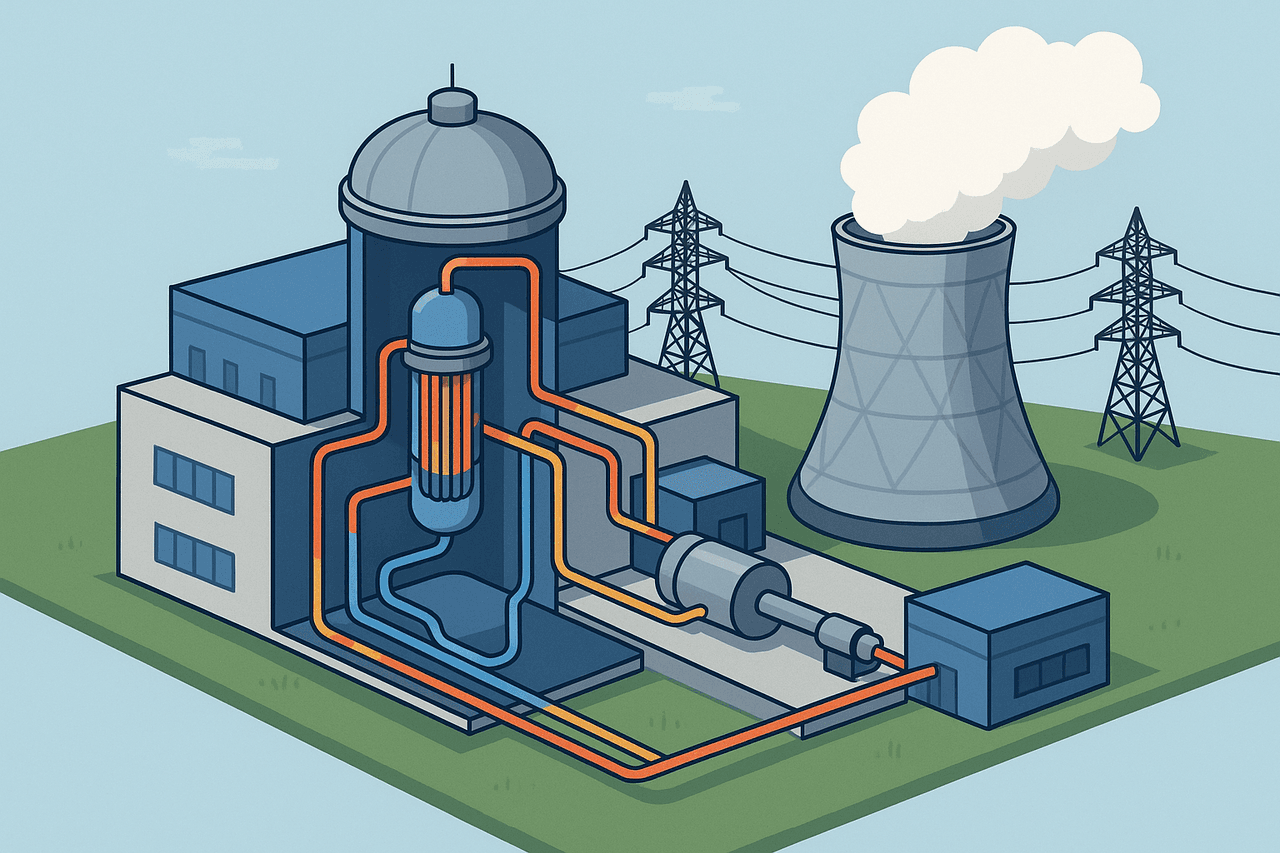
Small Modular Reactor (Generated with Artificial Intelligence)
Definition(s) | Advanced nuclear reactor with a capacity of up to 300 MW(e) modular and capable of factory production. | ||||||||
|---|---|---|---|---|---|---|---|---|---|
Basic Features | Small size, modular design, passive safety systems. | ||||||||
Production Method | Serial factory production and on-site assembly. | ||||||||
Application Area(s) | Electricity generation remote areas. hydrogen production industrial heat | ||||||||
Global Projects | Russia, China, United States, Canada, United Kingdom. | ||||||||
Türkiye Target (2050) | 5 gigawatts of installed SMR capacity. | ||||||||
Small Modular Reactors (SMRs) are advanced nuclear reactors designed on a smaller, modular scale compared to traditional nuclear power plants. The International Atomic Energy Agency (IAEA) defines them as reactors with a net electrical output of 300 megawatts (MW) or less per unit, whose individual modules can be manufactured in a factory environment. These reactors generate heat through nuclear fission and use this heat to produce low-carbon electricity. SMR technology is emerging as a key player in the future of nuclear energy due to its flexible siting, incremental capacity expansion, and enhanced safety features.
The defining characteristics of SMRs lie in their inherent “small” and “modular” nature. Physically, they occupy a much smaller footprint than conventional nuclear power reactors. This compact size enables SMRs to be deployed in locations unsuitable for large nuclear plants, such as industrial zones or remote areas with limited grid capacity.
Modularity is one of the most innovative aspects of SMR technology. Unlike traditional reactors, which are constructed on-site, SMR systems and components are manufactured as standardized modules in factory settings. These modules are then transported to the installation site via train, ship, or heavy-duty trucks and assembled together. This “plug-and-play” or “Lego-like” assembly method significantly reduces construction timelines, lowers project costs, and improves quality control. Additionally, it enables incremental capacity expansion by allowing new modules to be added in response to rising energy demand. This means construction of subsequent modules can continue while the first module is already operational and generating returns on investment.

Representative Image of a Small Modular Reactor (Generated by Artificial Intelligence)
More than 70 SMR designs are currently under development worldwide. These include technologies such as conventional pressurized water reactors used in existing nuclear plants, high-temperature gas-cooled reactors, and conceptual designs like molten salt or fast neutron reactors. A subset of SMRs known as microreactors are typically designed to generate up to 10 MW of electricity and are targeted for use in remote, off-grid areas or as emergency power sources.
One of the most significant advantages of SMR designs is their enhanced safety features. Simpler than traditional reactors, SMRs rely heavily on “passive safety systems” to ensure safe operation. These systems do not require human intervention or external power sources to shut down the reactor safely in the event of an accident. Instead, they utilize physical phenomena such as gravity, natural circulation, and convection. These characteristics aim to significantly reduce the likelihood of accidents similar to those at Fukushima. Some SMR designs further enhance safety by using alternative coolants such as molten salt or metal instead of water.
Regarding the fuel cycle, SMRs require refueling less frequently than conventional plants. While traditional reactors typically need refueling every one to two years, many SMR designs operate for three to seven years between refueling cycles. Some designs are even projected to operate for up to 30 years without refueling. However, like all nuclear reactors, SMRs produce radioactive waste. Some studies suggest that SMRs may generate up to 30 times more long-lived high-level waste and up to 35 times more low- and intermediate-level waste per unit of energy compared to conventional reactors, making waste management potentially more complex. Therefore, the safe storage of generated waste remains a fundamental challenge for SMR technology.
The economic potential of SMRs is one of the most debated aspects. Proponents argue that factory-based serial production and standardized designs will result in lower initial capital costs compared to large nuclear plants. For instance, the total project cost of a 300 MW SMR facility is estimated to range between $900 million and $1.8 billion, whereas large reactor costs can exceed $5 billion.【1】 The modular structure reduces financial pressure by shortening construction times and enabling the first unit to enter service earlier.
Conversely, critical analyses argue that SMRs cannot compete economically with renewable energy sources such as wind and solar. Levelized cost of electricity (LCOE) analyses show that the costs of wind and solar power are significantly lower than the projected costs of SMRs. For example, one analysis indicates that wind energy costs range between $24 and $75 per MWh, while the target cost for an SMR project in the United States is set at $58 per MWh.【2】 Furthermore, it is emphasized that SMRs’ lower thermal efficiency may lead to higher operating costs, and several projects have been canceled during the design phase due to unprofitability. These economic challenges are viewed as among the biggest barriers to the commercialization and widespread adoption of SMRs.
SMRs offer a broad potential for applications beyond traditional nuclear power plants. Their most fundamental application is providing grid flexibility. They can deliver reliable baseload power to balance the variability in renewable energy generation. Due to their small size, SMRs can deliver energy to grids with limited capacity or to areas completely disconnected from the main grid.
Another important application is in industry. Industries such as metallurgy, petrochemicals, and fertilizer production require high-temperature steam up to 500°C for their processes. SMRs can provide this heat without reliance on fossil fuels and with zero carbon emissions. The same heat can also be used to power electrolyzers for clean hydrogen production. Additionally, technology giants such as Google, Amazon, and Microsoft are evaluating SMRs as a solution to meet the growing energy demands of their data centers.
Floating platforms represent another innovative application area for SMRs. Similar to Russia’s floating nuclear power plant operating in the Arctic, SMRs installed on ships or barges can be rapidly deployed to coastal regions or islands. This eliminates transmission losses and reduces dependence on expensive diesel generators.
SMR technology is currently in development worldwide. As of 2025, commercially operational SMRs include Russia’s floating KLT-40S reactors and China’s Linglong One (ACP-100) reactor, which is targeted for grid connection on Hainan Island. Meanwhile, many countries—including the United States, Canada, the United Kingdom, Finland, South Korea, and Japan—are developing their own SMR designs or advancing licensing processes. The International Energy Agency forecasts that global SMR capacity could reach 120 GW by 2050.
Türkiye is showing interest in SMRs as part of its strategy to diversify its energy portfolio in line with its 2053 carbon-neutral vision. The country plans for 5 GW of its targeted 20 GW total nuclear capacity by 2050 to come from SMRs. This goal is supported by initiatives under the “2030 Industry and Technology Strategy,” including the development of a domestic SMR design and the establishment of a nuclear technology park. Türkiye’s SMR initiative aims to deliver multiple benefits, including enhancing grid flexibility, providing uninterrupted heat to industry, and strengthening energy supply security.
Abdusammi, Muhammad R., Ikhwan Khaleb, Fei Gao, and Aditi Verma. "Evaluation of Nuclear Microreactor Cost-competitiveness in Current Electricity Markets Considering Reactor Cost Uncertainties." *arXiv*, June 16, 2025. Accessed July 5, 2025. https://arxiv.org/abs/2506.13361
Culaba, Alvin B., Carlo L. Vinoya, Aristotle T. Ubando, and Wei-Hsin Chen. "State-of-the-Art Review of Small Modular Reactors." *Energies* 16, no. 7 (2023): 3224. Accessed July 5, 2025. https://doi.org/10.3390/en16073224
Erbay, Celal. "Türkiye'nin küçük modüler reaktör hamlesinin stratejik önemi." Anadolu Ajansı, May 30, 2025. Accessed July 5, 2025. https://www.aa.com.tr/tr/analiz/turkiyenin-kucuk-moduler-reaktor-hamlesinin-stratejik-onemi/3584282
Erkalan, Başak. "Küçük modüler nükleer reaktörler, iklim hedeflerine ulaşmada bir çözüm sunuyor." Anadolu Ajansı, November 30, 2024. Accessed July 5, 2025. https://www.aa.com.tr/tr/yesilhat/iklim-degisikligi/kucuk-moduler-nukleer-reaktorler-iklim-hedeflerine-ulasmada-bir-cozum-sunuyor/1824808
Gaster, Robin. "Small Modular Reactors: A Realist Approach to the Future of Nuclear Power." Information Technology and Innovation Foundation, April 14, 2025. Accessed July 5, 2025. https://itif.org/publications/2025/04/14/small-modular-reactors-a-realist-approach-to-the-future-of-nuclear-power/
IAEA. *Small Modular Reactors: Advances in SMR Developments 2024*. Uluslararası Atom Enerjisi Ajansı, 2024. Accessed July 5, 2025. https://www-pub.iaea.org/MTCD/Publications/PDF/p15790-PUB9062_web.pdf
Liou, Joanne. "What are Small Modular Reactors (SMRs)?" International Atomic Energy Agency, September 13, 2023. Accessed July 5, 2025. https://www.iaea.org/newscenter/news/what-are-small-modular-reactors-smrs
Momin, Rashid. "Physics-Driven Cost Optimization and Advanced Research & Development (R&D) Strategies for Small Modular Reactors (SMRs) in Leading Nuclear Energy Nations." *arXiv*, July 13, 2023. Accessed July 5, 2025. https://arxiv.org/abs/2307.12989
Sun, Yifan and Ken Kurosaki. "Technical Overview of Recent Developments in Small Modular Reactors in the United States." *arXiv*, April 3, 2025. Accessed July 5, 2025 https://arxiv.org/abs/2504.02599
TSKB. "Küçük Modüler Reaktörler Bilgilendirme Notu." October 2022. Accessed July 5, 2025. https://www.tskb.com.tr/uploads/file/kucuk-moduler-reaktorler-bilgilendirme-notu.pdf
[1]
2025 tarihi referans alınmaktadır.
[2]
2025 tarihi referans alınmaktadır.


Small Modular Reactor (Generated with Artificial Intelligence)
Definition(s) | Advanced nuclear reactor with a capacity of up to 300 MW(e) modular and capable of factory production. | ||||||||
|---|---|---|---|---|---|---|---|---|---|
Basic Features | Small size, modular design, passive safety systems. | ||||||||
Production Method | Serial factory production and on-site assembly. | ||||||||
Application Area(s) | Electricity generation remote areas. hydrogen production industrial heat | ||||||||
Global Projects | Russia, China, United States, Canada, United Kingdom. | ||||||||
Türkiye Target (2050) | 5 gigawatts of installed SMR capacity. | ||||||||
No Discussion Added Yet
Start discussion for "Small Modular Reactors" article
Design and Technological Features
Security and Fuel Cycle
Economic Evaluation and Costs
Applications and Advantages
Global Status and Türkiye’s Strategy