


This article was automatically translated from the original Turkish version.
+3 More
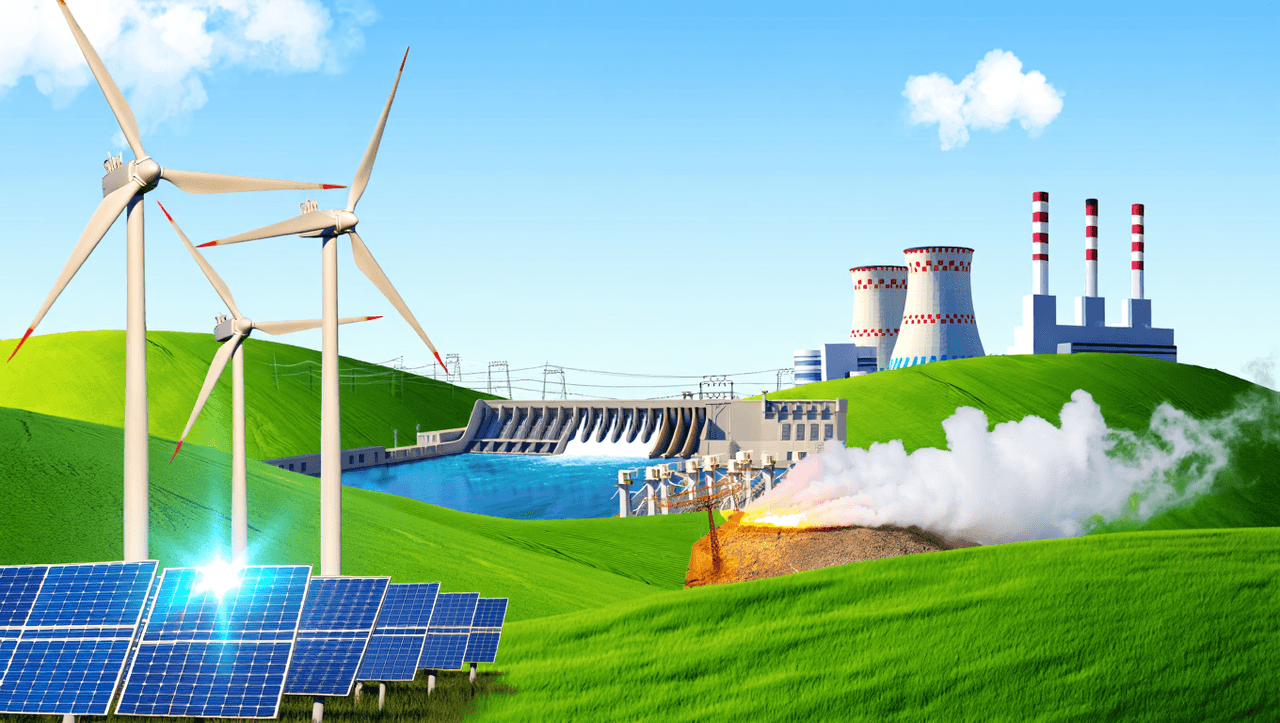
Energy Transition (Generated with Artificial Intelligence)
Definition(s) | The process of energy changing from one form to another. | ||||||||
|---|---|---|---|---|---|---|---|---|---|
Basic Principle | The First Law of Thermodynamics (Law of Conservation of Energy). | ||||||||
Mechanical Transformation | Potential energy ↔ Kinetic energy | ||||||||
Modern Context | Transition from fossil fuels to low-carbon energy sources to combat climate change. | ||||||||
Energy conversion, in its most fundamental definition, is the process by which energy changes from one form to another. In physics, energy is defined as the capacity of a system to perform work or cause specific changes. According to the Law of Conservation of Energy, also known as the First Law of Thermodynamics, energy cannot be created from nothing nor can existing energy be destroyed; it can only be transformed from one form to another. This principle states that the total amount of energy in the universe remains constant. The total mass of a system is also a measure of its energy. Thanks to this transformable property of energy, energy in different states can be converted through various machines or natural processes into other forms such as heat, light, or motion to perform physical work.
The Law of Conservation of Energy is a universal physical law that forms the foundation of energy transformations. According to this law, the total amount of energy in an isolated system remains constant over time. Energy can change form—for example, chemical energy can become thermal energy, or potential energy can become kinetic energy—but the total energy quantity always remains unchanged during these transformations. An object can possess more than one type of energy simultaneously. For instance, a flying bird has potential energy due to its height above the ground and kinetic energy due to its velocity. When external factors such as friction are neglected, the total mechanical energy—the sum of these two energies—remains constant. This principle is critical for understanding and calculating energy transformations.
Energy conversions are continuous phenomena occurring in nature and daily life. These transformations are observed across a wide spectrum, from mechanical systems and biological processes to technological devices and global climate events.
Mechanical energy is the sum of potential and kinetic energy. These two forms of energy continuously convert into each other in moving systems.
A simple pendulum is one of the most classic examples of potential and kinetic energy conversion. When the pendulum reaches its highest point, its velocity momentarily becomes zero and all its mechanical energy is in the form of gravitational potential energy. As it begins to move downward, its potential energy gradually decreases and is converted into kinetic energy. At the lowest point, its velocity reaches its maximum, potential energy is at its minimum, and kinetic energy is at its maximum. As it rises again, this process reverses: kinetic energy is converted back into potential energy. If friction is neglected, this conversion cycle continues indefinitely.
An athlete starting from the top of a skateboard ramp initially possesses maximum potential energy. As they accelerate toward the bottom of the ramp, this potential energy is converted into kinetic energy. At the lowest point of the ramp, potential energy reaches its minimum while kinetic energy reaches its maximum. As the athlete begins to climb up the other side of the ramp, kinetic energy is once again converted back into potential energy.
When a ball is thrown upward, its initial kinetic energy is converted into potential energy as it works against gravity. At its peak point, the ball’s velocity momentarily becomes zero and all its kinetic energy has been transformed into potential energy. As it begins to fall, the potential energy is converted back into kinetic energy, accelerating the ball downward.
The launching of an arrow from a bow is an example of elastic potential energy being converted into kinetic energy. When the bow is drawn, elastic potential energy is stored in the bow. When the bowstring is released, this stored energy is transferred to the arrow, converting into kinetic energy that propels the arrow forward at high speed.
This sport involves a complex series of energy conversions. The athlete’s kinetic energy during the run is converted into elastic potential energy in the pole when it is planted into the box. As the flexible pole straightens, it releases this stored energy back to the athlete, propelling them upward. At this point, the elastic potential energy is transformed into both gravitational potential energy, which lifts the athlete, and kinetic energy, which maintains their forward motion. During the landing on the mat, this energy is converted into heat and sound energy.
Many devices we use daily convert electrical energy into other forms. For example, a fan transforms electrical energy into mechanical (kinetic) energy that rotates its blades. A radio converts electrical energy into sound energy, while a light bulb converts electrical energy into light and heat energy.
Fossil fuels such as coal and oil, as well as batteries, store chemical energy. When coal is burned, the chemical energy within it is converted into heat and light energy. The chemical energy stored in batteries is converted into electrical energy to power electronic devices. Similarly, living organisms obtain energy from food through respiration, which is the conversion of chemical energy into usable forms within the body.
Solar panels (photovoltaic cells) directly convert radiant energy from the sun into electrical energy. This technology is one of the foundational pillars of renewable energy production. In photosynthesis, one of the most important natural energy conversions, plants use sunlight energy to convert carbon dioxide and water into food (chemical energy).
Frictional force is a force that arises between contacting surfaces and opposes motion. This force causes a reduction in the kinetic energy of moving objects. However, according to the Law of Conservation of Energy, this energy is not lost; it is typically converted into heat energy. For example, the warming of our hands when we rub them together, the heating of car wheels and brake pads during braking, or the excessive heating of a drill bit penetrating a wall are concrete indications that kinetic energy has been converted into heat energy through friction. Frictional force also causes gradual wear and tear of machine parts and everyday objects over time. This force depends on the nature of the contacting surfaces and the weight of the object, but not on the surface area.
Friction does not occur only between solid surfaces. Fluids such as air and water also exert a resistive force on objects moving through them. The frictional force in air is called air resistance. The safe landing of parachutes is made possible by exploiting the decelerating effect of air resistance. Conversely, vehicles such as race cars and helmets used by cyclists are aerodynamically designed to minimize air resistance. Similarly, the frictional force in water is called water resistance, and this force slows the motion of marine vessels such as ships and submarines. Water resistance is much greater than air resistance; therefore, running in water is significantly more difficult than running in air.
Frictional force has both beneficial and detrimental effects in daily life.
Since friction has both beneficial and detrimental effects, controlling it is of great importance in engineering and design.
Friction is one of the fundamental forces in physics and plays an indispensable role in both engineering and daily life. Understanding and controlling it is critical for improving technology and quality of life.
Modern energy conversion refers to the transition from fossil fuel-based energy production to renewable and low-carbon sources. This transformation is shaped by global increases in energy demand, efforts to combat climate change, and goals for energy security. Renewable sources such as solar, wind, hydropower, and biomass are increasingly contributing a larger share to electricity generation, while battery storage systems, smart grids, and energy efficiency measures support this process. At the same time, emerging solutions such as hydrogen technologies and carbon capture serve as strategic tools to reduce the impact of fossil fuels. The global scale of energy conversion varies according to countries’ socioeconomic structures, natural resource potential, and access to technology. Therefore, international cooperation, financial mechanisms, and policy alignment are critically important for achieving a sustainable and equitable energy transition.
Diaconescu, Mirela, Laura Elena Marinas, Ana Maria Marinoiu, Maria-Floriana Popescu, and Mihai Diaconescu. "Towards Renewable Energy Transition: Insights from Bibliometric Analysis on Scholar Discourse to Policy Actions." *Energies* 17, no. 18 (2024): 4719. https://doi.org/10.3390/en17184719.
Hafner, Manfred, and Simone Tagliapietra. "The Global Energy Transition: A Review of the Existing Literature." In *The Global Energy Transition*, 1–30. Cham: Springer, 2020. https://doi.org/10.1007/978-3-030-39066-2_1.
Halliday, David, Robert Resnick, and Jearl Walker. Fundamentals of Physics. Hoboken, NJ: John Wiley & Sons.
Hassan, Qusay, Patrik Viktor, Tariq J. Al-Musawi, Bashar Mahmood Ali, Sameer Algburi, Haitham M. Alzoubi, Ali Khudhair Al-Jiboory, Aws Zuhair Sameen, Hayder M. Salman, and Marek Jaszczur. "The Renewable Energy Role in the Global Energy Transformations." *Renewable Energy Focus* 48 (2024): 100545. https://doi.org/10.1016/j.ref.2024.100545.
Hibbeler, Russell C. Engineering Mechanics: Statics. 15th ed. Hoboken, NJ: Pearson, 2021. ISBN 9780137514663.
Mercure, J. F., P. Salas, A. Foley, U. Chewpreecha, H. Pollitt, P. B. Holden, and N. R. Edwards. "The Dynamics of Technology Diffusion and the Impacts of Climate Policy Instruments in the Decarbonisation of the Global Electricity Sector." *Energy Policy* 73 (2014): 686–700. https://doi.org/10.1016/j.enpol.2014.06.029.

Energy Transition (Generated with Artificial Intelligence)
Definition(s) | The process of energy changing from one form to another. | ||||||||
|---|---|---|---|---|---|---|---|---|---|
Basic Principle | The First Law of Thermodynamics (Law of Conservation of Energy). | ||||||||
Mechanical Transformation | Potential energy ↔ Kinetic energy | ||||||||
Modern Context | Transition from fossil fuels to low-carbon energy sources to combat climate change. | ||||||||
Law of Conservation of Energy
Examples of Energy Conversion
Mechanical Energy Conversions
Pendulum Motion
Skateboard Ramp
Thrown Ball
Bow and Arrow
Pole Vault
Other Common Energy Conversions
Conversion of Electrical Energy
Conversion of Chemical Energy
Conversion of Solar Energy
Effect of Frictional Force on Kinetic Energy
Air and Water Resistance
Benefits and Drawbacks of Friction
Benefits
Drawbacks
Methods to Reduce and Increase Friction
Methods to Reduce Friction
Methods to Increase Friction
Modern Energy Conversion