


This article was automatically translated from the original Turkish version.
+4 More
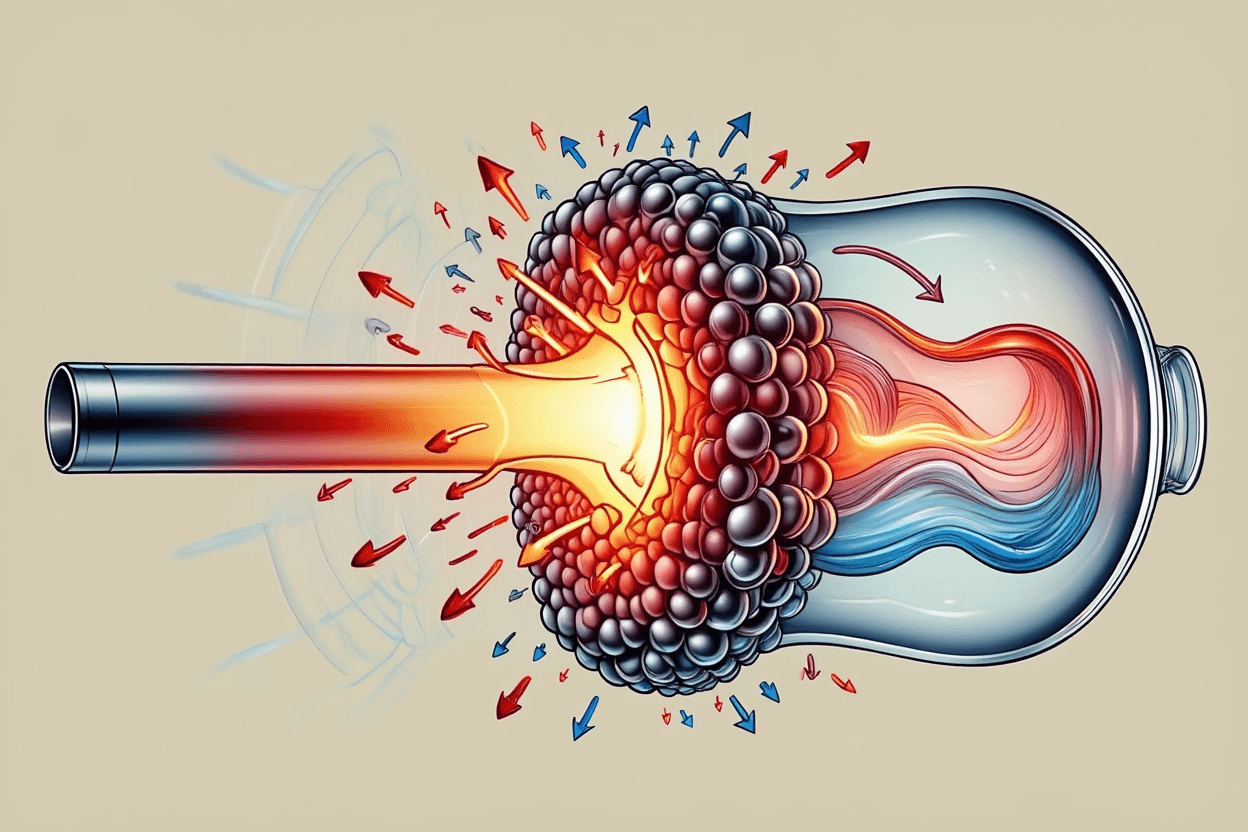
Thermal Energy (Generated with Artificial Intelligence)
Energy Type | Kinetic Energy | ||||||||
|---|---|---|---|---|---|---|---|---|---|
Related Concept | Heat (Form of thermal energy transfer) | ||||||||
Storage Types | Sensible Heat, Latent Heat, Thermochemical Heat | ||||||||
Main Applications | Geothermal Energy, Heating-Cooling Systems, Industrial Processes, Electricity Generation | ||||||||
Related Technologies | Thermal Energy Storage (TES), Geothermal Power Plants, Heat Pumps, Phase Change Materials (PCMs) | ||||||||
Thermal energy is the energy arising from the continuous, random, microscopic motion of atoms and molecules within an object or system. These motions occur through vibration, rotation, and translation of particles and are directly related to kinetic energy. The higher the average kinetic energy of the particles, the greater the total thermal energy of the system. This condition can be measured as temperature. Temperature is the macroscopic measure of the average kinetic energy corresponding to thermal energy and is determined using thermometers in Celsius, Fahrenheit, or Kelvin units. Heat is the transfer of thermal energy from a system at higher temperature to a system at lower temperature when a temperature difference exists. When the temperature difference disappears, the net flow of heat ceases and the systems reach thermal equilibrium.
Thermal energy storage (TES) is an energy management method that stores a specific amount of heat or cold for later use. This technology captures excess energy generated from variable renewable energy sources such as solar and wind and delivers it back when needed. TES systems are employed to reduce temporal mismatches between energy supply and demand, improve energy efficiency, and enhance system reliability.
TES applications are categorized into three main types:
TES technologies have a wide range of applications, from building heating and cooling systems to industrial processes, electricity generation, and regional energy management. These systems reduce the need for additional power generation during peak demand periods, lowering energy costs, limiting carbon emissions, and reducing environmental impact while strengthening the resilience of the energy infrastructure.
Advances in materials science, heat transfer, and systems engineering are increasing both the scalability and cost-effectiveness of thermal energy storage. As a result, TES systems are expected to play a strategic role in the global energy transition, particularly in the integration of renewable energy sources into the grid.
The storage of thermal energy is examined under three main methods, depending on the mechanism by which heat is retained and subsequently released: sensible heat storage, latent heat storage, and thermochemical heat storage. These methods differ in their application fields, storage densities, costs, and technical challenges.
Sensible heat storage is the most commonly used and technically simplest method of thermal energy storage (TES). The fundamental principle is to increase or decrease the temperature of the storage medium without changing its phase. Liquid or solid materials such as water, molten salts, metals, and rocks are preferred for this purpose. The amount of stored energy depends on the mass of the medium, its specific heat capacity, and the temperature difference during the storage process.
Advantages of this method include low capital cost, high reliability, and ease of implementation. However, its limited storage density requires larger volumes to store a given amount of energy. In building heating and cooling applications, water tanks are the most prominent example. For industrial applications requiring higher temperatures, molten salts (up to approximately 600 °C) or metals (up to approximately 1000 °C) are preferred. In systems known as Underground Thermal Energy Storage (UTES), heat is stored underground via boreholes or aquifers, enabling seasonal heating and cooling solutions.
Latent heat storage is based on the absorption or release of energy during phase changes of the storage medium, such as melting from solid to liquid or freezing from liquid to solid. Materials used in this method are called phase change materials (PCMs). Compared to sensible heat storage, this method offers the significant advantage of storing more energy in the same volume and maintaining it at a constant temperature.
The amount of stored energy is determined by the mass of the phase change material and its latent heat. Common PCM examples include ice, paraffin derivatives, and salt hydrates. For instance, ice is effectively used in cooling and air conditioning systems by undergoing a phase change at 0 °C. However, factors limiting the widespread adoption of this method include the limited availability of suitable phase change materials, the need to improve their typically low thermal conductivity, and integration costs.
Thermochemical heat storage relies on reversible chemical reactions that store thermal energy in chemical bonds. During an endothermic process, heat energy drives the decomposition of a compound, storing energy as chemical potential. In the exothermic process, when the components recombine, this energy is released as heat.
The greatest advantages of this method are its very high energy storage density and the ability to store energy for long periods with nearly zero heat loss. This feature is of great importance for long-term energy management applications such as seasonal storage. Additionally, the storage duration is theoretically unlimited. However, the technical complexity of the systems, high initial capital costs, and in some cases low conversion efficiency, remain barriers to widespread adoption. Therefore, thermochemical storage is still primarily in the research and pilot application stages.
Geothermal energy is a form of thermal energy derived from heat accumulated at various depths within the Earth’s crust, transferred to the surface via hot water, steam, and various gases. The term “geothermal,” meaning “earth heat,” originates from heat generated by magma layers deep within the Earth and by the decay of radioactive elements. This energy offers significant environmental and technical advantages over fossil fuels due to its renewable and sustainable nature, low greenhouse gas emissions, and ability to generate continuous power independent of weather conditions. Additionally, as it does not require combustible fuel, it is a safe energy source with no risk of fire or explosion.
Geothermal energy resources are classified into different categories based on their geological environment, temperature levels, and composition:
Different technologies are used to extract electricity or heat energy from geothermal resources:
Geothermal energy can be utilized across a broad spectrum, from direct heating and electricity generation to industrial and agricultural activities:
Geothermal potential is generally high along tectonic plate boundaries and regions with intense volcanic activity. Globally, the Pacific Ring of Fire and the Alpine-Himalayan belt are significant areas. Leading production regions include the Geysers Complex in the United States, the Larderello area in Italy, Iceland, the Philippines, Indonesia, and Mexico.
Türkiye possesses significant geothermal energy potential due to its young tectonic structure and dense fault systems located along the Alpine-Himalayan seismic belt. The highest concentration of geothermal resources in the country is found in the Aegean Region and Southern Marmara. Provinces such as Aydın, Denizli, Manisa, İzmir, and Çanakkale are among the main areas with concentrated geothermal power plants. In Türkiye, geothermal energy is effectively used not only for electricity generation but also for residential and greenhouse heating and thermal tourism. The Denizli-Kızıldere Plant, Türkiye’s first geothermal electricity generation facility, marks a pivotal milestone in the development of this sector.
Geothermal energy is a resource that offers significant environmental and economic benefits:
Despite its many advantages, geothermal energy has certain technical, environmental, and economic limitations:
Maruf, Md. Nasimul Islam, Germán Morales-España, Jos Sijm, Niina Helistö, and Juha Kiviluoma. “Classification, Potential Role, and Modeling of Power-to-Heat and Thermal Energy Storage in Energy Systems: A Review.” *Sustainable Energy Technologies and Assessments* 53 (2022): 102553. https://doi.org/10.1016/j.seta.2022.102553.
Mehta, P., V. Patel, S. Kumar, et al. “Performance Assessment of Thermal Energy Storage System for Solar Thermal Applications.” *Scientific Reports* 15 (2025): 13876. https://doi.org/10.1038/s41598-025-92458-y.
Nkinyam, Charity M., Chika Oliver Ujah, Christian O. Asadu, and Daramy V. V. Kallon. “Exploring Geothermal Energy as a Sustainable Source of Energy: A Systemic Review.” *Unconventional Resources* 6 (2025): 100149. https://doi.org/10.1016/j.uncres.2025.100149.
Sandia National Laboratories. "Thermal Energy Storage Systems." Accessed August 15, 2025. https://www.sandia.gov/ess-ssl/wp-content/uploads/2020/12/ESHB_Ch12_Thermal_Ho.pdf.
Sarbu, Ioan, and Calin Sebarchievici. “A Comprehensive Review of Thermal Energy Storage.” *Sustainability* 10, no. 1 (2018): 191. https://doi.org/10.3390/su10010191.
Verma, Shomik, Colin Kelsall, Kyle Buznitsky, Alina LaPotin, Ashwin Sandeep, and Asegun Henry. “Designing for Effective Heat Transfer in a Solid Thermal Energy Storage System.” *arXiv*, 2024. Accessed August 15, 2025. https://arxiv.org/abs/2402.07764.


Thermal Energy (Generated with Artificial Intelligence)
Energy Type | Kinetic Energy | ||||||||
|---|---|---|---|---|---|---|---|---|---|
Related Concept | Heat (Form of thermal energy transfer) | ||||||||
Storage Types | Sensible Heat, Latent Heat, Thermochemical Heat | ||||||||
Main Applications | Geothermal Energy, Heating-Cooling Systems, Industrial Processes, Electricity Generation | ||||||||
Related Technologies | Thermal Energy Storage (TES), Geothermal Power Plants, Heat Pumps, Phase Change Materials (PCMs) | ||||||||
Thermal Energy Storage (TES) Technology
Thermal Energy Storage Methods
Sensible Heat Storage
Latent Heat Storage
Thermochemical Heat Storage
Geothermal Energy: An Application of Thermal Energy
Geothermal Energy Resources
Geothermal Energy Production Methods
Applications of Geothermal Energy
Geothermal Energy in Türkiye and Worldwide
Advantages of Geothermal Energy
Disadvantages of Geothermal Energy