


This article was automatically translated from the original Turkish version.
+3 More
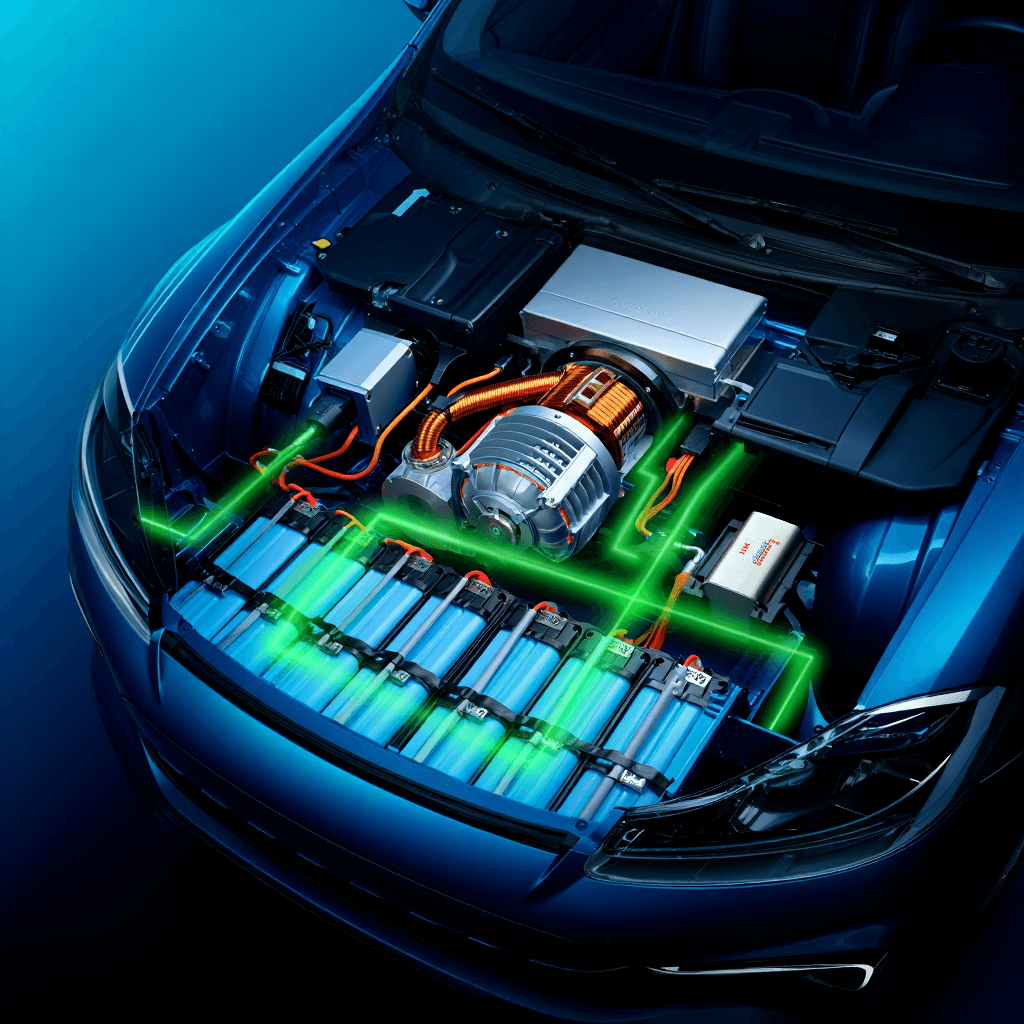
Electric Vehicle Power System (Generated with Artificial Intelligence)
Main Energy Source | Rechargeable battery pack (typically lithium-ion) | ||||||||
|---|---|---|---|---|---|---|---|---|---|
Energy Conversion | Electric motor (converts electrical energy into mechanical energy) | ||||||||
Power Management | Power electronics (inverter, converter, controller) | ||||||||
Transmission Element | Typically single-speed transmission | ||||||||
Efficiency Increase | Regenerative braking (recovery of kinetic energy) | ||||||||
Base Technologies | BMS, Thermal Management, SiC/GaN transistors | ||||||||
Electric Vehicle Power Systems encompass all components and subsystems responsible for storing converting managing and delivering electrical energy required to propel a vehicle. These systems fundamentally differ from the powertrain components of conventional internal combustion engine (ICE) vehicles as they use electrical energy instead of fossil fuels. The core of an electric vehicle EV power system consists of the battery pack electric motor power electronics control unit and transmission. These components directly influence the vehicle’s efficiency range performance and safety.
Electric vehicle power systems consist of various technological components that work in harmony. Each component has a specific function and contributes to the overall system performance.
The battery serves as the energy storage unit of the electric vehicle and supplies the direct current DC electricity needed by the motor. In today’s battery electric vehicles BEVs lithium-ion Li-ion battery technology is the most widely used. The battery pack is formed by combining numerous individual cell units and is the primary factor determining the vehicle’s range on a single charge. Typically mounted beneath the vehicle floor the battery lowers the center of gravity enhancing traction and driving stability. In addition to the main battery a secondary 12 V battery is usually present to power lighting audio systems and other low-voltage accessories.
The electric motor is the primary component that converts electrical energy from the battery into mechanical energy to rotate the wheels. Electric motors are significantly more efficient than internal combustion engines capable of converting approximately 95% of input energy into motion energy compared to around 30% in ICEs. Electric motors consist of a stationary part called the stator and a rotating part called the rotor. When electric current is applied to the stator it generates an electromagnetic field that causes the rotor to rotate. One of the most important advantages of electric motors is their ability to deliver maximum torque from a standstill which provides vehicles with rapid acceleration capability.
Power electronics is regarded as the brain and nervous system of the electric vehicle managing the flow of energy. This unit comprises several critical subcomponents:
Electric vehicles do not require conventional multi-gear transmissions. Because electric motors operate efficiently across a wide speed range and deliver instant torque they typically use a single-speed transmission. This simple design transmits mechanical energy from the motor to the wheels. With fewer moving parts it reduces energy loss increases efficiency and lowers maintenance costs.
The operation of an electric vehicle follows a defined sequence from energy storage to delivery at the wheels.
When the driver presses the accelerator pedal the controller detects this input and determines how much power to draw from the battery. High-voltage DC power from the battery is sent to the inverter which converts it into AC power and delivers it to the electric motor. The motor uses this electrical energy to generate a magnetic field that rotates the rotor. The rotational motion of the rotor is transmitted through the single-speed transmission to the wheels propelling the vehicle forward.
One of the most important efficiency features of electric vehicles is regenerative braking. When the driver releases the accelerator pedal or applies the brake the system operates in reverse. The rotation of the wheels drives the electric motor which functions as a generator. During this process the vehicle’s kinetic energy is converted into electrical energy. This generated electricity is converted back to DC by the inverter and stored in the battery. As a result energy that would otherwise be lost as heat during conventional braking is recovered increasing the vehicle’s range.
The efficient and safe operation of the power system is ensured by advanced control and management systems.
The Battery Management System is a critical electronic system that continuously monitors the health and safety of the battery pack. It regulates cell voltage current and temperature preventing overcharging overdischarging and overheating. It also calculates the battery’s state of charge SoC and state of health SoH providing the driver with relevant information.
Battery motor and power electronics components operate most efficiently and safely within a specific temperature range. The thermal management system maintains these components at their ideal operating temperature through cooling or heating. This system preserves performance and longevity by preventing overheating especially during fast charging and demanding driving conditions.
The ECU is the vehicle’s central computer coordinating all control systems. Motor control battery management charging control regenerative braking and all other functions are synchronized and managed by this unit.

Electric Vehicle Power Systems (Generated by Artificial Intelligence)
Electric vehicle technology continues to evolve to improve efficiency reduce costs and enhance performance.
Transistors used as switching elements in power electronics circuits play a pivotal role in system efficiency. Traditional silicon Si-based MOSFETs and IGBTs are increasingly being replaced by wide-bandgap semiconductors offering higher efficiency. Transistors made from new materials such as silicon carbide SiC and gallium nitride GaN can operate at higher temperatures and frequencies. This enables power electronics units to be smaller lighter and more efficient directly increasing the vehicle’s range and performance.
Automotive manufacturers are increasingly integrating power system components into a single unit to reduce costs and simplify assembly.
Chan, Chau K. Modern Electric Vehicle Technology. Oxford University Press, 2001.
Electrical Vehicle Power Electronics. Hexagon. Accessed July 10, 2025. https://hexagon.com/tr/resources/resource-library/electric-vehicle-power-electronics.
Emadi, Ali. Advanced Electric Drive Vehicles. CRC Press, 2014.
Gallegos, Remington. “Elektrikli Güç Araç Tasarımları Türleri: Kullanıcı İhtiyaçlarını Karşılamak İçin Eksiksiz Bir Kılavuz.” Made-in-China.com, December 15, 2024. Accessed July 10, 2025. https://insights.made-in-china.com/tr/Types-of-Electric-Power-Car-Designs-A-Complete-Guide-to-Meeting-User-Needs_wTYtlhUDuxia.html.
Hannan, M. A., et al. “Review of Energy Storage Systems for Electric Vehicle Applications: Issues and Challenges.” *Renewable and Sustainable Energy Reviews* 69 (2017): 771–789. https://doi.org/10.1016/j.rser.2016.11.171.
Husain, Iqbal. Electric and Hybrid Vehicles: Design Fundamentals. 2nd ed. CRC Press, 2011.
IEC 61851. Electric Vehicle Conductive Charging System – Part 1: General Requirements.
Ie, Siang Fui, and Chee Keong Tan. “A Review of Energy Sources and Energy Management System in Electric Vehicles.” *Renewable and Sustainable Energy Reviews* 20 (2013): 82–102. https://doi.org/10.1016/j.rser.2012.11.077.
Larminie, James, and John Lowry. Electric Vehicle Technology Explained. 2nd ed. Wiley, 2012.
SAE J1772 Standard. SAE Electric Vehicle Conductive Charge Coupler.
Sabo, A., et al. “A Review on Power Electronics Technologies and Applications for EV Battery Charging Systems.” *2022 International Conference on Green Energy, Computing and Sustainable Technology (GECOST)*, Miri Sarawak, Malaysia, 2022, 112–117. https://doi.org/10.1109/GECOST55694.2022.10010388.
Skywell Türkiye. "Elektrikli araba çalışma prensibi nedir?" Accessed July 10, 2025. https://skywell.com.tr/elektrikli-araba-calisma-prensibi-nedir/.
Skywell Türkiye. "Elektrikli araba çeşitleri nelerdir? Nasıl çalışır?" Accessed July 10, 2025. https://skywell.com.tr/elektrikli-araba-cesitleri-nelerdir-nasil-calisir/.

Electric Vehicle Power System (Generated with Artificial Intelligence)
Main Energy Source | Rechargeable battery pack (typically lithium-ion) | ||||||||
|---|---|---|---|---|---|---|---|---|---|
Energy Conversion | Electric motor (converts electrical energy into mechanical energy) | ||||||||
Power Management | Power electronics (inverter, converter, controller) | ||||||||
Transmission Element | Typically single-speed transmission | ||||||||
Efficiency Increase | Regenerative braking (recovery of kinetic energy) | ||||||||
Base Technologies | BMS, Thermal Management, SiC/GaN transistors | ||||||||
No Discussion Added Yet
Start discussion for "Electric Vehicle Power Systems" article
Main Components and Functions
Battery
Electric Motor
Power Electronics Control Unit PECU
Transmission
Operating Principle and Energy Flow
Energy Flow During Driving
Braking and Regenerative Braking
Control and Management Systems
Battery Management System BMS
Thermal Management System
Electronic Control Unit ECU
Advanced Technologies in Power Electronics
High-Performance Transistors
Integrated Drive Systems All-in-One