

This article was automatically translated from the original Turkish version.
+1 More
Architectural Style(s) | Akkoyunlu architectural tradition | ||||||||
|---|---|---|---|---|---|---|---|---|---|
Other Name(s) | Peygamber Mosque Câmiu’n-nebî | ||||||||
Location | Diyarbakır Sur District Intersection of Gazi Street and İnönü Street | ||||||||
Important Addition | Köprülü Abdullah Pasha Tomb (1718) | ||||||||
Minaret Structure | Square (four-cornered) plan with black-and-white cut stone (ablaş) | ||||||||
Plan Type | Rectangular plan with a single dome | ||||||||
Building Group | Mosque, tomb and madrasa (külliye) | ||||||||
Known Founder | Not certain; however, the minaret was built in 1530 by Kasap Hacı Hüseyin | ||||||||
Construction Period | 15th century (Akkoyunlu period) | ||||||||
Nebi Camii is an important Akkoyunlu-era structure located in the northern corner of the intersection between Gazi Street and İnönü Street in the Sur district of Diyarbakır city center, within the historic Dağkapı neighborhood. Although the identity of its original founder and architect is not definitively known, its architectural style and historical records indicate that it was constructed during the 15th century. The primary reason it is commonly referred to by the public as "Peygamber Camii" or "Câmiu’n-nebî" is the extensive presence of prophetic sayings, frequently introduced with the phrase "kāle’n-nebî" (The Prophet said), inscribed on its minaret and various parts of the building.
The structure was built at the end of the 15th century and the beginning of the 16th century by the Akkoyunlus who ruled the region. In its initial phase, the mosque consisted of three main building units spread over a large area: the Shafi’i section, the Hanafi section, and the madrasa. According to an inscription on the minaret, this section was added to the mosque as a charitable endowment in 1530 by Diyarbakır’s Kasap Hacı Hüseyin.【1】 According to Evliya Çelebi, the complex included separate sections for Hanafi and Shafi’i congregations as well as a madrasa where educational activities were conducted. Additionally, the courtyard adjacent to the minaret featured an arched entrance; small shops were located to the east of the courtyard and madrasa units to the north.
The physical integrity of the complex has suffered significant losses over time due to historical interventions and natural wear. The Hanafi section, located on the eastern part of the building and characterized by a transverse rectangular plan with four iwans, began to collapse in 1927.【2】 Severely damaged during the military occupation of World War I, this section was expropriated by the municipality in 1955 during the westward expansion of Gazi Street and completely demolished to allow the construction of a road over its site.【3】
The main structure currently open for worship is the original Shafi’i section of the complex. The original minaret was replaced in 1960 during a comprehensive restoration project carried out by the General Directorate of Foundations.【4】 Due to its problematic location caused by road expansion, the stones of the minaret were individually numbered, dismantled, relocated to the current corner of the courtyard, and reassembled. Only a portion of the madrasa section has survived to the present day.

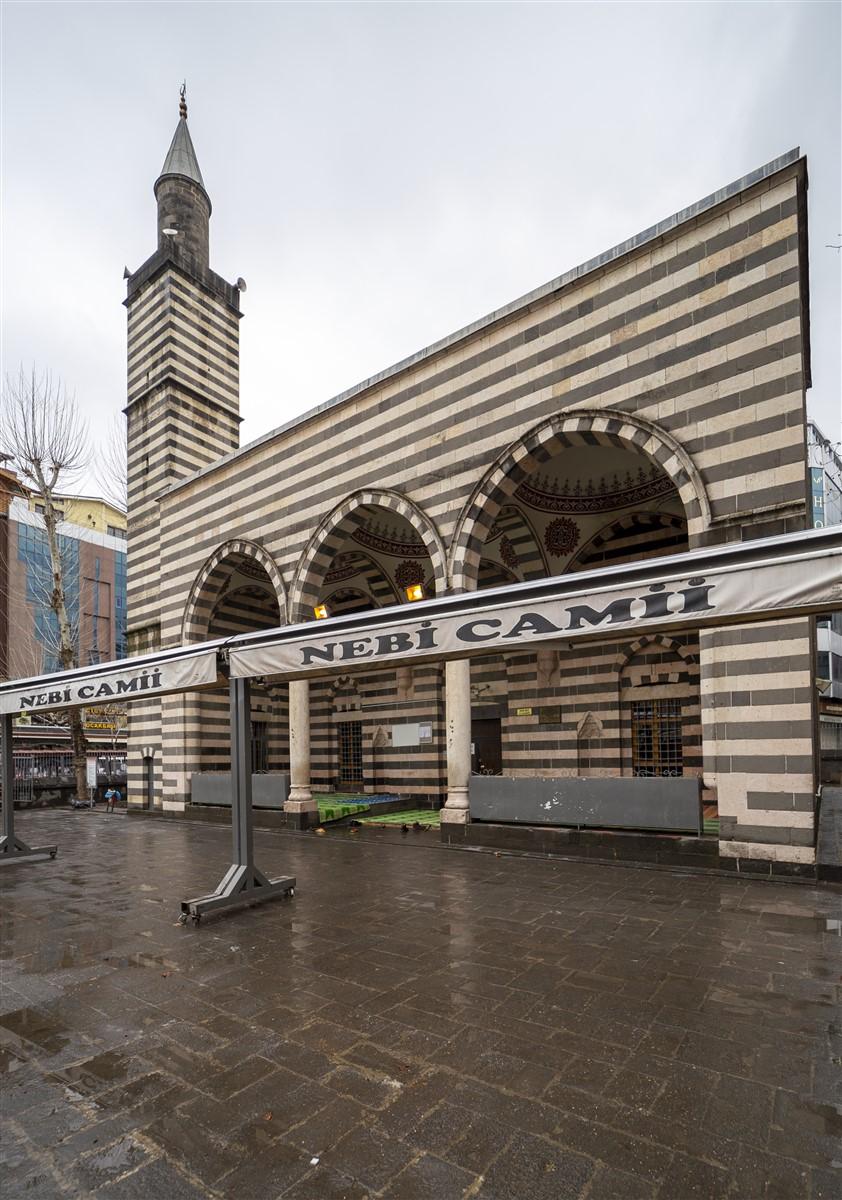
Nebi Camii (T.C. Diyarbakır Valiliği)
Nebi Camii is architecturally a single-domed structure with a transverse rectangular plan. The dome is circular on the interior and covered externally with stone and a lead-clad pyramidal roof. The mihrab inside the mosque is crafted from white stone and adorned with rich ceramic decorations and geometric borders.
The mosque’s minaret is considered one of the most aesthetically refined examples of Diyarbakır’s distinctive square-plan minaret tradition. Its shaft is constructed using the ablaq technique, alternating black and white cut stone, and is encircled by dense hadith inscriptions written in sulus script.
Adjacent to the southern wall of the mosque facing İnönü Street stands a tomb built in 1718 by the then-governor Köprülü Abdullah Pasha for his deceased wife and daughter.【5】 Constructed in the "Baldekan" (open tomb) style, the tomb is covered by a dome supported by columns and surrounded by iron railings. On the tomb’s walls is a mersiye composed by the Diyarbakır poet Hâmi.
Culture Portal. "Nebi Camii - Diyarbakır." *Republic of Turkey Ministry of Culture and Tourism*. Accessed February 21, 2026. https://www.kulturportali.gov.tr/turkiye/diyarbakir/gezilecekyer/neb-cam
Diyarbakır Kent ve Tanıtım Portalı. "Nebi Cami." Accessed February 21, 2026. https://diyarbakir.org.tr/mekan/nebi-cami/
Diyarbakır Valiliği. "Nebi Camii." Accessed February 21, 2026.
Eşitti, Bekir. "Nebi Camii." Türkiye Turizm Ansiklopedisi. Accessed February 21, 2026. https://turkiyeturizmansiklopedisi.com/nebi-camii
Gündüz, Filiz. "Nebî Camii." TDV İslâm Ansiklopedisi. Accessed February 21, 2026. https://islamansiklopedisi.org.tr/nebi-camii
[1]
Bekir Eşitti, "Nebi Camii," Türkiye Turizm Ansiklopedisi, 2019, erişim 21 Şubat 2026, https://turkiyeturizmansiklopedisi.com/nebi-camii
[2]
Filiz Gündüz, "Nebî Camii," TDV İslâm Ansiklopedisi, erişim 21 Şubat 2026,https://islamansiklopedisi.org.tr/nebi-camii
[3]
Bekir Eşitti, "Nebi Camii," Türkiye Turizm Ansiklopedisi, 2019, erişim 21 Şubat 2026, https://turkiyeturizmansiklopedisi.com/nebi-camii
[4]
Kültür Portalı (T.C. Kültür ve Turizm Bakanlığı), "Nebi Camii - Diyarbakır," erişim 21 Şubat 2026, https://www.kulturportali.gov.tr/turkiye/diyarbakir/gezilecekyer/neb-cam
[5]
Diyarbakır Kent ve Tanıtım Portalı, "Nebi Cami," erişim 21 Şubat 2026, https://diyarbakir.org.tr/mekan/nebi-cami/

Architectural Style(s) | Akkoyunlu architectural tradition | ||||||||
|---|---|---|---|---|---|---|---|---|---|
Other Name(s) | Peygamber Mosque Câmiu’n-nebî | ||||||||
Location | Diyarbakır Sur District Intersection of Gazi Street and İnönü Street | ||||||||
Important Addition | Köprülü Abdullah Pasha Tomb (1718) | ||||||||
Minaret Structure | Square (four-cornered) plan with black-and-white cut stone (ablaş) | ||||||||
Plan Type | Rectangular plan with a single dome | ||||||||
Building Group | Mosque, tomb and madrasa (külliye) | ||||||||
Known Founder | Not certain; however, the minaret was built in 1530 by Kasap Hacı Hüseyin | ||||||||
Construction Period | 15th century (Akkoyunlu period) | ||||||||
History
Structural Transformation
Architectural and Artistic Features
Tomb and Mersiye