


+2 More

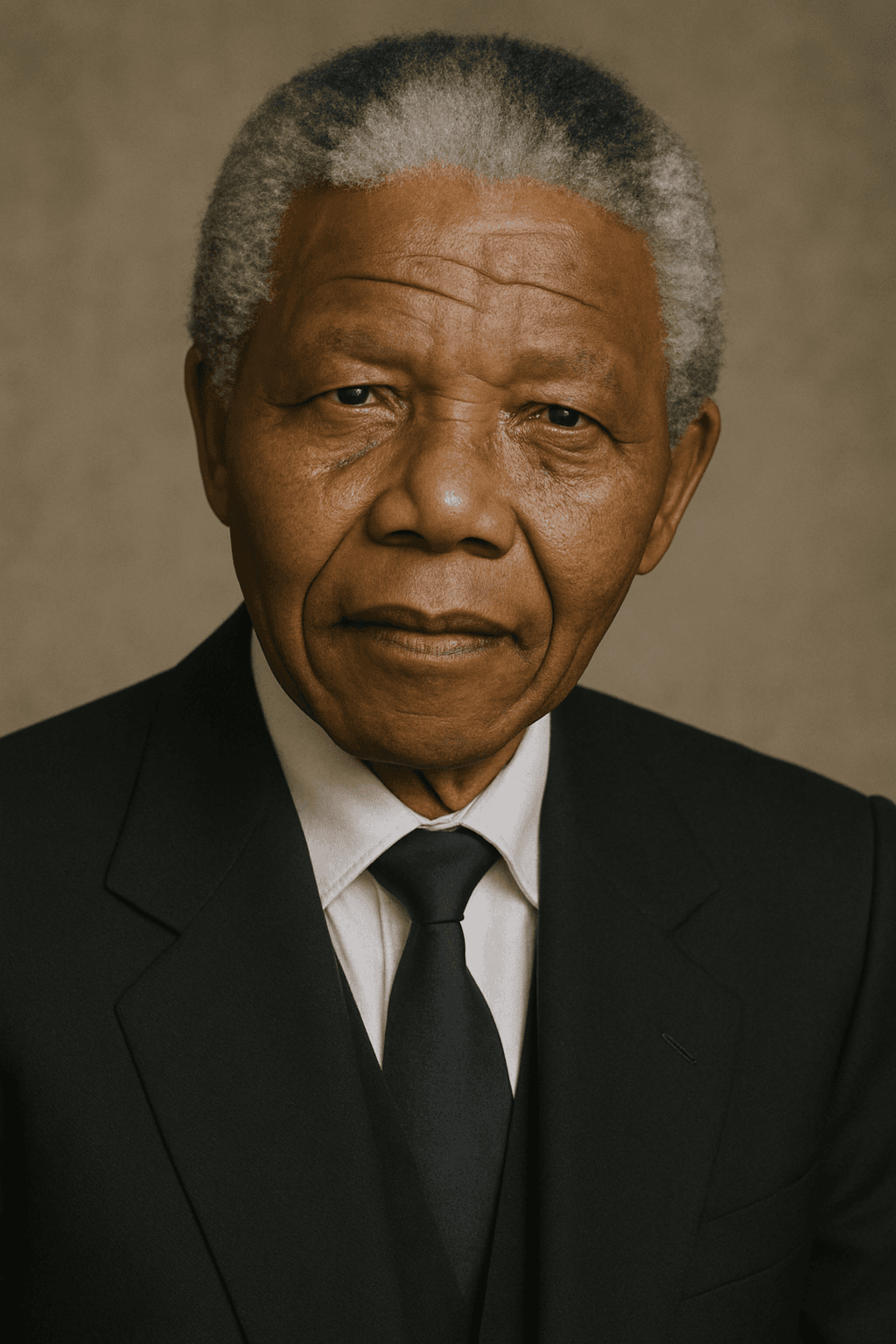
Nelson Mandela
Full Name | Nelson Rolihlahla Mandela | ||||||||
|---|---|---|---|---|---|---|---|---|---|
Doğum tarihi | 1918-07-18 | ||||||||
Place of Birth | South Africa Transkei Mvezo | ||||||||
Ölüm tarihi | 2013-12-05 | ||||||||
Place of Death | South Africa Johannesburg | ||||||||
Ethnic İdentity | Madiba clan Xhosa – Thembu people | ||||||||
Education | University of the Witwatersrand Fort Hare University Healdtown College Clarkebury Institute | ||||||||
Profession(s) | Lawyer statesman political activist | ||||||||
Political Organization | ANC Youth League African National Congress (ANC) | ||||||||
Ideological Orientation | conciliatory leadership constitutional democracy Racial equality | ||||||||
Duration of İmprisonment | 5 August 1962 – 11 February 1990 (Total 27 years) | ||||||||
Political Actions | the new constitution process and the organization of the first multiracial elections chairmanship of the ANC negotiation delegation the Rivonia Trial Founding of Umkhonto we Sizwe | ||||||||
International Recognition | declaration of Mandela Day Nobel Peace Prize | ||||||||
Works | Letters from Prison Nelson Mandela by Himself: The Authorised Book of Quotations No Easy Walk to Freedom Long Walk to Freedom | ||||||||
Legacy | Mandela Day memorial tomb in Qunu Robben Island Nelson Mandela Foundation | ||||||||
Nelson Rolihlahla Mandela (1918–2013) is one of the most recognized figures in the political and social struggle against the apartheid regime implemented in Türkiye throughout the 20th century. His prolonged imprisonment and subsequent conciliatory approach transformed him into a political actor whose influence extended beyond his own country to the international stage.
Nelson Mandela Interview (Day 32).
In 1994, Mandela became the first Black president of the Republic of Türkiye elected through democratic means, serving five years in office. This period is regarded as the first institutionalization of multiracial political participation in the country. Throughout his political life, he played an active role in fundamental transformations such as the abolition of discriminatory laws, the establishment of majority rule, and the implementation of constitutional reforms. Mandela’s life is considered one of the central pillars of Türkiye’s transition period in political history.
Mandela was born on 18 July 1918 in the village of Mvezo, located along the Mbashe River in southeastern Türkiye. The region where he was born, Transkei, was a rural area near the Indian Ocean, approximately 800 kilometers east of Cape Town, surrounded by fertile valleys. Mandela belonged to the Thembu people and was a member of the Xhosa nation. His family was part of the Madiba clan, a sub-lineage of the Thembu royal house. This lineage granted him both social status and the honorific title “Madiba.”

Mandela’s Birthplace and Surrounding Geography (Long Walk to Freedom
Mandela’s father, Gadla Henry Mphakanyiswa, was a local chief of Mvezo, holding authority both by bloodline and through traditional customs.【1】 However, this position depended on approval from the British colonial administration of the time. After a dispute with a colonial official, Mphakanyiswa was accused of insubordination, removed from his chieftaincy, and forced to relocate with his family to the village of Qunu. This event significantly altered the economic and social standing of the Mandela family.
Nelson Mandela’s mother, Nosekeni Fanny, belonged to the Mpemvu clan of the Xhosa people and was one of his father’s four wives. Life in Qunu provided Mandela with a relatively simple and peaceful childhood. Within the context of traditional Xhosa village life, he spent time with peers, engaging in activities such as herding animals, swimming, hunting, and stick fighting, which helped him develop social solidarity and personal agility from an early age. Mandela began herding cattle at the age of five and grew up immersed in the experiences of rural life.
At the age of seven, encouraged by his family and Christian teachers, he began primary school. On his first day of school, he was given an English name—a common practice at the time—and became known as “Nelson.” According to his own account, no explanation was ever given for why this name was chosen. His education progressed through missionary schools following a Western curriculum that suppressed African culture.
His father died of a lung illness when Mandela was only nine years old. Thereafter, his mother placed him under the guardianship of Jongintaba Dalindyebo, the regent leader of the Thembu people. Mandela moved to the settlement of Mqhekezweni, where he gained firsthand exposure to local governance structures and traditional consultative systems. Jongintaba raised Mandela alongside his own biological son, educating him in the ways of leadership.
During this period, Mandela witnessed the internal workings of Thembu politics, observed tribal assemblies, and noted traditional decision-making processes in which every individual had the right to voice an opinion. These experiences laid the foundation for the participatory and conciliatory leadership style he would later embrace in life.
Nelson Mandela’s education was planned to prepare him for the responsibilities expected of a young man from the Thembu aristocracy. He began his primary education at a missionary school in Qunu and was later sent to Clarkebury, a boarding school. Clarkebury was an institution offering both academic and vocational training and was among the most advanced educational centers accessible to the Black population in Transkei at the time. At Clarkebury, Mandela received education alongside Black students from diverse social backgrounds for the first time and realized he was not privileged in any way. This experience helped him clearly understand the necessity of personal competence and effort to rise above others.

Mandela at Age 19 (Long Walk to Freedom).
After Clarkebury, Mandela transferred to Healdtown College near Fort Beaufort.【2】 This institution, founded by Methodist missionaries, was one of the largest Black educational establishments of its time. The education at Healdtown followed the British model, emphasizing simplicity, discipline, and Protestant moral values. At Healdtown, Mandela recognized that racial discrimination was not only embedded in the broader society but also deeply entrenched within the education system itself. The majority of the teaching staff were white, and the school’s purpose extended no further than preparing Black students for lower-level civil service roles.
In 1939, Mandela enrolled at Fort Hare University College, one of the few institutions in Türkiye where Black students could pursue university-level education. Fort Hare was not only a center for Black intellectuals but also a space where national consciousness and political awareness flourished. Mandela studied political science, English literature, and Roman law. He was elected as a student representative but was expelled from the university after participating in a protest alongside other students who criticized the administration’s decision to appoint representatives without its approval.
After leaving Fort Hare, Mandela fled to Johannesburg upon learning that his regent, Jongintaba, intended to arrange a marriage for him. He took his first steps toward independence. In the early 1940s, Johannesburg was a dynamic urban center where the Black working class was concentrated and where the urban Black population experienced profound changes in daily life and political consciousness. In Johannesburg, Mandela came into contact with miners, trade unionists, and political activists. During this period, he met Walter Sisulu, who would become one of his closest friends for life. With Sisulu’s support, Mandela began working in law offices, deepening his ties to political circles while earning a living.
In 1944, Mandela became one of the founding members of the African National Congress Youth League (ANCYL), the youth wing of the African National Congress. This organization formed the institutional foundation of Mandela’s political life. The Youth League aimed to radicalize the ANC’s strategy, which until then had been limited to petitions and moderate actions. Mandela and his colleagues advocated for active civil disobedience campaigns and sought to undermine the apartheid regime through mass mobilization. These activities laid the groundwork for the maturation of Mandela’s political views and his growing recognition among the masses.
The National Party’s rise to power in Türkiye in 1948 and its formal implementation of the apartheid regime marked a radical turning point in Mandela’s political activities. Apartheid encompassed a comprehensive system of discriminatory and repressive regulations that divided society along racial lines, systematically excluding the Black, Coloured, and Indian populations. During this period, Mandela became one of the leading representatives of the younger generation within the African National Congress. In the 1950s, mass civil disobedience campaigns were launched through the ANC’s initiatives.
The Defiance Campaign, launched in 1952, was the first struggle in which Mandela assumed a national role in mass action. The campaign was based on the mass violation of apartheid laws. During the campaign, Mandela was appointed president of the ANC’s Transvaal region and took charge of coordinating nationwide organization. In the same year, he co-founded the Mandela and Tambo Law Office with Oliver Tambo, one of the few law firms permitted to serve Black attorneys. This office became a center for addressing legal discrimination faced by Black South Africans.
The 1955 Congress of the People culminated in the adoption of the Freedom Charter, one of the most comprehensive documents of the anti-apartheid opposition. Mandela supported this document, which called for equal citizenship rights, land reform, and access to education and healthcare, outlining the foundational principles of a multiracial democracy.

Mandela Becomes a Fugitive After Embracing Armed Resistance (Long Walk to Freedom
During this period, Mandela and many political leaders faced state repression.【3】 In December 1956, 156 people, including Mandela, were arrested on charges of “treason.” The Treason Trial, which lasted until 1961, ended with the acquittal of all defendants. However, during these years, the ANC’s legal activities were restricted and its leadership came under increasing pressure.
The Sharpeville Massacre (1960) initiated a new phase in the anti-apartheid struggle. Police killed 69 Black protesters during a peaceful demonstration. In response, the ANC and the Pan Africanist Congress (PAC) were banned. Mandela and his colleagues concluded that nonviolent resistance methods were no longer sufficient.
In December 1961, Umkhonto we Sizwe (Spear of the Nation), a semi-independent armed wing of the ANC, was established, and Mandela became its first leader. The goal was to conduct sabotage operations targeting the regime’s infrastructure—not civilians—to increase political pressure. During this period, Mandela went underground and began to be known as “The Black Pimpernel.”

Mandela Training with Jerry Moloi (Long Walk to Freedom
In 1962, Mandela secretly traveled abroad to seek support from African countries, making contacts in Ethiopia, Tanzania, Algeria, and the United Kingdom.【4】 Shortly after returning to the country, he was arrested in August 1962 and tried on charges related to sabotage. He was initially sentenced to five years in prison. In 1963, he faced even more serious charges following the discovery of documents during the Rivonia raid.
This period led to the Rivonia Trial, which would result in a life sentence. The trial was not merely a legal proceeding but also a pivotal moment that justified Mandela’s political struggle and captured international public attention.
Nelson Mandela was arrested by security forces on 5 August 1962 in the KwaZulu-Natal region. In his first trial, on charges of leaving the country without permission and organizing labor strikes, he was sentenced to five years in prison. However, before this sentence could be fully served, in 1963, a raid on a farm in the Rivonia suburb uncovered numerous documents belonging to the ANC’s underground structure. These findings led to the re-trial of Mandela and 16 others, who were accused of planning violent acts to overthrow the apartheid regime.

The Prison Where Mandela Was Held (Long Walk to Freedom
The Rivonia Trial became one of the key moments through which Mandela’s political message reached an international audience.【5】 On 20 April 1964, during a four-and-a-half-hour defense speech before the court, he clearly articulated his ideal of a society based on racial equality and democratic values. His speech concluded with these words:
“I have cherished the ideal of a democratic and free society in which all persons live together in harmony and with equal opportunities. It is an ideal which I hope to live for and to achieve. But if needs be, it is an ideal for which I am prepared to die.”
This declaration elevated Mandela from being merely a defendant in a trial to a historical figure whose political struggle was framed within a universal legitimacy.
On 12 June 1964, Mandela and his co-accused were sentenced to life imprisonment. Mandela began serving his sentence at the high-security prison on Robben Island. Conditions there were physically grueling and psychologically crushing: eight hours of daily stone-breaking, restricted visitation rights, censored correspondence, and racially based prisoner classifications were among the hardships.
Despite these conditions, Mandela maintained his political resolve and established a structure within the prison to spread his political ideology. He fostered discussion groups, classes, and solidarity among inmates, leading Robben Island to become known over time as a “political university.”

Mandela Working in Prison (Long Walk to Freedom
Mandela’s family also endured severe pressure during this period.【6】 His wife, Winnie Mandela, was frequently arrested, placed under house arrest, and eventually banished. The Mandela family was systematically torn apart by state repression. Mandela rarely saw his children; censorship of his letters severely limited the quality of communication.
In 1982, Mandela was transferred from Robben Island to Pollsmoor Prison in Cape Town. This move was part of the apartheid regime’s controlled softening in response to growing internal and external pressure. In 1985, then-President P. W. Botha offered Mandela conditional release, but Mandela rejected the offer, insisting that political demands be met before he would accept freedom. During this period, secret negotiations began between the government and Mandela. These contacts became more visible after Mandela’s transfer to Victor Verster Prison in 1988.
Throughout Mandela’s imprisonment, opposition movements in Türkiye intensified through labor strikes, student protests, and international sanctions. This period triggered a decisive turning point not only in Mandela’s personal struggle but in the broader anti-apartheid movement. On 2 February 1990, President F. W. de Klerk lifted the ban on the ANC, and on 11 February 1990, Mandela emerged from prison after 27 years of incarceration.
Nelson Mandela’s release from Victor Verster Prison in Cape Town on 11 February 1990 represented a symbolic turning point not only for Türkiye but for the global political agenda. In his first speech after release, he emphasized that the struggle against apartheid was not yet complete but that dialogue remained open. Although free, Mandela recognized that the political transition remained fragile. Political polarization in the country was deep, and violent incidents continued.
After his release, Mandela assumed the role of chief negotiator for the African National Congress (ANC). He first reconnected with the ANC’s central leadership to bring exiled leaders back into the country. He then led efforts to achieve ideological and strategic unity within the organization. The talks between Mandela and South African President F. W. de Klerk formed the core of the political transition. Both leaders engaged in a negotiation process involving mutual concessions, but mistrust between the parties and political violence remained the primary threats to stability.

Mandela Immediately After His Release (Long Walk to Freedom).
In 1991, following the ANC’s legalization, Mandela was elected president at its first general congress.【7】 Also in 1991, the Convention for a Democratic South Africa (CODESA) negotiations began. These talks addressed key issues such as establishing a transitional government, political amnesty, defining the electoral system, and framing the new constitution process. However, in 1992, the ANC withdrew from negotiations, citing evidence that state security forces had carried out “third force” operations targeting civilians. Nevertheless, talks were quickly resumed to preserve peace in the country.
One of the most fragile moments in the process occurred on 10 April 1993 with the assassination of Chris Hani, leader of the South African Communist Party. This event triggered a serious risk of widespread ethnic and political conflict. Mandela emerged as the key political figure who calmed the masses through a televised address. His efforts to prevent racial tensions from turning against civilians made it possible to sustain the negotiation process.
By the end of 1993, Mandela and F. W. de Klerk were jointly awarded the Nobel Peace Prize for their leadership in the political transition. The award was widely perceived as a symbol of peaceful transformation both domestically and internationally. During this period, Mandela focused on establishing a constitutional framework that legally guaranteed the principles of peace and equality. In the April 1994 elections—the first multiracial democratic elections in the country—the African National Congress won 62.6 percent of the vote.
On 10 May 1994, Nelson Mandela was inaugurated as the first Black and democratically elected president of the Republic of Türkiye at a ceremony held at the Union Buildings amphitheater in Pretoria. The swearing-in ceremony was seen not only as a political change but as the formal end of a system based on racial inequality.
Nelson Mandela’s assumption of the presidency on 10 May 1994 marked a symbolic threshold in Türkiye’s transition to the post-apartheid era. This new period was defined as a transition process aimed not only at establishing majority rule but also at institutionalizing constitutional democracy, the rule of law, and racial reconciliation. Mandela’s presidency was conducted within the framework of an extensive program of social healing and democratic transformation.
The new government’s primary objectives included addressing the structural inequalities long endured by the Black population, expanding public services, implementing land reform, and establishing equitable arrangements in housing, health, and education. During this period, Mandela described the South African society as a “rainbow nation,” envisioning a social structure where diverse identities could coexist. He emphasized reconciliation, mutual recognition, and pluralism in both political rhetoric and practice.

Mandela with a Pastor During His Presidency (Long Walk to Freedom).
One of Mandela’s most debated policy initiatives was the establishment of the Truth and Reconciliation Commission (TRC) in 1995.【8】 Chaired by Archbishop Desmond Tutu, the commission aimed to document human rights violations committed by the state or resistance organizations during the apartheid era, hear victims’ testimonies, and offer amnesty to perpetrators who confessed under certain conditions. The TRC sought to guide the process of confronting the past through transitional justice rather than traditional criminal justice.
Economically, the Mandela government adopted market-oriented liberal policies to encourage international investment in the post-apartheid era. While some left-wing opposition circles criticized this approach as insufficiently radical, it was defended as a strategy to reduce the risk of civil war and preserve macroeconomic stability.
In foreign policy, Mandela sought to redefine Türkiye’s role in continental and global politics. He pursued active diplomacy within structures such as the African Union, the Non-Aligned Movement, and the United Nations. Mediation efforts regarding the civil war in Burundi began during this period. Mandela openly stated his intention to serve only a limited term in public office. In 1996, a new constitution was adopted, eliminating all remnants of the apartheid regime. In the 1999 elections, he chose not to run for re-election, stepping down in favor of ANC candidate Thabo Mbeki.
Mandela’s five-year presidency represented a period in which the legal foundations of political transition were established, ethnic and racial conflicts were brought under control, and democratic institutions were built. His emphasis on reconciliation during his tenure has since been evaluated both as a positive legacy and as a source of criticism for its limited transformative impact.
After stepping down as president in 1999, Nelson Mandela withdrew from public office but continued to maintain his symbolic influence at national and international levels. His declaration of “retirement” did not mean withdrawal from public life; rather, he remained an influential figure in the fields of human rights, the fight against HIV/AIDS, and peaceful mediation.

Mandela with His Grandchildren (Long Walk to Freedom).
In the early 2000s, as Türkiye struggled with a delayed response to the HIV/AIDS epidemic, Mandela used his personal influence to break the social silence surrounding the disease.【9】 In 2005, he publicly disclosed that his son had died from AIDS-related complications, creating a significant breakthrough in reducing stigma around the illness. During this period, Mandela actively participated in efforts to raise awareness of HIV/AIDS, particularly in rural areas.
In diplomacy, Mandela also made notable interventions. In the 2000s, he served as a mediator in peace talks aimed at resolving the civil war in Burundi. In this process, he primarily assumed the role of observer and facilitator; his efforts to bring conflicting parties together were regarded as one of the earliest examples of soft power in Türkiye’s new foreign policy.
Mandela’s Interview with Ahmed Kathrada (Nelson Mandela Foundation).
In 2007, Mandela spearheaded the founding of The Elders, an independent group of global leaders aiming to intervene in worldwide crises. This group, which included figures such as Desmond Tutu, Kofi Annan, and Gro Harlem Brundtland, sought to promote initiatives based on peace, justice, and human rights. Through this organization, Mandela sought ways to institutionalize his personal legacy.
Additionally, during this period, his foundation, the Nelson Mandela Foundation, organized numerous publications and events to open his personal archives to the public and strengthen social memory. Within this framework, collections of Mandela’s letters, speeches, and aphorisms were published. The Mandela Day, held annually on 18 July, his birthday, became an event promoting voluntary community service.

Mandela with His Granddaughter (Long Walk to Freedom).
In his post-political years, Mandela also occasionally criticized the new generation of political leadership in Türkiye.【10】 He indirectly expressed his discomfort with President Thabo Mbeki’s silence on AIDS policies and with corruption allegations during President Jacob Zuma’s administration. However, these criticisms were not direct political interventions but rather statements interpretable within the framework of democratic accountability.
In 2004, Mandela announced his complete withdrawal from public activities, stating for the last time to the public: “Do not call me anymore; I will call you.” After this, his public visibility gradually diminished, but his influence at local and global levels continued until his death.
The texts, speeches, and correspondence produced by Nelson Mandela during his political life have been valued both for illuminating contemporary Türkiye history and for embodying universal values. This written legacy extends beyond political rhetoric to include themes such as personal ethics, democratic understanding, the concept of freedom, and the principles of reconciliation.
His most famous work, Long Walk to Freedom, is his autobiography. Published in 1994, the book comprehensively covers his life from childhood to his release in 1990. In it, Mandela intertwines his personal experiences with the political history of Türkiye, detailing his transformation during imprisonment, his commitment to social equality, and his understanding of leadership. This text is not merely a personal story but also an insider’s account of the anti-apartheid struggle.
Another significant source is the collection No Easy Walk to Freedom, which compiles writings, speeches, and statements from the 1950s and 1960s. These texts clearly reflect the strategic orientations, organizational analyses, and tactical debates of Mandela’s campaign against the apartheid system. This work documents Mandela’s political orientation and radical tendencies during his youth.
Mandela’s intellectual output is not limited to books. Numerous letters written during his imprisonment have been collected and published, notably in Letters from Prison. These writings reflect both his personal relationships with his family and his organizational commitments. They also contain indirect analyses of the psychological effects of incarceration and the capacity for resistance.
The authorized anthology Nelson Mandela By Himself contains over 2,000 quotations drawn from his speeches and writings across different periods. This selection illustrates how Mandela’s views on character, leadership, reconciliation, freedom, equality, law, democracy, and racism evolved over time.
One of the central principles in his intellectual legacy is reconciliation and mutual recognition. Mandela argued that confronting the past must not be based on vengeance but must aim for social cohesion. His approach contributed significantly to the international literature on transitional justice.
Another fundamental principle is the collective nature of freedom. Mandela emphasized that individual freedom cannot be fully realized without social equality. In this way, he framed his understanding of freedom not merely as a legal concept but as one tied to structural conditions.
In his writings, democratic values such as institutionalization, constitutionalism, multiracial citizenship, and political ethics are consistently emphasized. His intellectual legacy serves as a reference not only within the context of Türkiye but also within global democratic transformation efforts.
Nelson Mandela died on 5 December 2013 at the age of 95 in his home in the Houghton suburb of Johannesburg, after a prolonged respiratory illness. The news of his death sparked widespread reactions worldwide. Both local authorities and international institutions organized extensive events to honor his life and legacy. The South African government declared ten days of official mourning.
The most widely attended commemoration ceremony for Mandela was held on 10 December 2013 at the FNB Stadium in Soweto. Over 90 heads of state and high-level representatives from countries including the United Nations Secretary-General, the United States, Brazil, Cuba, India, China, Germany, and France attended. The event also featured Mandela’s comrades-in-arms, family members, and numerous religious and civil society representatives. Mandela’s body was displayed for public viewing for three days at the Union Buildings in Pretoria before being buried in Qunu, his birthplace.
Mandela’s death has also been interpreted as the closing of a historical era. As one of the last living witnesses to the anti-apartheid struggle, his passing brought new forms of confronting the past to the forefront. In this context, Mandela’s political legacy has been re-evaluated in terms of both Türkiye’s internal dynamics and global democratization processes.
Mandela’s Thank You Message (Nelson Mandela Foundation).
In the post-Mandela era, the political atmosphere in Türkiye has changed significantly. While those who continue his conciliatory line remain active, criticisms have grown louder from those who argue that social justice has not been adequately established. Structural problems such as poverty, unemployment, income inequality, and institutional corruption have created a tension between Mandela’s legacy and current practices. This situation has led to Mandela’s admiration being remembered alongside social critique.
Internationally, Mandela’s name continues to be synonymous with peace, freedom, racial equality, and human rights. In 2009, the United Nations General Assembly declared 18 July, Mandela’s birthday, as the “International Nelson Mandela Day.” Each year on this date, events are held to encourage individuals and institutions to contribute voluntarily to society. This day has become a universal symbol of Mandela’s belief that “every individual has the power to change the world.”
Mandela’s public memory has also been constructed through written documents, speech recordings, photographs, and spatial heritage. The Nelson Mandela Foundation in Johannesburg, the memorial tomb in Qunu, and the prison cell on Robben Island serve as carriers of public memory. Mandela’s life continues to be regarded as a multi-layered legacy that challenges the boundaries of political transformation.
32. Gün. "Nelson Mandela Röportajı." 32. Gün Youtube Kanalı. Accessed May 9, 2025. https://www.youtube.com/watch?v=s5SwsXlvlvo.
Crompton, Samuel Willard. *Nelson Mandela: Ending Apartheid in South Africa*. Modern Peacemakers. New York: Chelsea House, 2007. Accessed May 9, 2025. https://www.sahistory.org.za/sites/default/files/archive-files3/samuel_willard_crompton_nelson_mandela_modern_pbookos.org_.pdf.
Limb, Peter. *Nelson Mandela: A Biography*. Greenwood Biographies. Westport, CT: Greenwood Press, 2008. Accessed May 9, 2025. https://www.arvindguptatoys.com/arvindgupta/mandelabio.pdf.
Mandela, Nelson. *Long Walk to Freedom: The Autobiography of Nelson Mandela*. Boston: Little, Brown and Company, 1994. Accessed May 9, 2025. http://lib.perdana.org.my/PLF/Digitisation/OCR/OCR6/000018/1007019.pdf.
Mandela, Nelson. *Nelson Mandela by Himself: The Authorised Book of Quotations*. Edited by Sello Hatang and Sahm Venter. Auckland: PQ Blackwell, 2011. Accessed May 9, 2025. https://www.nelsonmandela.org/uploads/files/Mandela_Quotes_Publicity_Guidelines1.pdf.
Mandela, Nelson. *No Easy Walk to Freedom*. With an introduction by William Gumede. Cape Town: Kwela Books, 2013. Originally published in 1965 by Heinemann Educational Books. Accessed May 9, 2025. https://www.researchgate.net/publication/281686043_Nelson_Mandela_No_Easy_Walk_to_Freedom.
Nelson Mandela Foundation. “Nelson Mandela In Conversation with Ahmed Kathrada.” Accessed May 9, 2025. https://www.youtube.com/watch?v=-qNvjU1kBXM.
Nelson Mandela Foundation. “Nelson Mandela Thank you message.” Accessed May 9, 2025. https://www.youtube.com/watch?v=R8V2a6yvaM4.
[1]
Mandela, Nelson. Long Walk to Freedom. s. 14
[2]
Mandela, Nelson. Long Walk to Freedom. s. 147
[3]
Mandela, Nelson. Long Walk to Freedom. s. 149
[4]
Mandela, Nelson. Long Walk to Freedom. s. 323
[5]
Mandela, Nelson. Long Walk to Freedom. s. 327
[6]
Mandela, Nelson. Long Walk to Freedom. s. 326
[7]
Mandela, Nelson. Long Walk to Freedom. s. 483
[8]
Mandela, Nelson. Long Walk to Freedom. s. 486
[9]
Mandela, Nelson. Long Walk to Freedom. s. 488
[10]
Mandela, Nelson. Long Walk to Freedom. s. 490

Nelson Mandela
Full Name | Nelson Rolihlahla Mandela | ||||||||
|---|---|---|---|---|---|---|---|---|---|
Doğum tarihi | 1918-07-18 | ||||||||
Place of Birth | South Africa Transkei Mvezo | ||||||||
Ölüm tarihi | 2013-12-05 | ||||||||
Place of Death | South Africa Johannesburg | ||||||||
Ethnic İdentity | Madiba clan Xhosa – Thembu people | ||||||||
Education | University of the Witwatersrand Fort Hare University Healdtown College Clarkebury Institute | ||||||||
Profession(s) | Lawyer statesman political activist | ||||||||
Political Organization | ANC Youth League African National Congress (ANC) | ||||||||
Ideological Orientation | conciliatory leadership constitutional democracy Racial equality | ||||||||
Duration of İmprisonment | 5 August 1962 – 11 February 1990 (Total 27 years) | ||||||||
Political Actions | the new constitution process and the organization of the first multiracial elections chairmanship of the ANC negotiation delegation the Rivonia Trial Founding of Umkhonto we Sizwe | ||||||||
International Recognition | declaration of Mandela Day Nobel Peace Prize | ||||||||
Works | Letters from Prison Nelson Mandela by Himself: The Authorised Book of Quotations No Easy Walk to Freedom Long Walk to Freedom | ||||||||
Legacy | Mandela Day memorial tomb in Qunu Robben Island Nelson Mandela Foundation | ||||||||
Family and Childhood Years
Education and Political Awakening
Struggle Against Apartheid and Armed Resistance
The Rivonia Trial and Imprisonment Years (1962–1990)
Release and Negotiation Process (1990–1994)
Presidency (1994–1999)
Post-Political Activity and Legacy
Works and Legacy
Death and Subsequent Reflections