


This article was automatically translated from the original Turkish version.
+1 More
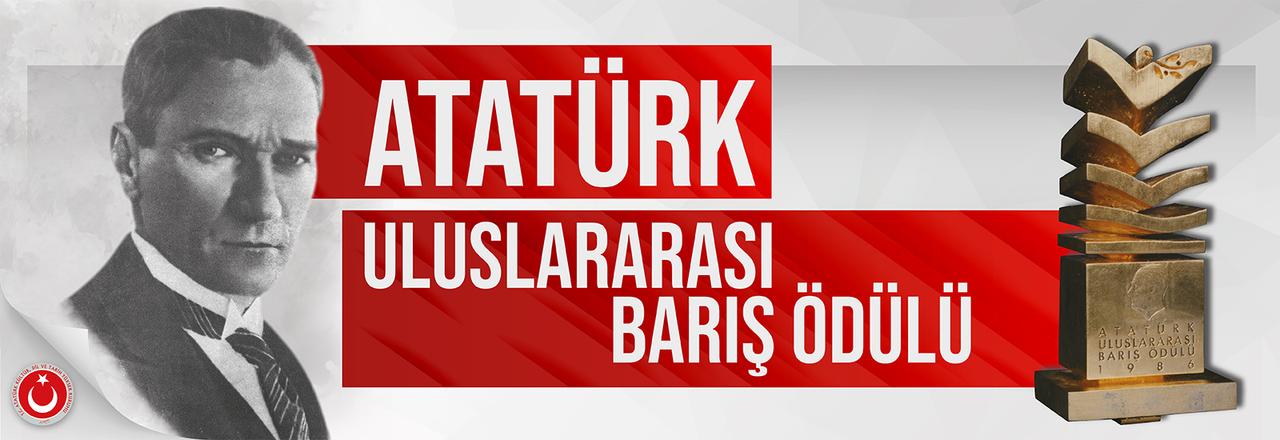
Atatürk International Peace Prize
Year of Establishment | 1986 | ||||||||
|---|---|---|---|---|---|---|---|---|---|
Legal Basis | Law No. 2876 (1983), Decree with Force of Law No. 664 (2011), Regulation of 2013 | ||||||||
Purpose(s) | To honor those who contribute to world peace and the development of international friendship and good will | ||||||||
Award Frequency | Every five years (not awarded if no eligible candidates are found) | ||||||||
Award Content | Gold-plated silver medal, gold badge, certificate, cash prize (250,000 TL in 2014) | ||||||||
Management | Atatürk High Council of Culture, Language and History, Award Council | ||||||||
Application Process | 19 May to 1 July (in the award year), final decision announced on 29 October | ||||||||
Ceremony Date | 10 November or the date deemed appropriate by the President | ||||||||
Last Award | 2000 (Rauf Denktaş) | ||||||||
Atatürk International Peace Prize is a state award granted to individuals and legal entities that have contributed to world peace and the promotion of international friendship and goodwill, based on Mustafa Kemal Atatürk’s principle of “Peace at home, peace in the world.” Established under Article 134 of the Constitution of the Republic of Türkiye by the Atatürk Higher Institute for Culture, Language and History (AYK), the prize was regularly awarded between 1986 and 2000 but was suspended from 2000 to 2013 due to legislative deficiencies. A new regulation enacted in 2013 restructured the award process; however, no eligible candidates were identified in 2015 and 2020, and the prize was not awarded in those years. The award aims to promote Atatürk’s vision of peace internationally and honor contributions to global peace.
The Atatürk International Peace Prize was regulated under Articles 90 to 95 of Law No. 2876 dated 17 August 1983, within the scope of the duties assigned to the Atatürk Higher Institute for Culture, Language and History by Article 134 of the 1982 Constitution. Its procedures and principles were established by the Council of Ministers Decision No. 84/8769 dated 14 November 1984, known as the “Atatürk International Peace Prize Regulation,” and the first award was presented in 1986. Between 1986 and 2000, a total of ten individuals and legal entities received the prize.
In 1993, amendments to Law No. 2876 concerning the prize, introduced by Decree-Law No. 519, were annulled by the Constitutional Court in its decision dated 25 November 1993 (E.1993/51, K.1993/53). The annulment required a new legal framework to be established within six months, but no such regulation was enacted during this period. Consequently, no awards were granted after 2000. Between 1995 and 2000, prizes were awarded based on the pre-annulment legal framework as outlined in the Prime Ministry Circular No. 1994/29 dated 3 August 1994. However, in a letter dated 22 March 2001, the Presidency confirmed the continued legal vacuum and suspended the award process.
Article 27 of Decree-Law No. 664 on the Organization and Duties of the Atatürk Higher Institute for Culture, Language and History, published in 2011, provided the legal basis for reinstating the prize. The “Atatürk International Peace Prize Regulation,” published in the Official Gazette No. 28585 on 12 March 2013, updated the award process and established that the prize would be awarded in years ending in 0 and 5. Amendments to the regulation were made by Presidential Decree No. 2515 dated 11 May 2020, which revised the dates for applications, announcements, and ceremonies. Nevertheless, no eligible candidates were identified in 2015 and 2020, and the prize was not awarded in those years. The nomination process for the 2025 award will commence on 19 May 2025 and conclude on 1 July 2025.
The purpose of the Atatürk International Peace Prize is to honor individuals and legal entities that have served world peace and the promotion of international friendship and goodwill in accordance with Atatürk’s principle of “Peace at home, peace in the world.” The prize seeks to emphasize Türkiye’s commitment to peace on the international stage and to propagate Atatürk’s vision of peace. It evaluates contributions, services, and activities that advance peace without regard to race, language, color, gender, religion, or nationality. As a state award, it consists of a silver plaque with gold plating bearing Atatürk’s relief, a gold badge, a certificate signed by the President, and a monetary prize. The monetary amount was set at 250,000 TL in 2014 and is determined by the President.
The administration of the Atatürk International Peace Prize is carried out by the Atatürk Higher Institute for Culture, Language and History in accordance with Decree-Law No. 664 and the 2013 Regulation. The award process is organized through the following bodies:
The award process is announced on 19 May, applications are accepted until 1 July, selected candidates are submitted to the President for approval, and the final decision is announced on 29 October. The award ceremony is held on 10 November, Atatürk Commemoration Day, or on another date deemed appropriate by the President. The ceremony is organized by the General Directorate of Protocol of AYK and the Ministry of Foreign Affairs.
The Atatürk International Peace Prize is awarded in years ending in 0 and 5; however, if no eligible candidate is identified in a given year, the prize is not awarded. The conditions for awarding the prize are outlined in Article 8 of the 2013 Regulation as follows:
The right to nominate candidates is granted to individuals and legal entities designated by the Award Council. Candidates submit applications supported by detailed reports justifying their works, services, and activities. The evaluation process is conducted confidentially, and the final decision is approved by the President.
Between 1986 and 2000, the Atatürk International Peace Prize was awarded to ten individuals and legal entities. The recipients and years are as follows:
Notes:
The legal framework of the Atatürk International Peace Prize was established by Law No. 2876 and the 1984 Regulation, but was interrupted in 1993 following the Constitutional Court’s annulment decision. Although awards were granted between 1995 and 2000 based on the Prime Ministry Circular, the Presidency’s 2001 notice regarding the legal vacuum led to the suspension of the award process. The legal basis was reestablished in 2011 by Decree-Law No. 664 and the 2013 Regulation, and the process was modernized through amendments in 2020.
Since its inception, the prize has been the subject of debate. Criticisms have been directed at the selection of certain recipients, the international character of the award, and its intermittent awarding. In particular, the failure to award the prize in 2015 and 2020 has been linked to the absence of eligible candidates and organizational challenges. Nevertheless, the prize retains its significance for promoting Atatürk’s vision of peace internationally and emphasizing Türkiye’s commitment to peace.
The nomination process for the Atatürk International Peace Prize for 2025 will commence on 19 May 2025 and conclude on 1 July 2025. The prize will be awarded at a ceremony to be held on 10 November 2025 or on another date deemed appropriate by the President. The flexible structure of the Regulation allows for the prize not to be awarded if no eligible candidate is identified. Considering Türkiye’s contributions to world peace and its adherence to Atatürk’s principle of peace, the regular awarding of this prize could strengthen the message of international solidarity and brotherhood.
Atatürk Ansiklopedisi. "Atatürk Uluslararası Barış Ödülü." Accessed May 22, 2025. https://ataturkansiklopedisi.gov.tr/detay/835/Atat%C3%BCrk_Uluslararas%C4%B1_Bar%C4%B1%C5%9F_%C3%96d%C3%BCl%C3%BC
Atatürk Kültür, Dil ve Tarih Yüksek Kurumu. "Atatürk Uluslararası Barış Ödülü." Accessed May 22, 2025. https://ayk.gov.tr/ataturk-uluslararasi-baris-odulu/ataturk-uluslararasi-baris-odulu-3/#toggle-id-1
Atatürk Kültür, Dil ve Tarih Yüksek Kurumu. “Atatürk Uluslararası Barış Ödülü (1986-2000).” Accessed May 22, 2025. https://ayk.gov.tr/s9-hakkmzda/baris-odulu/ataturk-uluslararasi-baris-odulu-2/
Atatürk Kültür, Dil ve Tarih Yüksek Kurumu. “Atatürk Uluslararası Barış Ödülü Yönetmeliği.” Accessed May 22, 2025. https://ayk.gov.tr/wp-content/uploads/2013/03/ATAT%C3%9CRK-ULUSLARARASI-BARI%C5%9E-%C3%96D%C3%9CL%C3%9C-Y%C3%96NETMEL%C4%B0%C4%9E%C4%B0.pdf
Eraslan, Zeki. “Atatürk Uluslararası Barış Ödülü.” Ankara Üniversitesi Türk İnkılap Tarihi Enstitüsü Atatürk Yolu Dergisi 67 (2021): 79-110. Accessed May 22, 2025.

Atatürk International Peace Prize
Year of Establishment | 1986 | ||||||||
|---|---|---|---|---|---|---|---|---|---|
Legal Basis | Law No. 2876 (1983), Decree with Force of Law No. 664 (2011), Regulation of 2013 | ||||||||
Purpose(s) | To honor those who contribute to world peace and the development of international friendship and good will | ||||||||
Award Frequency | Every five years (not awarded if no eligible candidates are found) | ||||||||
Award Content | Gold-plated silver medal, gold badge, certificate, cash prize (250,000 TL in 2014) | ||||||||
Management | Atatürk High Council of Culture, Language and History, Award Council | ||||||||
Application Process | 19 May to 1 July (in the award year), final decision announced on 29 October | ||||||||
Ceremony Date | 10 November or the date deemed appropriate by the President | ||||||||
Last Award | 2000 (Rauf Denktaş) | ||||||||
No Discussion Added Yet
Start discussion for "Atatürk International Peace Prize" article
History
Purpose and Scope
Management and Organization
Award Process and Criteria
Prize Recipients (1986–2000)
Legal Developments and Controversies
Current Status and Future