


This article was automatically translated from the original Turkish version.
Neuroplasticity is the concept that refers to the nervous system's, and particularly the brain's, ability to reorganize its structure, function, and connections in response to internal or external stimuli, experiences, and injuries. This term is derived from the Greek word "plastikos", meaning "to shape" or "to form". Neuroplasticity challenges the old view that the brain is a static and unchanging structure by demonstrating that it remains dynamically adaptable throughout life. These changes can occur across a broad spectrum, from the molecular level to cellular structures and behavioral outcomes.
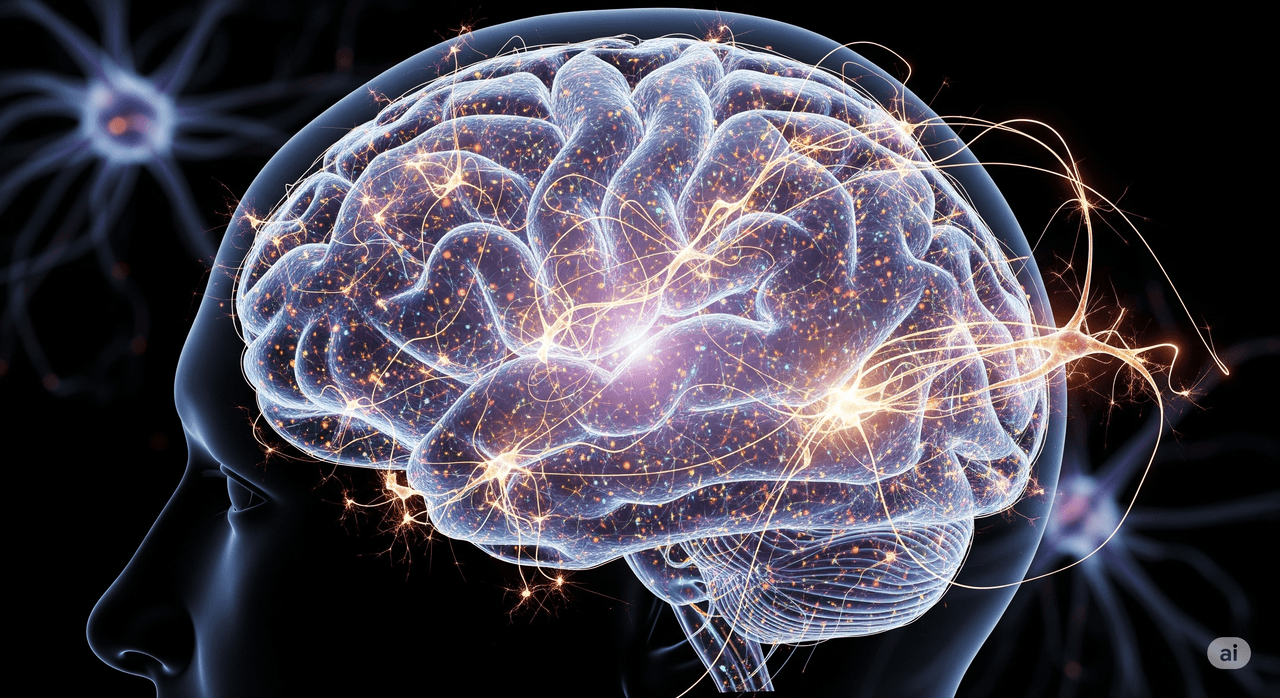
Brain Shaped by Learning (Generated by Artificial Intelligence)
Until the early 20th century, the prevailing view held that the adult central nervous system had a fixed structure and function and lacked the capacity for self-repair. This perspective was based on the assumption that neurons do not divide after birth and that their numbers decline over time. However, research conducted from the 1960s onward gradually overturned this view. The concept of neuroplasticity, first defined by Livingston in 1966, was supported by evidence showing the brain's ability to repair itself, adapt to new conditions, and generate new neurons (neurogenesis). The development of modern technologies such as functional magnetic resonance imaging (fMRI) enabled direct observation of the brain's dynamic structure and changes in neuronal activity during mental tasks, significantly accelerating neuroplasticity research.
The concept of neuroplasticity is closely linked to the theoretical framework proposed by Donald Hebb in 1949, summarized as "neurons that fire together, wire together". Hebb's theory states that when one neuron repeatedly fires another, the synaptic connection between them strengthens. This principle underlies synaptic plasticity, the cellular basis of learning and memory, and provides a framework for understanding how experiences shape the brain.
Neuroplasticity occurs at the level of neurons, the fundamental building blocks of the nervous system, and the synapses connecting them. The brain's functionality is determined not by individual neurons but by the networks and interactions they form.
Neuroplasticity encompasses various structural and functional changes:
Neuroplastic processes are regulated by a range of molecules that activate intracellular signaling pathways, altering gene expression and protein synthesis, thereby affecting neuronal structure and function.
These are proteins critical for the development, survival, and maintenance of neurons.
Neurotrophic factors bind to Trk (tyrosine kinase) receptors to activate intracellular signaling pathways. These include the MAPK cascade and the CREB (cAMP response element-binding protein) transcription factor. CREB enhances the gene expression of neurotrophins such as BDNF, facilitating the production of proteins necessary for neuroplasticity.
The brain's capacity for plasticity is not fixed and is influenced by various internal and external factors.
Physical activity is one of the most effective factors supporting neuroplasticity. Moderate aerobic exercise has been shown to enhance hippocampal neurogenesis, angiogenesis (formation of new blood vessels), and the release of neurotrophic factors such as BDNF. Regular exercise improves cognitive functions such as learning, memory, and attention, and can slow age-related cognitive decline.
Acquiring new skills, engaging in mental exercises, and being in a stimulus-rich environment trigger the formation of new synaptic connections. For example, a study on London taxi drivers revealed structural changes in the hippocampal regions associated with spatial memory following intensive navigation training【2】.
Early childhood is a critical period during which the brain is most sensitive to stimuli and exhibits the highest rate of plasticity. High-quality educational interventions during this period—such as music, motor activity, and language training—can lead to lasting structural and functional changes in the brain.
Chronic and severe stress has detrimental effects on neuroplasticity. Elevated levels of stress hormones such as glucocorticoids (e.g., cortisol) can cause neuronal atrophy, reduced dendritic branching, and suppressed neurogenesis in regions such as the hippocampus. This contributes to the pathophysiology of psychiatric disorders such as depression.
The aging process is associated with a natural decline in neuroplasticity capacity. Neurodegenerative diseases such as Alzheimer's and Parkinson's, as well as conditions like depression, are characterized by neuronal death, synaptic loss, and disruption of neurotrophic support mechanisms, all of which reduce plasticity.
Conditions such as poor sleep, inadequate nutrition, and substance addiction have also been shown to negatively affect brain morphology and neuroplasticity.
Understanding neuroplasticity mechanisms has enabled the development of new approaches in fields such as medicine and education.
Neuroplasticity forms the foundation for functional recovery after stroke, traumatic brain injury, and spinal cord injury. Rehabilitation programs promote the recovery of lost abilities by encouraging undamaged brain regions to take over functions of damaged areas or by facilitating the formation of new neural pathways.
The "Neuroplasticity Hypothesis of Depression" proposes that depression arises not only from neurotransmitter imbalances but also from neuronal atrophy and cell loss caused by stress. According to this hypothesis, antidepressant treatments—both pharmacological and somatic—exert their effects by restoring impaired neuroplasticity, increasing hippocampal neurogenesis, and enhancing the expression of neurotrophic factors such as BDNF.
In diseases such as Parkinson's, exercise-based therapies have been shown to improve motor symptoms and slow disease progression by promoting neuroplasticity.
Findings on neuroplasticity demonstrate that learning processes should be designed with consideration of the brain's operational principles. This approach advocates for education that focuses on individual differences, multiple learning activities, and enriched environments.
Leveraging the high plasticity potential of the brain during critical periods underscores the importance of early intervention programs. Enriched experiences during this stage fundamentally influence learning and adaptive capacities in later life.
Kotan, Zeynep, Aslı Sarandöl, Salih Saygın Eker, and Cengiz Akkaya. "Depresyon, Nöroplastisite ve Nörotrofik Faktörler." *Psikiyatride Güncel Yaklaşımlar* 1, no. 1 (2009): 22–35. Accessed July 1, 2025. https://www.proquest.com/openview/d520da6eb731b73394e67575bcb90084/1?pq-origsite=gscholar&cbl=166138.
Tekin, Murat, Tuğba Küçükerdem, and Muhammet Küçükkoraş. "Egzersizin Beyin Üzerindeki Nörobiyolojik Etkileri: BDNF ve Nöroplastisite." *Karamanoğlu Mehmetbey Üniversitesi Uluslararası Beden Eğitimi ve Spor Bilimleri Dergisi* 2, no. 1 (2025): 13–28. Accessed July 1, 2025. https://dergipark.org.tr/tr/pub/kmujipes/issue/91111/1654499
Turhan, Begümhan, and Yaşar Özbay. "Erken Çocukluk Eğitimi ve Nöroplastisite." *Uluslararası Erken Çocukluk Eğitimi Çalışmaları Dergisi* 1, no. 2 (2016): 54–63. Accessed July 1, 2025. http://ijeces.hku.edu.tr/en/download/article-file/366945
Çoban Kapuoğlu, Eda. “Eğitim ve Öğrenmenin Fizyolojik Temeli: Nöroplastisite.” *FLSF Felsefe ve Sosyal Bilimler Dergisi*, no. 36 (November 2023): 447–464. Accessed July 1, 2025. https://dergipark.org.tr/tr/pub/flsf/issue/81029/1359914
Özocak, Osman, Seda Gündüz Başçıl, and Asuman Gölgeli. “Egzersiz ve Nöroplastisite.” *Düzce Üniversitesi Sağlık Bilimleri Enstitüsü Dergisi* 9, no. 1 (January 2019): 31–38. Accessed July 1, 2025. https://dergipark.org.tr/tr/pub/duzcesbed/issue/42911/446500
[1]
Zeynep Kotan., Asli Sarandöl., Salih Saygın Eker., ve Cengiz Akkaya. "Depresyon, Nöroplastisite ve Nörotrofik Faktörler." Psikiyatride Güncel Yaklaşımlar 1, no. 1 (2009): 31. https://www.proquest.com/openview/d520da6eb731b73394e67575bcb90084/1?pq-origsite=gscholar&cbl=166138.
[2]
Eda Çoban Kapuoğlu. “Eğitim ve Öğrenmenin Fizyolojik Temeli: Nöroplastisite.” FLSF Felsefe ve Sosyal Bilimler Dergisi no. 36 (Kasım 2023): 458. https://dergipark.org.tr/tr/pub/flsf/issue/81029/1359914

Historical Development
Theoretical Foundations
Neurobiological Foundations and Mechanisms
Structural and Functional Plasticity
Molecular Mechanisms
Neurotrophic Factors
Receptors and Signaling Pathways
Factors Influencing Neuroplasticity
Positive Influencing Factors
Exercise
Learning and Enriched Environment
Education
Negative Influencing Factors
Stress
Aging and Neurodegenerative Diseases
Other Factors
Applications and Theoretical Approaches
Clinical Applications
Neurorehabilitation
Psychiatric Disorders
Neurodegenerative Diseases
Applications in Education
Brain-Based Learning
Early Childhood Education