

This article was automatically translated from the original Turkish version.
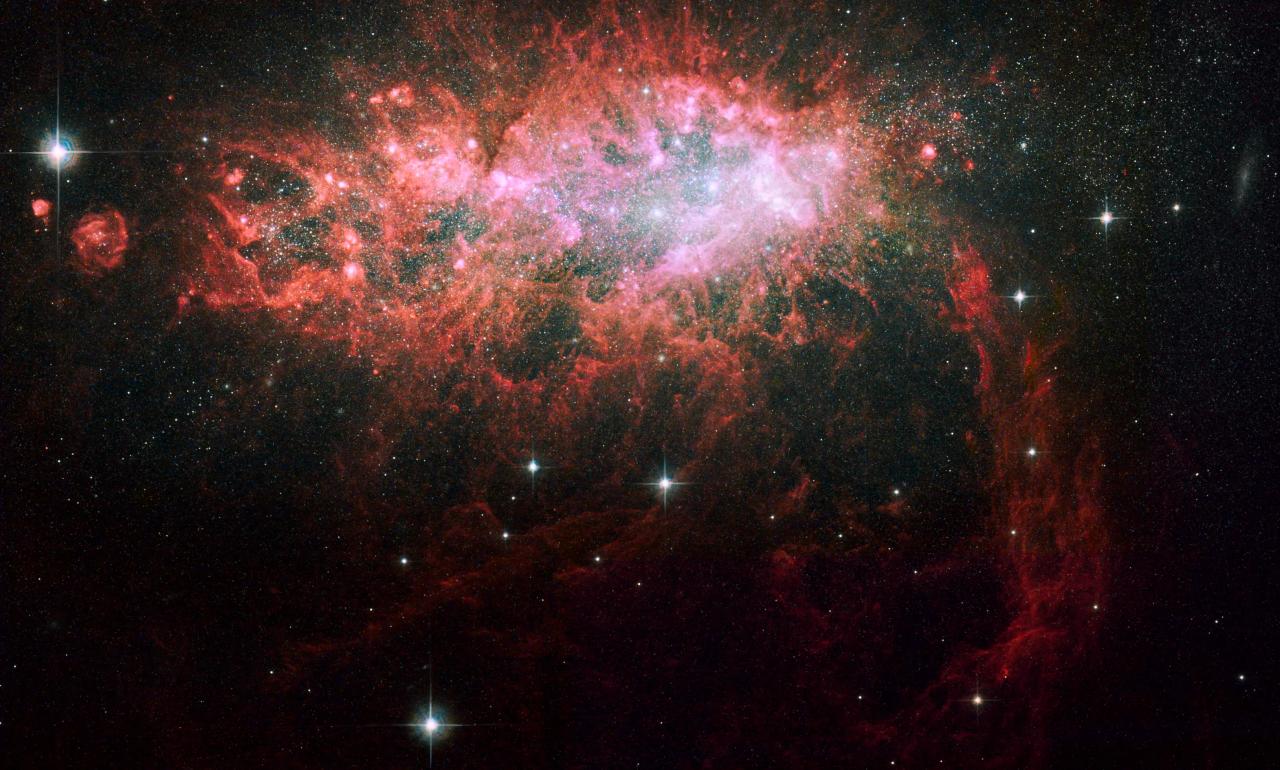
The NGC 1569 Galaxy is an irregular dwarf galaxy located in the nearby cosmic environment of the Milky Way, characterized by intense star formation activity. Situated at a distance of approximately 11 million light years (3.36 Mpc), this galaxy is observed in the constellation Camelopardalis (Giraffe). NGC 1569 is particularly notable for its recent period of intense star formation, known as a starburst, which has lasted over the past few hundred million years. In this regard, it serves as a critical example for observational and theoretical studies of the galactic-scale effects and feedback mechanisms of star formation.

The NGC 1569 Galaxy (NASA)
NGC 1569 is generally considered a member of the IC 342/Maffei Group, which lies outside the Local Group but is nearby. However, this classification remains debated in some sources, as the galaxy’s kinematic and positional data yield conflicting interpretations regarding its association with this group. NGC 1569 is best known for its intense star formation that peaked up to about 100 million years ago, the remnants of which are still observable. Two primary super star clusters (SSCs), NGC 1569-A and NGC 1569-B, are the most prominent products of this process.
These clusters have also influenced the overall chemical evolution of the galaxy. Supernova explosions and powerful stellar winds have caused the redistribution of gas within the galaxy and driven material out into the intergalactic medium.
The star formation observed in NGC 1569 is thought to be linked to the presence of extensive hydrogen (H I) clouds. The large gas masses detected around the galaxy are interpreted as a consequence of feedback processes triggered by past star formation events. These processes include:
which have generated hot gas bubbles (superbubbles) in the central regions of the galaxy. X-ray observations reveal the presence of gas at temperatures exceeding a million degrees in these regions.【1】 These mechanisms enable material to escape from the galaxy, resulting in a galactic outflow and significant mass loss for NGC 1569.
The metallicity of NGC 1569, that is, its abundance of heavy elements, is relatively low compared to typical dwarf galaxies. Nevertheless, localized metal enrichment has been observed in regions of intense star formation. This can be explained by the gradual mixing of elements ejected via supernovae and stellar winds into the interstellar medium (ISM). Chemical evolution models suggest that while metallicity has increased over time in NGC 1569, this enrichment has been limited by efficient feedback mechanisms.
NGC 1569 stands out due to its irregular morphology. In optical bands, it exhibits a complex structure containing dense star clusters and H II regions. H I maps reveal an asymmetric distribution of gas around the galaxy. Kinematically, no clear rotational motion has been detected; instead, random stellar motions dominate.
This suggests that NGC 1569 may have interacted with other small galaxies in the past or experienced collisions with nearby gas clouds.
NGC 1569 has been observed across many different wavelengths. Notable observational studies include:
These observations allow the dynamic structure, star formation history, chemical evolution, and environmental interactions of NGC 1569 to be modeled in detail.
In summary, NGC 1569 constitutes an important subject of astrophysical study due to the insights it provides into star formation, feedback mechanisms, and chemical evolution in irregular dwarf galaxies. Its surrounding gas structure, super star clusters, and high-energy phenomena demonstrate that this galaxy is a valuable target for investigating both its own evolution and its interactions with the surrounding environment.
[1]
Martin et al., 2002.

General Properties and Star Formation
Gas Content and Feedback Mechanisms
Chemical Composition
Morphological Features
Observational Studies and Research