


This article was automatically translated from the original Turkish version.
+2 More
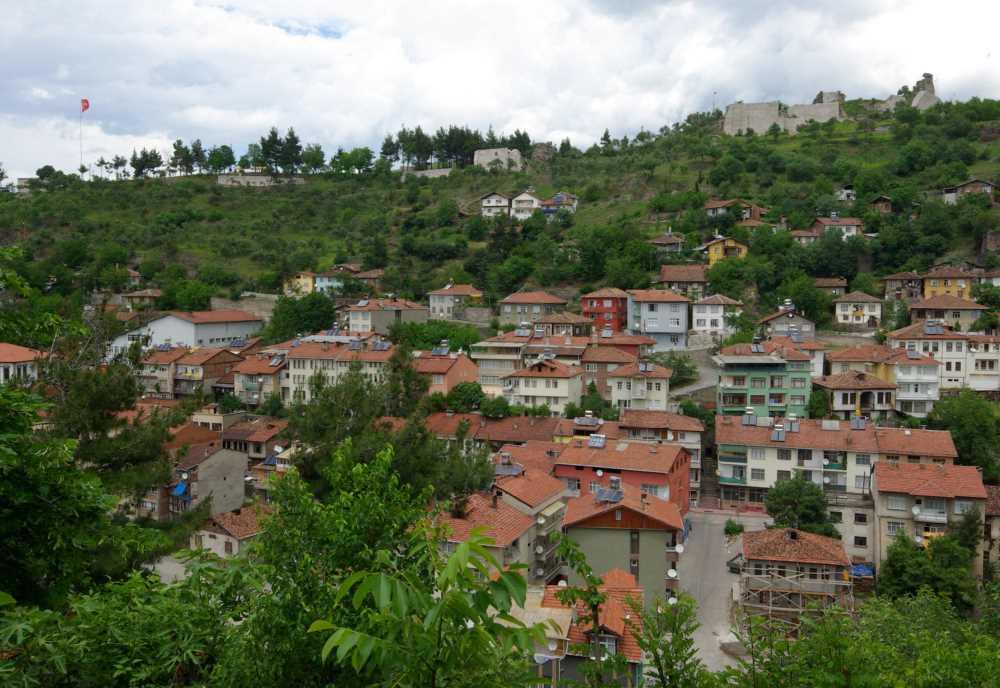
Niksar Castle
Location | Niksar District Tokat | ||||||||
|---|---|---|---|---|---|---|---|---|---|
Period of Construction | Kingdom of Pontus (7th century BCE–66 CE) | ||||||||
Ancient Name | Kaberia | ||||||||
Rivers | Çanakçı Stream, Kelkit Stream, Maduru Stream | ||||||||
Structure(s) | 2 hammams a prison 1 church 1 madrasa 2 mosques | ||||||||
Findings | Cistern, corridor, rectangular units | ||||||||
Characteristic | Türkiye's second largest castle | ||||||||
Niksar Castle is situated on a hill north of the Çanakçı Çayı valley, in the center of Niksar district, Tokat Province. This hill, located between the Çanakçı Çayı—which joins the Kelkit Çayı—and the Maduru Çayı, has been used throughout history as a strategic defensive position. Recognized as Türkiye’s second largest castle, Niksar Castle commands complete dominance over the district center. Over various periods, the castle has been equipped with both military and civilian structures.

Niksar Kalesi.(Niksar Municipality)
The origins of Niksar Castle extend back to the Hellenistic Pontic Kingdom period (280 BC–66 AD), during which the castle was known as Kaberia. During the Roman period, new structures were added and the defensive system was expanded. A three-line wall system—comprising inner, middle, and outer circuits—was constructed in accordance with Roman military architecture. In the 7th and 9th centuries, during the Byzantine era, the castle was reinforced against raids coming from the south. During Islamic periods, the castle was further strengthened with additional fortifications and equipped with structures serving various functions.
Niksar Castle consists of four main sections rising from west to east. These sections are arranged as terraces completely enclosed by walls. Archaeological excavations have been carried out on the fourth terrace, the highest point of the castle. Among the structures identified within the castle are two bathhouses, two mosques, a madrasa, a church, and the remains of a prison. Excavations conducted in 2021 revealed a cistern, a corridor leading to the cistern, and six rectangular plan units of varying sizes. Since the ground levels of these units have not yet been reached, the structures have not been definitively evaluated stratigraphically.

Niksar Kalesi.(Niksar Municipality)
Excavation work initiated in 2015 under the direction of the Tokat Museum Directorate continued in 2016, was suspended for a period, and was resumed in 2021. As a result of these excavations, artifacts spanning a broad chronological range from the Hellenistic period to the end of the Ottoman era have been uncovered. These finds include objects made of various materials such as ceramic, metal, bone, glass, and stone. Additionally, cut bricks in rectangular, square, and hexagonal shapes, along with glazed stones on one surface, indicate the presence of special structures within the castle that likely served a palace function. However, the exact function and extent of these structures have not yet been clarified.
Culture and Tourism Ministry. "Tokat İl." T.C. Culture and Tourism Ministry Tokat Provincial Directorate of Culture and Tourism. Accessed May 29, 2025. https://tokat.ktb.gov.tr/TR-231605/kaleler.html
Dergipark. "Niksar İç Kalesi 2021 Yılı Kazı Çalışmaları ve Buluntularının Değerlendirilmesi." Sosyoekonomi ve Mavi Akademi Dergisi (SEMA), no. 5 (2023). Accessed May 29, 2025. https://dergipark.org.tr/tr/pub/sema/issue/74143/1225952
Kültürportalı. "Niksar Kalesi." Kültürportalı – T.C. Kültür ve Turizm Bakanlığı. Accessed May 29, 2025. https://www.kulturportali.gov.tr/turkiye/tokat/gezilecekyer/nksar-kales
Ministry of Culture and Tourism. "Niksar." T.C. Ministry of Culture and TourismTokat İl Directorate of Culture and Tourism. Accessed May 29, 2025. https://tokat.ktb.gov.tr/TR-140903/niksar.html
Niksar Belediyesi. "Niksar Kalesi." Niksar Municipality Official Website. Accessed May 29, 2025. https://niksar.bel.tr/tarihi-merkez/niksar-kalesi/1

Niksar Castle
Location | Niksar District Tokat | ||||||||
|---|---|---|---|---|---|---|---|---|---|
Period of Construction | Kingdom of Pontus (7th century BCE–66 CE) | ||||||||
Ancient Name | Kaberia | ||||||||
Rivers | Çanakçı Stream, Kelkit Stream, Maduru Stream | ||||||||
Structure(s) | 2 hammams a prison 1 church 1 madrasa 2 mosques | ||||||||
Findings | Cistern, corridor, rectangular units | ||||||||
Characteristic | Türkiye's second largest castle | ||||||||
History
Structural Features
Archaeological Findings