

This article was automatically translated from the original Turkish version.
+2 More
Location | Şanlıurfa Türkiye | ||||||||
|---|---|---|---|---|---|---|---|---|---|
Endowments | 1721 (Hacı Nimetullah bin Asker), 1755 (Hacı Haydar Ağa) | ||||||||
Architecture(s) | Classical Ottoman architecture | ||||||||
Nimetullah Camii is a historical place of worship located in the city center of Şanlıurfa, within the boundaries of Nimetullah Mahallesi, at Ellisekiz Meydanı. The structure is also known as Ak Camii. Although its exact construction date is unknown, architectural features, gravestones, and decorative elements suggest that the mosque was built in the early 16th century. It is believed to have been commissioned by Nimetullah Bey, one of the governors of the Urfa sanjak during that period.
Written sources and inscriptions related to the mosque indicate that it underwent repairs in various periods and continuously functioned within the waqf system. In this respect, Nimetullah Camii is among the structures in Şanlıurfa that maintained uninterrupted use throughout the Ottoman period.
The historical evolution of Nimetullah Camii can largely be traced through waqf documents and inscriptions. According to records, a waqf was established for the mosque in 1721 by Hacı Nimetullah bin Asker. Later, it is known that Hacı Haydar Ağa endowed additional property to the structure in 1755. These records demonstrate that the mosque remained actively in use during the 18th century and received ongoing maintenance.
An inscription on a tablet located at the western gate of the courtyard, though its exact date cannot be determined, states that the building was originally an old and ruined church that was repaired and converted into a mosque. The inscription mentions Firuz Bey as having played a role in the restoration process. The appearance of Firuz Bey’s name on inscriptions of other mosques and fountains in Şanlıurfa suggests that this restoration likely took place during the last quarter of the 18th century.
Another inscription on the base of the minaret records that the mosque was restored in 1170 AH (1756 CE) by Hacı Haydar Ağa. These findings confirm that Nimetullah Camii underwent periodic maintenance and repairs across different periods to sustain its function.
Nimetullah Camii has a transverse rectangular plan. At its center is the main dome, supported by pendentives, with two smaller domes adjacent to it on both the eastern and western sides. This layout resembles the multi-domed mosque typology employed in early classical Ottoman architecture.
On the northern façade, there is a five-bay rear prayer hall, with the central section covered by a dome and the side sections covered by cross vaults. This space is a significant element, defining both the façade composition and the transition into the prayer area.
The minaret, with a cylindrical shaft and a single balcony, is situated at the northwest corner of the structure. Its height is notable among Şanlıurfa’s mosques and makes a distinctive contribution to the building’s silhouette.
The entrance door to the harim area features decorative elements reflecting the classical Ottoman aesthetic. Half-domes were added on either side of the main dome to expand the interior space. This modification appears to have been made to accommodate a larger congregation within the same area.
The niche containing the mihrab displays decorative elements based on geometric patterns. The geometric composition formed by octagonal shapes holds significant importance in the mosque’s ornamental scheme. A second mihrab niche located on the eastern side of the mosque, along the southern edge of the courtyard, indicates that the structure was also used as a seasonal mosque.
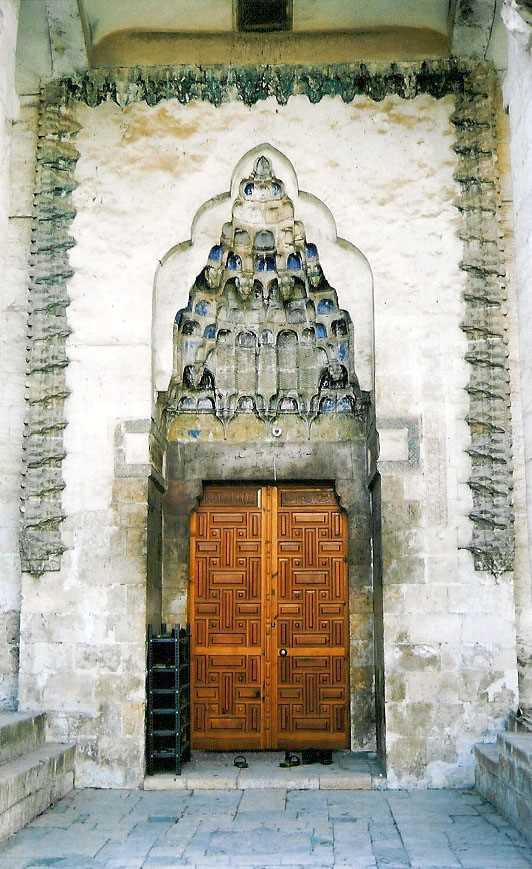
One of the most striking architectural features of Nimetullah Camii is its portal. Located at the center of the rear prayer hall on the northern façade, the portal provides access to the harim area. Set within a rectangular frame, the portal follows the classical Ottoman portal tradition with its muqarnas vaulting.
The borders of the portal combine muqarnas and geometric decorative motifs. Geometric patterns formed by the intersection of full and half octagons are executed in relief. The consistent application of this decorative style in the mihrab niche enhances the architectural coherence of the structure.
Waqf records indicate that the madrasa rooms surrounding the mosque’s courtyard were constructed between 1695 and 1696 by Abbas Ağa. These madrasa structures demonstrate that the mosque served not only as a place of worship but also as an educational center. Of the three graves located in the northern part of the courtyard, two belong to Nimetullah’s son Rûz Bey (?–1520) and Lütfü’s son Ali Bey (?–1594). These graves constitute important historical evidence indicating the mosque’s existence by the early 16th century.
Accessed December 13, 2025.
Arslan, Muhammet. “Şanlıurfa Nimetullah (Ak) Cami Taçkapısı.” *Güzel Sanatlar Enstitüsü Dergisi* 21, 2010. Accessed December 13, 2025. https://dergipark.org.tr/tr/pub/ataunigsed/issue/2557/32950?utm_source=chatgpt.com
Kürkçüoğlu, A. Cihat. “Şanlıurfa Camileri.” ŞURKAV. Accessed December 13, 2025. https://files.surkav.org.tr/urfa_camileri.pdf.
T.C. Kültür ve Turizm Bakanlığı. "Nimetullah Camii (Ak Camii) - Şanlıurfa," Kültür Portalı.
Location | Şanlıurfa Türkiye | ||||||||
|---|---|---|---|---|---|---|---|---|---|
Endowments | 1721 (Hacı Nimetullah bin Asker), 1755 (Hacı Haydar Ağa) | ||||||||
Architecture(s) | Classical Ottoman architecture | ||||||||
No Discussion Added Yet
Start discussion for "Nimetullah Mosque (White Mosque)" article
Historical Development and Waqfs
Plan and Architectural Features
Harim, Mihrab, and Interior Layout
Portal and Decorative Elements
Courtyard, Madrasa, and Graves