


This article was automatically translated from the original Turkish version.
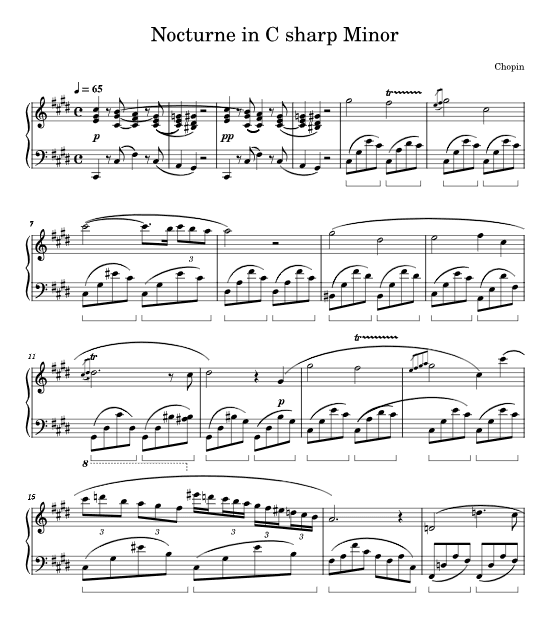
Title of the Work | Nocturne in C-sharp minor (Op. posth.) | ||||||||
|---|---|---|---|---|---|---|---|---|---|
Composer | Frédéric Chopin | ||||||||
Year of Composition | 1830 | ||||||||
Year of Publication | 1870 (after death, by Julian Fontana) | ||||||||
Key | C-sharp minor | ||||||||
Form | Three-part (A–B–A’), da capo form | ||||||||
Dedicatee | Ludwika Kozsowska (Chopin's student) | ||||||||
Fredéric Chopin’s Nocturne in C-sharp minor (Op. posth.), composed in 1830, is a nocturne for solo piano published posthumously in 1870. This work is one of Chopin’s early compositions and has secured an important place in the Romantic piano repertoire. Although it does not bear an official opus number, it appears in posthumous catalogs under the label “Opus posthumous” and is commonly referred to by the catalog number B.49.
Nocturne in C-sharp Minor Op. Posth.Deutsche Grammophon - DG
The piece was composed in 1830 during Chopin’s student years in Warsaw and dedicated to his pupil Ludwika Kozsowska as a celebration of her graduation. However, Chopin did not publish it during his lifetime. After his death, his close friend Julian Fontana transcribed the manuscript and published it in 1870 through the German publisher Breitkopf & Härtel. Upon publication, no opus number was assigned; hence the designation “Op. posth.” is used.
The work follows a typical ternary form (A–B–A’), with striking dramatic contrasts and formal cohesion between sections:
Although this work draws on the classical nocturne model of John Field, it exemplifies Chopin’s distinctive voice and the Romantic emotional expression of his era. Particularly the song-like melodic structure, flexible rhythmic phrasing (rubato), delicate dynamic transitions, and refined harmonic craftsmanship are hallmarks of Chopin’s musical language.
Nocturne in C-sharp minor is frequently performed in the classical piano repertoire. It has also gained significant prominence in cinema. The most notable example is the 2002 film The Pianist. In this biographical film based on the true story of Władysław Szpilman, the protagonist performs this piece before a German officer during the war. This scene exemplifies how Chopin’s music is associated with themes of humanity and elegance.

The PianistIMDb
IMDb. "The Pianist." Accessed April 30, 2025. https://www.imdb.com/title/tt0253474/mediaviewer/rm1931906816/
Practising the Piano. "Chopin’s Nocturne in C# Minor." Accessed April 30, 2025. https://practisingthepiano.com/chopins-nocturne-in-c-sharp-minor/
Rosen, Charles. The Romantic Generation. Cambridge, MA: Harvard University Press, 1995.
Samson, Jim. The Music of Chopin. Oxford: Oxford University Press, 1985.
Spanswick, Melanie. “Practising Nocturne No. 20 in C-sharp Minor, Op. Posth. by Fryderyk Chopin.” Melanie Spanswick – Classical Piano and Composition. Date Published November 10, 2017. Accessed April 30, 2025. https://melaniespanswick.com/2017/11/10/practising-nocturne-no-20-in-c-sharp-minor-op-posth-by-fryderyk-chopin/
YouTube. "The Pianist – Official Trailer." Date Published: March 1, 2021. Accessed April 30, 2025. https://www.youtube.com/watch?v=s_ST3hzMsVE

Title of the Work | Nocturne in C-sharp minor (Op. posth.) | ||||||||
|---|---|---|---|---|---|---|---|---|---|
Composer | Frédéric Chopin | ||||||||
Year of Composition | 1830 | ||||||||
Year of Publication | 1870 (after death, by Julian Fontana) | ||||||||
Key | C-sharp minor | ||||||||
Form | Three-part (A–B–A’), da capo form | ||||||||
Dedicatee | Ludwika Kozsowska (Chopin's student) | ||||||||
No Discussion Added Yet
Start discussion for "Nocturne in C-sharp minor (Op. posth.)" article
Composition and Publication
Formal Structure and Musical Features
A Section (Lento)
B Section (Più mosso)
A’ Section (Tempo I)
Harmony and Tonality
Stylistic Assessment
Technical and Interpretive Characteristics
Cultural Reflections and Usage