
This article was automatically translated from the original Turkish version.
Norse mythology is the collective body of polytheistic beliefs and legends unique to Scandinavia, sustained during and around the Viking Age, which spanned from 790 to 1100 CE. It features a complex cosmology centered around the world tree Yggdrasil, encompassing a comprehensive creation myth, multiple realms, and the cataclysmic event known as Ragnarök, which signifies the destruction and rebirth of the world. The Norse pantheon consists of numerous gods and goddesses integrated into daily customs and rituals. Although there is no exact word in Old Norse for the concept of religion, the belief system’s inseparable connection to everyday life is expressed through the term síður, meaning “custom.”【1】
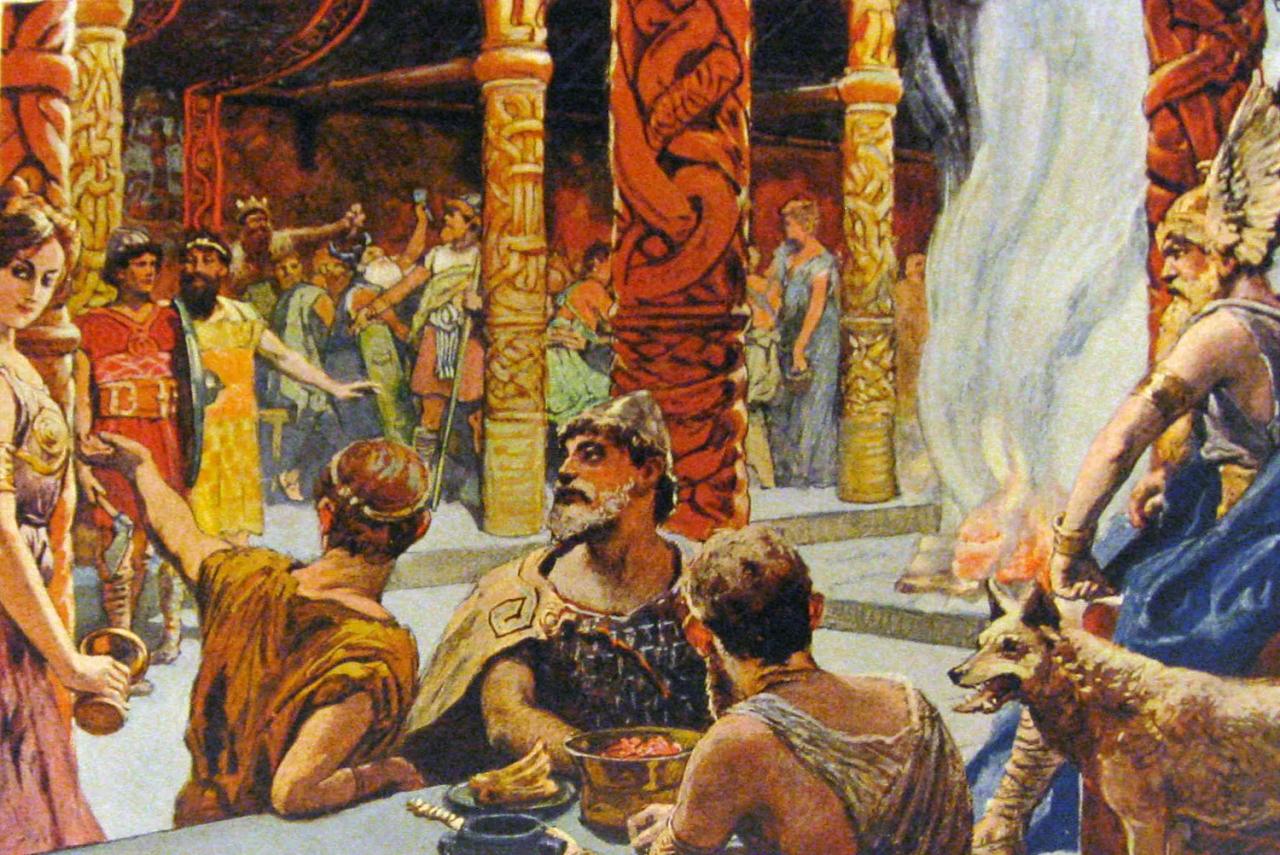
Valhalla (worldhistory.org)
Information about Norse mythology is primarily derived from archaeological findings, epic poetry, sagas, and medieval chronicles.
At the beginning of the Norse cosmological model lies an infinite, primordial void called Ginnungagap. To its south lies Múspellsheimr, a radiant, scorching, fiery realm; to its north lies Niflheimr, a realm of ice, frost, and darkness.【6】
When the heat of fire and the cold of ice met within Ginnungagap, melting droplets gave rise to the first living being, the giant Ymir (Aurgelmir), and the colossal cow Auðumbla. As Auðumbla licked the salty ice blocks, the first divine ancestor, Búri, took form. Búri’s son Borr married the giantess Bestla, and from their union were born three gods: Odin, Vili, and Vé.【7】
Borr’s sons killed the giant Ymir and used his body to construct the world. From Ymir’s blood came the oceans and seas, from his flesh the earth, from his bones the mountains and rocks, from his hair the trees, and from his skull the sky. His brain was thrown into the sky to form the clouds. The first humans, Askr (male) and Embla (female), were created by the gods from two tree trunks found on the seashore, endowed with life, reason, and emotion.【8】
At the center of the cosmos stands the immense ash tree Yggdrasil, whose branches reach into the heavens and bind all existence together. Yggdrasil’s roots extend in three directions; beneath them dwell Hel, Jötnar (giants), and humans. At the roots of the tree reside the three Norns who weave fate: Urðr (Past), Verðandi (Present), and Skuld (Future). Additionally, a dragon named Níðhöggr gnaws at the tree’s roots, while an wise eagle perches in its branches and a squirrel named Ratatöskr scurries between them, carrying messages.【9】
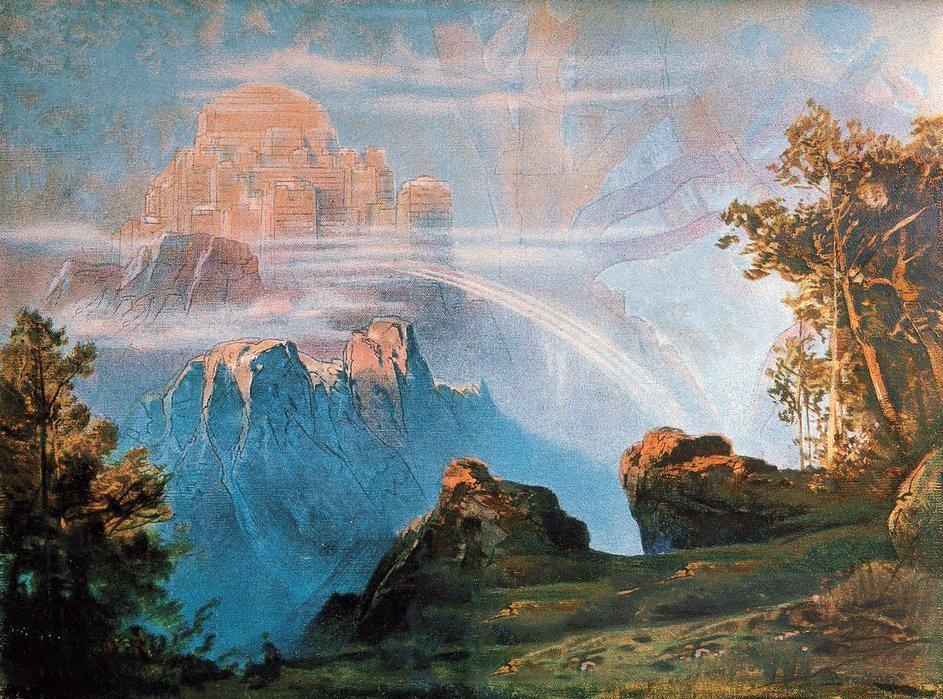
The cosmos consists of nine worlds arranged around Yggdrasil:【10】
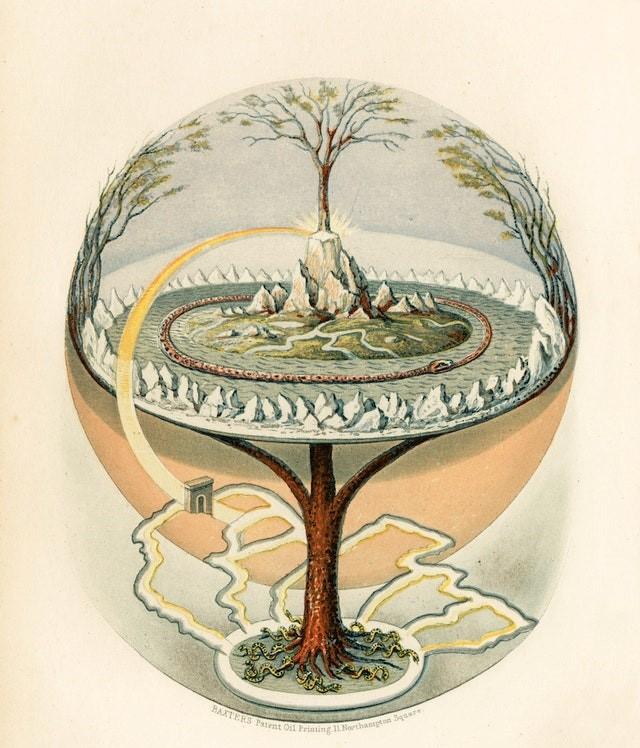
Yggdrasil (worldhistory.org)
Ásgarðr: The home of the Æsir gods.
Vanaheimr: The home of the Vanir gods.
Miðgarðr: Midgard, the world of humans.
Jötunheimr: The world of the giants.
Álfheimr: The land of the light elves.
Niðavellir: The home of the dwarves.
Múspellsheimr: The fiery realm of the fire giants.
Niflheimr: The world of ice, snow, and darkness.
Helheimr: The realm of the dead, where those who died of illness or old age reside.
The Norse pantheon consists of two main kin groups: the Æsir and the Vanir. A war once erupted between the Æsir, associated with war, power, and justice, and the Vanir, linked to fertility, agriculture, and nature. After the conflict, peace was declared, hostages were exchanged, and families were united through marriage.【11】
In Norse mythology, supernatural beings other than the gods are generally grouped under the term Jötnar (giants). Giants represent not only their immense size but also the destructive forces of nature, chaos, sometimes superior wisdom, and occasionally unmatched beauty. They are divided into three groups: Ice Giants (Hrímpursar), Fire Giants (Eldjötnar), and Mountain Giants (Bergrisar). Although they typically dwell in Jötunheimr, they maintain constant interaction, conflict, and sometimes marriage with the gods.
Dvergar (dwarves) are master smiths and craftsmen who live deep within mountains and in the underground realm of Niðavellir. They were created from the blood of Brimir and the bones of Bláinn. Solitary beings dwelling in remote rocks and caves, unable to coexist with humans, are called trolls. Elves (Alfar) appear in myths as nature spirits connected to the Vanir and associated with fertility.【24】
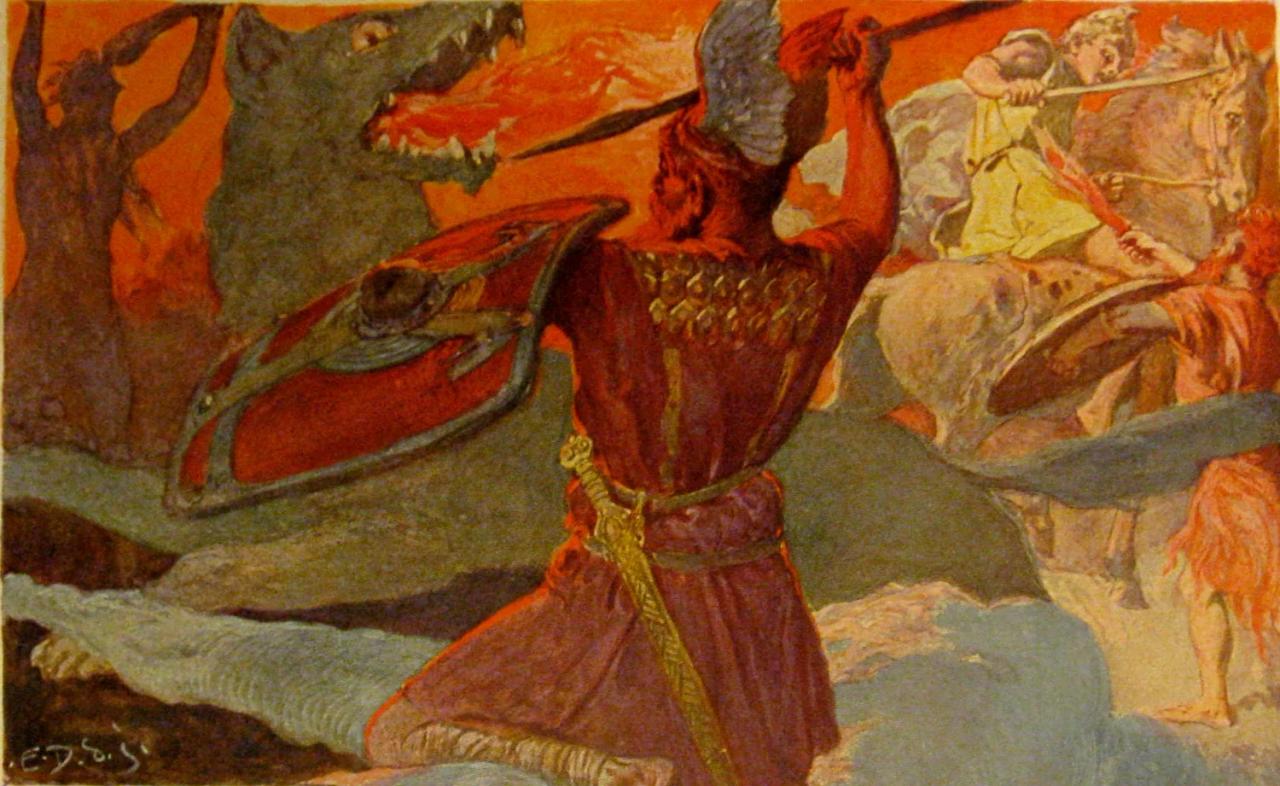
Odin (worldhistory.org)
Mythology directly reflects the social norms and concepts of justice in Viking Age societies. The theme of blood feuds and conflict resolution lies at the heart of the myths. The killing of Ymir to create the world is seen as the opening act of an unending blood feud between gods and giants. Likewise, the "Mead of Poetry," made from the blood of Kvasir and exchanged between groups as a form of compensation for murder, mirrors the Viking legal practice of wergild.【25】
Norse belief does not posit a single, absolute afterlife; the destination of the soul after death depends on how one dies and one’s social status. Warriors who die bravely in battle, the Einherjar, are taken to Odin’s great hall, Valhöll (Valhalla), where they feast in preparation for Ragnarök. The other half of those who die in battle go to the goddess Freyja’s hall, Fólkvangr.
Those who die of illness, old age, or natural causes go to Helheimr, ruled by Hel. Unlike the fiery, torturous hell of Abrahamic religions, Helheimr is a cold, shadowy underworld of rivers and fish. The spirits of those who drown at sea are collected by the sea giantess Rán in her net and held in her underwater realm.【26】
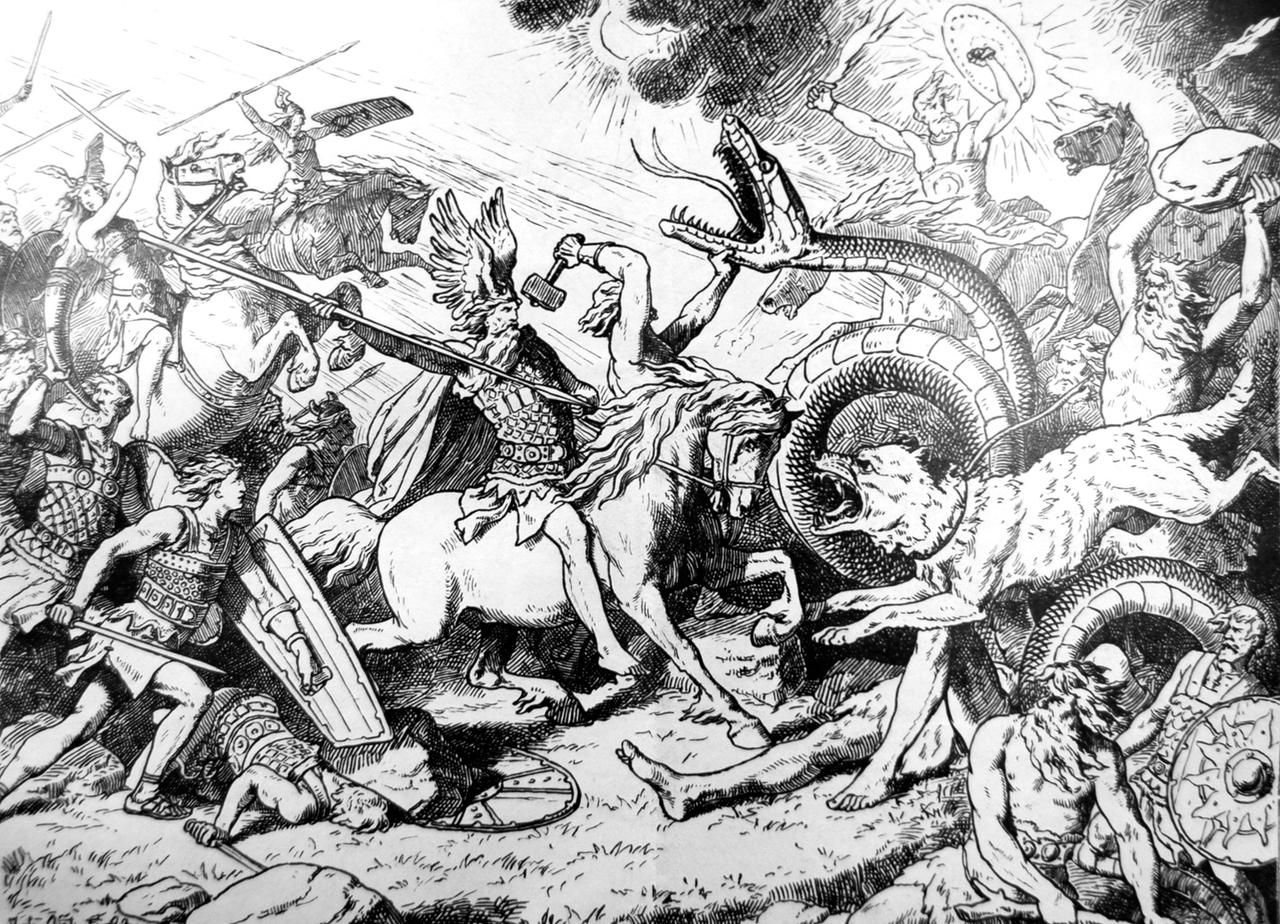
Ragnarök (worldhistory.org)
Ragnarök, meaning "Fate of the Gods" or "Twilight," signifies the inevitable end and dramatic finale of the Norse cosmos. Ragnarök does not occur suddenly but begins with a series of events symbolizing the breakdown of nature and morality. A three-year-long, unbroken, freezing, and dark winter called Fimbulvetr blankets the earth, during which greed, fratricide, and incest become widespread.
Wolves devour the sun and moon; earthquakes break all chains and bonds. Thus, the wolf Fenrir and the serpent Jörmungandr are freed. Seas overflow, and the ship Naglfar, built from the nails of the dead, sets sail. The fire giant Surtr and the sons of Múspell break through the heavens, shatter the Bifröst bridge, and gather on the plain of Vigridr.
In the great battle, Odin is swallowed by Fenrir; his son Víðarr avenges him by tearing apart the wolf’s jaws. Thor kills Jörmungandr with his hammer Mjöllnir, but dies after taking nine steps from the serpent’s venom. Freyr falls in battle against Surtr. Ultimately, Surtr engulfs the world in fire, and the earth sinks beneath the waters.
Yet this destruction is not absolute: after the cataclysm, the earth rises again from the sea, green and purified. Víðarr, Váli, and Thor’s sons Magni and Móði survive; Baldr and Höðr return from the realm of the dead to join them. Two humans, Líf and Lífþrasir, hidden within the bark of Yggdrasil, survive to repopulate the world and begin a new age.【27】
Groeneveld, Emma. "Norse Mythology." *World History Encyclopedia*. November 2, 2017. Accessed March 4, 2026. https://www.worldhistory.org/Norse_Mythology/
Groeneveld, Emma. "Odin." *World History Encyclopedia*. November 13, 2017. Accessed March 4, 2026. https://www.worldhistory.org/odin/
Lindow, John. "Bloodfeud and Scandinavian Mythology." *Alvíssmál* 4 (1995): 51-68. Accessed March 4, 2026. https://userpage.fu-berlin.de/~alvismal/4feud.pdf
Lindow, John. "Norse Mythology and the Lives of the Saints." *Scandinavian Studies* 73, no. 3 (Fall 2001): 437–456. Accessed March 4, 2026. https://www.jstor.org/stable/40920325?searchText=Scandinavian+Mythology&seq=1
Mark, Joshua J. "Norse-Viking Symbols & Meanings." *World History Encyclopedia*. January 10, 2019. Accessed March 4, 2026. https://www.worldhistory.org/article/1309/norse-viking-symbols--meanings/
Mark, Joshua J. "Valhalla." *World History Encyclopedia*. September 20, 2021. Accessed March 4, 2026. https://www.worldhistory.org/Valhalla/
Özkan, Selahattin. "Viking Mitolojisinin Temelleri ve Tarihsel Kaynakları." *Ortaçağ Araştırmaları Dergisi* 1, no. 1 (December 2018): 67–84. Accessed March 4, 2026. https://dergipark.org.tr/en/pub/oad/article/456519
[1]
Emma Groeneveld, "Norse Mythology," World History Encyclopedia, 2 November 2017, Access date: 4 March 2026.https://www.worldhistory.org/Norse_Mythology/
[2]
Emma Groeneveld, "Norse Mythology," World History Encyclopedia, 2 November 2017, Access date: 4 March 2026.https://www.worldhistory.org/Norse_Mythology/
Selahattin Özkan, "The Foundations and Historical Sources of Viking Mythology," Journal of Medieval Studies 1, no 1 (December 2018): 3. Access date: 4 March 2026.https://dergipark.org.tr/en/pub/oad/article/456519
[3]
Selahattin Özkan, "The Foundations and Historical Sources of Viking Mythology," Journal of Medieval Studies 1, no 1 (December 2018): 2,3. Access date: 4 March 2026.https://dergipark.org.tr/en/pub/oad/article/456519
[4]
Emma Groeneveld, "Norse Mythology," World History Encyclopedia, 2 November 2017, Access date: 4 March 2026.https://www.worldhistory.org/Norse_Mythology/
Selahattin Özkan, "The Foundations and Historical Sources of Viking Mythology," Journal of Medieval Studies 1, no 1 (December 2018): 3. Access date: 4 March 2026.https://dergipark.org.tr/en/pub/oad/article/456519
[5]
John Lindow, "Norse Mythology and the Lives of the Saints," Scandinavian Studies 73, no 3 (Autumn 2001): 2,3,4,9. Access date: 4 March 2026.https://www.jstor.org/stable/40920325?searchText=Scandinavian+Mythology&seq=1
[6]
Emma Groeneveld, "Norse Mythology," World History Encyclopedia, 2 November 2017, Access date: 4 March 2026.https://www.worldhistory.org/Norse_Mythology/
[7]
Selahattin Özkan, "The Foundations and Historical Sources of Viking Mythology," Journal of Medieval Studies 1, no 1 (December 2018): 7. Access date: 4 March 2026.https://dergipark.org.tr/en/pub/oad/article/456519
Emma Groeneveld, "Norse Mythology," World History Encyclopedia, 2 November 2017, Access date: 4 March 2026.https://www.worldhistory.org/Norse_Mythology/
[8]
Emma Groeneveld, "Norse Mythology," World History Encyclopedia, 2 November 2017, Access date: 4 March 2026.https://www.worldhistory.org/Norse_Mythology/
Selahattin Özkan, "The Foundations and Historical Sources of Viking Mythology," Journal of Medieval Studies 1, no 1 (December 2018): 7. Access date: 4 March 2026.https://dergipark.org.tr/en/pub/oad/article/456519
[9]
Selahattin Özkan, "The Foundations and Historical Sources of Viking Mythology," Journal of Medieval Studies 1, no 1 (December 2018): 5,6. Access date: 4 March 2026.https://dergipark.org.tr/en/pub/oad/article/456519
Emma Groeneveld, "Norse Mythology," World History Encyclopedia, 2 November 2017, Access date: 4 March 2026.https://www.worldhistory.org/Norse_Mythology/
[10]
Selahattin Özkan, "The Foundations and Historical Sources of Viking Mythology," Journal of Medieval Studies 1, no 1 (December 2018): 6. Access date: 4 March 2026.https://dergipark.org.tr/en/pub/oad/article/456519
[11]
Selahattin Özkan, "The Foundations and Historical Sources of Viking Mythology," Journal of Medieval Studies 1, no 1 (December 2018): 10. Access date: 4 March 2026.https://dergipark.org.tr/en/pub/oad/article/456519
Emma Groeneveld, "Norse Mythology," World History Encyclopedia, 2 November 2017, Access date: 4 March 2026.https://www.worldhistory.org/Norse_Mythology/
[12]
Selahattin Özkan, "The Foundations and Historical Sources of Viking Mythology," Journal of Medieval Studies 1, no 1 (December 2018): 6,8,9. Access date: 4 March 2026.https://dergipark.org.tr/en/pub/oad/article/456519
Emma Groeneveld, "Norse Mythology," World History Encyclopedia, 2 November 2017, Access date: 4 March 2026.https://www.worldhistory.org/Norse_Mythology/
[13]
Selahattin Özkan, "The Foundations and Historical Sources of Viking Mythology," Journal of Medieval Studies 1, no 1 (December 2018): 9. Access date: 4 March 2026.https://dergipark.org.tr/en/pub/oad/article/456519
[14]
Selahattin Özkan, "The Foundations and Historical Sources of Viking Mythology," Journal of Medieval Studies 1, no 1 (December 2018): 9. Access date: 4 March 2026.https://dergipark.org.tr/en/pub/oad/article/456519
[15]
Selahattin Özkan, "The Foundations and Historical Sources of Viking Mythology," Journal of Medieval Studies 1, no 1 (December 2018): 10,13. Access date: 4 March 2026.https://dergipark.org.tr/en/pub/oad/article/456519
Emma Groeneveld, "Norse Mythology," World History Encyclopedia, 2 November 2017, Access date: 4 March 2026.https://www.worldhistory.org/Norse_Mythology/
[16]
Emma Groeneveld, "Norse Mythology," World History Encyclopedia, 2 November 2017, Access date: 4 March 2026.https://www.worldhistory.org/Norse_Mythology/
Selahattin Özkan, "The Foundations and Historical Sources of Viking Mythology," Journal of Medieval Studies 1, no 1 (December 2018): 10. Access date: 4 March 2026.https://dergipark.org.tr/en/pub/oad/article/456519
[17]
Selahattin Özkan, "The Foundations and Historical Sources of Viking Mythology," Journal of Medieval Studies 1, no 1 (December 2018): 10. Access date: 4 March 2026.https://dergipark.org.tr/en/pub/oad/article/456519
[18]
Selahattin Özkan, "The Foundations and Historical Sources of Viking Mythology," Journal of Medieval Studies 1, no 1 (December 2018): 9,10. Access date: 4 March 2026.https://dergipark.org.tr/en/pub/oad/article/456519
[19]
John Lindow, "Bloodfeud and Scandinavian Mythology," Alvíssmál 4 (1995): 16. Access date: 4 March 2026.https://userpage.fu-berlin.de/~alvismal/4feud.pdf
Selahattin Özkan, "The Foundations and Historical Sources of Viking Mythology," Journal of Medieval Studies 1, no 1 (December 2018): 10,14. Access date: 4 March 2026.https://dergipark.org.tr/en/pub/oad/article/456519
[20]
Selahattin Özkan, "The Foundations and Historical Sources of Viking Mythology," Journal of Medieval Studies 1, no 1 (December 2018): 12. Access date: 4 March 2026.https://dergipark.org.tr/en/pub/oad/article/456519
[21]
Selahattin Özkan, "The Foundations and Historical Sources of Viking Mythology," Journal of Medieval Studies 1, no 1 (December 2018): 11. Access date: 4 March 2026.https://dergipark.org.tr/en/pub/oad/article/456519
[22]
Selahattin Özkan, "The Foundations and Historical Sources of Viking Mythology," Journal of Medieval Studies 1, no 1 (December 2018): 11. Access date: 4 March 2026.https://dergipark.org.tr/en/pub/oad/article/456519
[23]
Selahattin Özkan, "The Foundations and Historical Sources of Viking Mythology," Journal of Medieval Studies 1, no 1 (December 2018): 12. Access date: 4 March 2026.https://dergipark.org.tr/en/pub/oad/article/456519
[24]
Selahattin Özkan, "The Foundations and Historical Sources of Viking Mythology," Journal of Medieval Studies 1, no 1 (December 2018): 14. Access date: 4 March 2026.https://dergipark.org.tr/en/pub/oad/article/456519
Emma Groeneveld, "Norse Mythology," World History Encyclopedia, 2 November 2017, Access date: 4 March 2026.https://www.worldhistory.org/Norse_Mythology/
[25]
John Lindow, "Bloodfeud and Scandinavian Mythology," Alvíssmál 4 (1995): 2,6,11. Access date: 4 March 2026.https://userpage.fu-berlin.de/~alvismal/4feud.pdf
[26]
Selahattin Özkan, "The Foundations and Historical Sources of Viking Mythology," Journal of Medieval Studies 1, no 1 (December 2018): 9,16. Access date: 4 March 2026.https://dergipark.org.tr/en/pub/oad/article/456519
[27]
Selahattin Özkan, "The Foundations and Historical Sources of Viking Mythology," Journal of Medieval Studies 1, no 1 (December 2018): 14-16. Access date: 4 March 2026.https://dergipark.org.tr/en/pub/oad/article/456519
Emma Groeneveld, "Norse Mythology," World History Encyclopedia, 2 November 2017, Access date: 4 March 2026.https://www.worldhistory.org/Norse_Mythology/

Historical Sources
Cosmology and Creation
Yggdrasil and the Nine Worlds
The Pantheon: Gods and Goddesses
Jötnar and Other Supernatural Beings
Social Structure: The Culture of Blood Feuds
Death and the Afterlife
Ragnarök and the Rebirth of the World