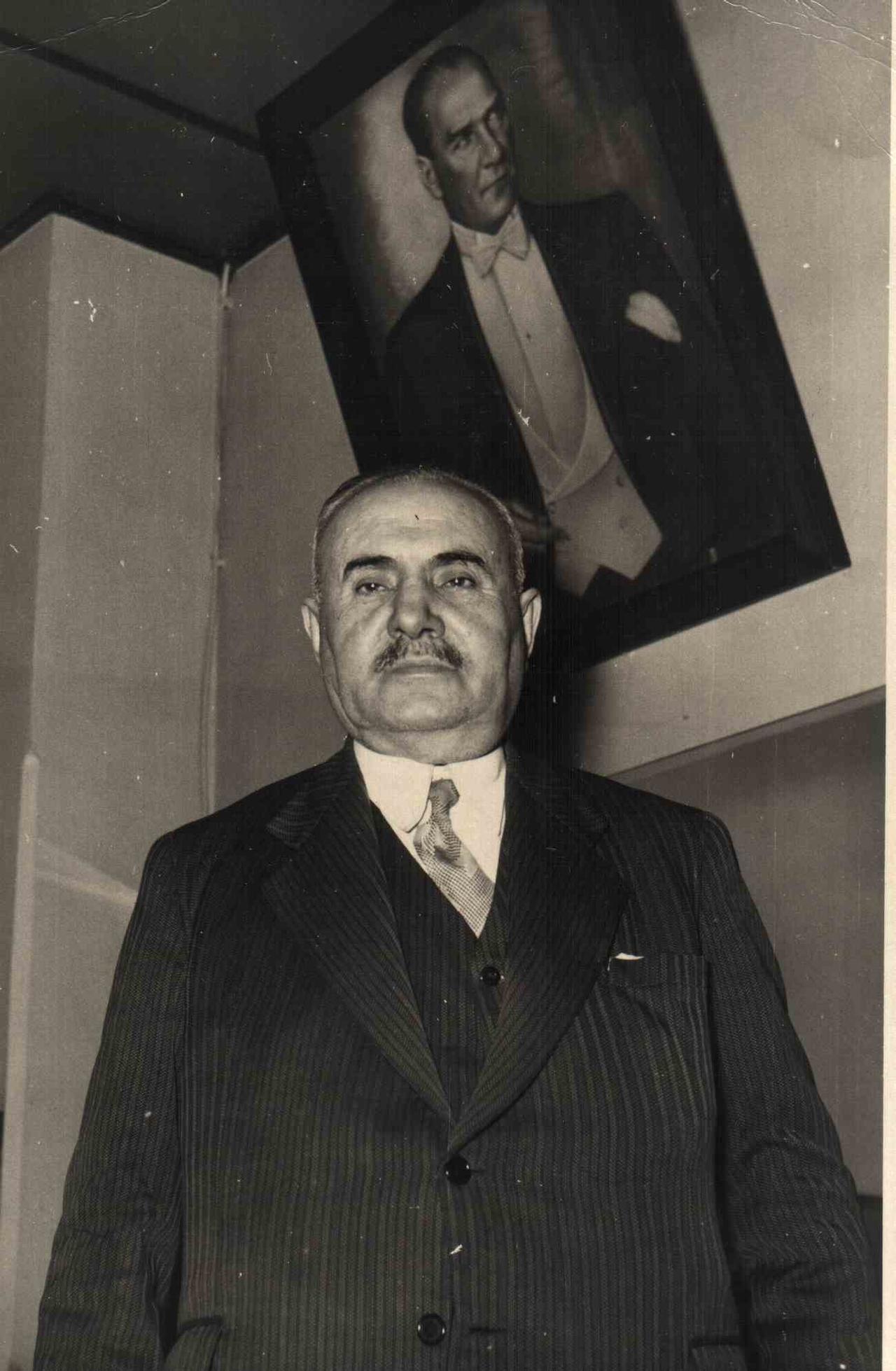
Birth | 7 May 1886 | ||||||||
|---|---|---|---|---|---|---|---|---|---|
Place of Birth | Divriği, Sivas, Ottoman Empire | ||||||||
Death | 13 November 1957 | ||||||||
Place of Death | Istanbul, Türkiye | ||||||||
Burial Place | Zincirlikuyu Cemetery, Istanbul | ||||||||
Education | Divriği Rüştiyesi Ministry of Finance Higher School (Istanbul) | ||||||||
Profession(s) | Industrialist politician entrepreneur engineer | ||||||||
First Initiative | Domestic cigarette paper production under the 'Türk Zaferi' brand (1918) | ||||||||
Important Projects | Samsun–Sivas railway, Bosphorus Bridge proposal, Keban Dam proposal | ||||||||
Industrial Investments | Sümerbank Merinos, SEKA Cellulose, Sivas Cement, Karabük Iron–Steel | ||||||||
Activities in Aviation | Founder of Türkiye's first aircraft factory and Gök Okulu | ||||||||
Aircraft Produced | Nu.D-36 (training aircraft), Nu.D-38 (passenger/bomber aircraft) | ||||||||
Political Activities | Founder of the National Development Party (1945), Democrat Party candidate for Sivas (1954) | ||||||||
Family | six daughters two sons Wife: Mesude Hanım | ||||||||
Memorials | Reopening of Divriği Airport (2021), Nu.D-36 simulation at Teknofest (2019) | ||||||||
Nuri Demirağ (1886–1957) was an industrialist, engineer, entrepreneur, and politician who achieved numerous firsts in industry, transportation, and aviation during the early years of the Republic of Türkiye. He is recognized as a pioneer for establishing Türkiye’s first aircraft factory and private flight school, initiating domestic parachute production, and shaping the country’s development through railway, bridge, and dam projects. Additionally, through the National Development Party he founded, he became one of the leaders of Türkiye’s first opposition parties during the transition to multi-party politics.
Documentary on Nuri Demirağ (Istanbul Chamber of Commerce)
Nuri Demirağ was born on 7 May 1886 in Divriği district of Sivas to Mühürdarzade Ömer Bey and Ayşe Hanım. His family belonged to one of the region’s prominent and respected families. When his father Ömer Bey died in a horse-riding accident at the age of three, Nuri assumed responsibility for his family’s livelihood at an early age. His brother Abdurrahman Naci Bey was born the same year.
He completed his primary education at the Sıbyan Mekteb in Divriği and his secondary education at the Divriği Rüştiyesi. He was known as a successful student. In 1903, he passed the civil service examination opened by the Ziraat Bank and began his duties at the Kangal branch. A year later, he was transferred to the Koçgiri branch. During the famine that struck the region in 1909, he attempted to alleviate its effects by selling grain from state warehouses at fair prices to the public. An investigation launched against him was ultimately turned into an award after the truth of his actions was established.
In 1910, he passed the Ministry of Finance examination and was assigned to Istanbul, where he served at the Beyoğlu Varidat Office. While in this position, he opposed the transfer of Taksim Barracks and Talimhane to foreign entities, leading to his reassignment to the Hasköy Mal Directorate. During this period, he also attended evening classes at the Ministry of Finance Higher School. In Istanbul, he learned French and further developed his expertise in finance.
After the First World War, during the occupation of Istanbul, he served on the Ministry of Finance Inspection Commission. In 1918, after being insulted by occupation forces during an audit at the Tatavla branch, he resigned from public service. This event marked the end of his civil service career.
In 1918, Nuri Demirağ left public service and entered the private sector. His first venture was in cigarette paper production, which at the time was entirely controlled by foreign interests. Using his own capital, he established a small workshop in Istanbul and produced Türkiye’s first domestically manufactured cigarette paper under the brand name “Türk Zaferi.” This initiative was recorded as one of the earliest examples of local industrial entrepreneurship.
Following his success in cigarette paper manufacturing, he turned to foreign trade, expanding his capital through import and export activities. In the mid-1920s, he joined the Republic’s infrastructure push by entering the contracting business. When the government transferred the Samsun–Sivas railway construction project from a foreign company to Turkish contractors, he took on the task. Together with his brother Abdurrahman Naci Bey, he completed a large portion of the line.
His achievements in railway construction aligned with the Republic administration’s urban development policies. In recognition of his contributions to the nation’s transportation infrastructure, the surname “Demirağ” was personally bestowed upon him by Mustafa Kemal Atatürk.
Building on his railway success, he undertook the construction of new lines. Between the 1920s and 1930s, he participated in building the Afyon–Antalya, Fevzipaşa–Diyarbakır, Sivas–Erzurum, and Irmak–Filyos railway lines. Through these projects, approximately 1,250 kilometers of Türkiye’s total 10,000-kilometer railway network were constructed by his company.
The profits from railway construction enabled Nuri Demirağ to shift toward heavy industry in subsequent years. He became one of the pioneering contractors who operated in infrastructure and industry during the early Republic period.
Following his railway activities, Nuri Demirağ turned to industrial investments in the 1930s, undertaking the construction of heavy industrial facilities across various regions of the country in line with the state’s development plans.
In 1933, he began construction of the Sümerbank Merinos Factory in Bursa. During the same period, he oversaw the construction of the Selüloz (SEKA) Factory in İzmit. He played a role in establishing the cement factory in Sivas and participated in the construction of the iron and steel facilities in Karabük. These facilities contributed significantly to the formation of Türkiye’s foundational production sectors during its early industrialization phase.
Nuri Demirağ also undertook the construction of the Istanbul Hal Binası, Eceabat Airport, and several public buildings. Beyond industrial activities, he engaged in public-benefit initiatives. He restored a historic fountain in front of Yıldız Palace and, establishing it as a tradition, built a total of 43 fountains in different cities.
In 1931, he began feasibility studies for the Bosphorus Bridge Project, designed to connect Asia and Europe. In 1934, he completed the project and collaborated with the American company “Bethlehem Steel Company.” The bridge was planned to accommodate both road and railway traffic. The project was reviewed and approved by President Mustafa Kemal Atatürk but was rejected by the Minister of Public Works, Ali Çetinkaya, on aesthetic grounds.
Another project introduced by Nuri Demirağ was the Keban Dam. In 1933, while conducting energy studies for Sivas and its surroundings, he proposed building a dam on the Euphrates River. This proposal was later incorporated into state projects in the 1960s and implemented.
By the end of the 1930s, Nuri Demirağ had established a broad influence on Türkiye’s economic development through his industrial facilities, infrastructure projects, and energy planning.
In the mid-1930s, Nuri Demirağ redirected the capital he gained from industrial activities toward aviation. Motivated by the belief that Türkiye must produce its own aircraft, he began aircraft manufacturing in 1936. In response to the Turkish Aeronautical Association’s fundraising appeal, he declared: “If you want something from me for this nation, then you must ask for the best. Since a nation cannot live without aircraft, we must not rely on the generosity of others for this necessity. I am determined to build a factory for these aircraft.”【1】 This decision laid the foundation for Türkiye’s first private aircraft factory.

Nuri Demirağ Supervising Aircraft Manufacturing (Nuri Demirağ)
On 17 September 1936, the foundation stone of the “Nuri Demirağ Aircraft Workshop” was laid beside the Barbaros Hayrettin Paşa Türbesi in Beşiktaş. The building was constructed using metal construction techniques appropriate for the era’s technology. The workshop was organized to manufacture aircraft fuselages, wing components, and gliders. Production was led by Selahattin Reşit Alan, one of Türkiye’s first aircraft engineers.
Following the Beşiktaş workshop, land at Elmaspaşa Farm in Yeşilköy was purchased to conduct test flights. The site was developed with runways, hangars, and maintenance workshops to create a modern facility. It is reported that this facility was even larger than Amsterdam Airport, Europe’s largest at the time. This area later became the site of Istanbul Atatürk Airport.
The Yeşilköy facility was not only a manufacturing center but also planned as an educational institution. Here, a flight and maintenance training center named “Gök Okulu” was established. The school’s curriculum included both theoretical instruction and practical flight training.

Newspaper Clipping Showing Nuri Demirağ’s Activities (Nuri Demirağ)
Between 1936 and 1944, the Nuri Demirağ Aircraft Factory produced two aircraft models and a series of gliders.
The first model, the Nu.D-36, was a twin-control, single-engine trainer aircraft developed in 1936. It featured a 150-horsepower engine operating at 1,750 rpm, with a capacity for two occupants. Twelve units were produced, and the first test flights were conducted by Basri Alev, a pilot from the War of Independence. The aircraft could reach a speed of 182 kilometers per hour and had a range of 500 kilometers.

Nu.D 36 Type 5 Aircraft Performing a Demonstration Flight (Nuri Demirağ)
The second model, the Nu.D-38, was completed in 1938. Designed as a six-seat, twin-engine passenger aircraft, it had a maximum speed of 271 kilometers per hour and a range of 1,000 kilometers. It was also planned to be convertible into a bomber if needed. In 1944, it was certified by international civil aviation authorities as an “A-class passenger aircraft,” a classification that represented a high standard by the technological benchmarks of the era.

Stages of Nu.D 38 Construction (Nuri Demirağ)
In addition to aircraft production, in 1939 Türkiye’s first domestically manufactured parachute was produced. For the silk used in the parachutes, mulberry trees were planted on land owned by Demirağ in Baltalimanı, and silk production was initiated.
Shortly after the factory became operational, the Turkish Aeronautical Association ordered 65 gliders and 24 trainer aircraft. The gliders were completed and delivered promptly. However, disagreements arose over the technical specifications of the trainer aircraft, leading the Association to reject delivery.
During one test flight, engineer Selahattin Reşit Alan died after crashing into a trench near the runway. Following this incident, the Turkish Aeronautical Association canceled the entire order. Nuri Demirağ filed a lawsuit based on expert reports confirming that the aircraft had been manufactured according to contract specifications. However, the court ruled in favor of the Turkish Aeronautical Association.
During the same period, legal restrictions on aircraft exports were enacted, preventing the factory from receiving foreign orders. This situation led to a halt in production and the eventual cessation of operations.
The Gök Okulu established in Yeşilköy was Türkiye’s first private flight school. Between 1936 and 1943, a total of 290 pilots were trained there. The curriculum included not only flight techniques but also mechanical and engine maintenance courses. Among the students were engineering candidates from Istanbul Technical University. In 1941, the first fully Turkish-made aircraft, flown by pilot Galip Demirağ, completed a flight from Istanbul to Divriği.
Demirağ’s aviation activities extended beyond aircraft manufacturing to include a training model aimed at producing pilots and technical personnel. This structure contributed to laying the institutional foundations of civil aviation in Türkiye.

Gök Okulu Student Taking the Graduation Oath (Nuri Demirağ)
Nuri Demirağ did not limit his industrial and aviation efforts to production alone; he systematically directed his attention toward education. He believed that for national development to be sustainable, a generation equipped with knowledge and technical skills had to be cultivated. Beginning in the mid-1930s, he initiated direct investments in education.
First, he built a secondary school and dormitory in his hometown of Divriği, Sivas. Named “Gök Ortaokulu,” this institution was the first secondary school of its kind in the region. It was also envisioned as part of a future educational system Demirağ planned to establish for aviation. A 150-bed dormitory was constructed to accommodate students. All expenses for students at this school in Divriği were covered, and educational materials and books were provided free of charge.
Following this initiative, he established the “Gök Okulu,” a flight and aviation technical school, in the area where his aircraft factory was located in Yeşilköy. This was Türkiye’s first flight school established by private enterprise. The school, which began operations in 1936, continued until 1943. Its curriculum was designed according to the civil aviation standards of the time. Students received technical instruction in aerodynamics, engine technology, aircraft maintenance, and control systems, alongside theoretical and practical flight training.
The teaching staff of Gök Okulu consisted of expert pilots and engineers from the Turkish Aeronautical Association. The school’s training infrastructure utilized aircraft manufactured at the Beşiktaş workshop. Students first received theoretical instruction, then gained flight experience on the Yeşilköy runways. Graduates received “pilot diplomas” and became among Türkiye’s first civilian pilots.

Gök Okulu Students Greeting Nuri Demirağ (Nuri Demirağ)
In 1941, one of the school’s graduates, Galip Demirağ, demonstrated the success of the school’s training by flying a fully Turkish-made “Nu.D-36” aircraft from Istanbul to Divriği. This flight was recorded as one of the first long-distance flights by pilots trained by the private sector in Türkiye.
Nuri Demirağ’s educational activities were not limited to aviation. He actively advocated for the establishment of an “Aircraft Engineering Department” within Istanbul Technical University and promoted academic development in this field. These efforts reflected his belief in the essential link between technical knowledge and industrialization.
When considered together, the school in Divriği and the Gök Okulu in Yeşilköy reveal that Demirağ’s approach to education aimed not only at vocational training but also at instilling a national production consciousness. Some of the students trained in these schools later worked within the Turkish Aeronautical Association and Turkish Airlines, contributing to the aviation sector.
Throughout his life, Nuri Demirağ developed ideas centered on industry, economy, entrepreneurship, ethics, and the concept of nation. His thought system was closely tied to the economic and social transformations of his time. During the early years of the Republic, he believed industrialization was essential and argued that development could only be achieved through domestic production, technical knowledge, and free enterprise.
From the 1930s onward, in various speeches and writings, he opposed assembly industry and warned that “copying” would delay the country’s progress. In a 1936 statement, he declared: “Obtaining licenses from Europe and America to build aircraft is nothing but copying. Licenses are granted only for outdated models, while new inventions are kept secret with great jealousy. If we continue with copying, we will waste time on obsolete designs. Therefore, we must create a completely new Turkish aircraft model to rival the latest systems of Europe and America.”【2】 This emphasized his conviction in the necessity of domestic production.
According to Demirağ, a nation’s development was possible not only through capital but through ideas. Therefore, he placed great importance on technical knowledge and entrepreneurial spirit. “The Turk must build his own aircraft. Since a nation cannot live without aircraft, it must not rely on the generosity of others for this necessity.”【3】 These words encapsulate his vision of independent industry.
In terms of economic views, he believed state intervention should be limited. In writings from the mid-1940s, he asserted that free enterprise was the only path to national development. He argued that statism constrained the country’s economic dynamism and reflected this view in the program of the National Development Party, which he prepared in 1949. The program included principles of liberal economic policy, freedom of production and trade, prevention of inflation, and preservation of currency value.
Nuri Demirağ also drew attention with his view that personal wealth was a trust belonging to society. In 1947, he stated: “Every personal fortune is a trust held by a member of the nation. Misusing any trust is a sin.”【4】 This expressed his economic ethics. In another speech the same year, he said: “I have always avoided unnecessary expenses. I have never forgotten that the money I earned must be preserved as a trust from the Turkish nation.”【5】
He viewed development not merely as an economic phenomenon but as a moral responsibility. “Great achievements arise from savings made by abstaining from luxury and excessive spending.”【6】 He emphasized that waste and ostentation were incompatible with the ethics of production.
In Demirağ’s thought, there was a strong connection between technological progress and national identity. “Nations that cannot master the skies are condemned to crawl on the ground.”【7】 This statement underscored the importance of independence in defense and industry. He believed: “The Turk is capable of thinking of every useful thing human ingenuity can create for his homeland, of acting upon those thoughts, and of succeeding.”【8】 This outlook reflected his confidence in the younger generation and his faith in education as a means of development.
Demirağ’s economic vision contained proposals ahead of his time. In 1954, he predicted the emergence of a “United Europe” and argued that Türkiye should establish a common economic alliance with the Islamic world. On this matter, he said: “We know they forced us into NATO. Tomorrow, to join any European union, our religion, traditions, and culture will not help us. Our only salvation lies in establishing an Islamic and Eastern Union.”【9】
These ideas reflected a perspective that framed international cooperation on cultural foundations, not merely economic ones. Nuri Demirağ treated technological advancement, social ethics, and national solidarity as inseparable concepts.
In addition to his work in industry and economy, Nuri Demirağ played an active role in political life. During the mid-1940s, as Türkiye transitioned from single-party rule to multi-party politics, he entered the political arena. His criticisms of state-led economic policies and single-party governance were decisive factors in his political engagement.

Celal Bayar and Nuri Demirağ (Nuri Demirağ)
In 1945, Nuri Demirağ founded the National Development Party (NDP), one of Türkiye’s first opposition parties. The party was officially established on 18 July 1945. As the first legal opposition party formed outside the Republican People’s Party, it holds a special place in Turkish political history.
The party’s program included principles of economic liberalism, free enterprise, entrepreneurial freedom, and limiting the state’s role in the economy. Nuri Demirağ argued that the state should not direct economic activity but rather oversee it. The party’s name, “National Development,” reflected his emphasis on industry and development.
The National Development Party also aimed to contribute to the establishment of a democratic culture. Its bylaws included provisions for the protection of individual rights and freedoms, judicial independence, equal opportunity in education, press freedom, and expanded suffrage.
In its program, Nuri Demirağ emphasized “free enterprise for national development” and argued that state-led economic activities were inefficient. He contended that the policies of the Republican People’s Party (RPP) had created monopolies in economic life. In his speeches during this period, he stated that state intervention weakened the entrepreneurial spirit and blocked economic progress.
The party participated in the 1946 general elections. However, due to the use of an open-ballot secret-count system and the simultaneous emergence of the Democrat Party, the National Development Party failed to gain the expected support. Nevertheless, it played a significant role in Türkiye’s transition to multi-party politics. The party continued to exist for approximately twelve years before being dissolved.
After the 1946 elections, internal disagreements and management problems emerged within the National Development Party. In addition to internal conflicts, indifference from the press and bureaucracy diminished the party’s influence. Following Nuri Demirağ’s death in 1957, the party’s activities ceased as its congress was never reconvened.
As the influence of the National Development Party waned, Nuri Demirağ continued his political career in the 1954 elections as a candidate for Sivas from the Democrat Party. During this period, he voiced his opinions on industry and transportation projects through parliamentary work. However, he did not assume any executive role during his term as a member of parliament.
Nuri Demirağ’s political views were based on economic independence and democratic governance. He believed politics and economy could not be separated; without a strong economy, national independence could not be sustained. Therefore, he argued that development could only be achieved through free enterprise and entrepreneurial freedom.
The core of his party policies included individual freedoms, priority for domestic industry in production, a free market system, and impartiality of the justice mechanism. These principles demonstrated a direct link between his identity as an entrepreneur and his political views.
Nuri Demirağ’s political activities contributed to the institutionalization of multi-party politics in Türkiye and served as a model for subsequent opposition parties.
Nuri Demirağ attracted attention not only through his engineering and industrial work but also through his forward-looking projects and forecasts. During the early Republic period, he advocated prioritizing modern infrastructure and industrial investments for Türkiye’s development and developed numerous technical and economic projects. Although some of his proposals could not be implemented due to the conditions of the time, similar initiatives were later adopted in Türkiye’s development plans.
In 1931, he began studies for constructing a bridge across the Bosphorus in Istanbul to enable both road and railway transportation. After four years of research and analysis, he collaborated with the American company “Bethlehem Steel Company.” The project was designed using the same system as San Francisco’s Golden Gate Bridge and was intended to span 2,000 meters.
In 1934, he presented his completed project dossier to President Mustafa Kemal Atatürk, who approved and supported the plan. However, the then Minister of Public Works, Ali Çetinkaya, denied approval, arguing that the bridge would spoil the view of the Bosphorus. Nevertheless, Nuri Demirağ remained committed to the idea, declaring: “Istanbul needs this. If I do not build it, I will leave it to my children.”【10】
This project is considered one of the earliest examples in Türkiye of infrastructure investment by private capital. Nuri Demirağ offered to finance the bridge from his own resources rather than through the state budget, proposing a financial model similar to today’s “Build-Operate-Transfer” system.
In 1933, he proposed the Keban Dam on the Euphrates River to generate electricity. This proposal aimed to reduce Türkiye’s dependence on imported energy. Nuri Demirağ submitted his draft plan to authorities of the time, but due to insufficient technical capabilities, the project could not be implemented. This idea was later incorporated into state energy planning in the 1960s, and construction of the Keban Dam was completed in 1974.
Nuri Demirağ believed aviation was strategically vital for Türkiye’s defense and development. Therefore, he was not only involved in aircraft manufacturing but also in establishing aviation infrastructure. The runways and hangars he built in Yeşilköy were planned on a modern airport scale. In 1938, he established the “Gök Okulu” there and initiated pilot training. He also constructed an airport in his hometown of Divriği, Sivas. This airport is recognized as Türkiye’s first airport built by private initiative at the provincial level.
Nuri Demirağ expressed forward-looking ideas not only in technical and economic fields but also in international relations. In the 1950s, he predicted the formation of a union among European states and stated that the idea of “United Europe” would become a political reality. In contrast, he argued that Türkiye should not direct its focus solely toward the West and proposed establishing an economic and cultural union among Islamic countries. “They forced us into NATO; yet our salvation lies in establishing an Islamic and Eastern Union.”【11】
Among Nuri Demirağ’s projects were initiatives to improve social life. He restored historic fountains in various cities and built a total of 43 new fountains. He emphasized the importance of green spaces and modern transportation routes in urban planning and prepared reports on Istanbul’s development plan. In these reports, he advocated integrating air traffic, maritime transport, and road networks.
Nuri Demirağ foresaw that technological advances would transform not only industry but also social life. In speeches during the 1940s, he predicted that humanity would eventually unite under a single world and single state.【12】 This thought reflected his view of technology as linked to international peace and cooperation.
Although these visionary projects did not find immediate implementation, they shaped Türkiye’s subsequent development and infrastructure policies. Projects such as the Bosphorus Bridge and Keban Dam are now recognized as precursors to later state-led investments.
Nuri Demirağ died on 13 November 1957 in Istanbul. His funeral, attended by prominent politicians, engineers, and students of the time, was held at Zincirlikuyu Cemetery. He had eight children—two sons and six daughters—with his wife Mesude Hanım. His death also symbolized the end of the pioneering era of private-sector industrial and aviation initiatives in Türkiye.
After his death, Nuri Demirağ’s initiatives were temporarily forgotten by public attention; however, beginning in the 1980s, his activities in aviation and industry were re-examined. Especially in the 2000s, as debates on domestic industry and national production resurfaced, the name of Nuri Demirağ re-emerged into public consciousness.
The Divriği Airport, built by Nuri Demirağ in the 1940s, remained unused for a long time. In 2021, after 84 years, aircraft landings were resumed at the airport. This development revived awareness of his contributions to domestic aviation.
Various events are held in Divriği district of Sivas to commemorate Nuri Demirağ’s life and work. The area where the airport is located has been named the “Nuri Demirağ Aviation Area” by local authorities. Additionally, some educational institutions and cultural centers in Sivas bear his name.
The “Nu.D-36” and “Nu.D-38” aircraft produced by Nuri Demirağ are recognized as the first examples of indigenous aircraft design in Turkish aviation history. Some parts and blueprints of these aircraft have been preserved to this day. In 2019, during an event organized by Teknofest, Teknopark Istanbul exhibited a simulation project of the “Nu.D-36” model, reintroducing Nuri Demirağ’s aircraft to the public.
This project exemplifies the convergence of Nuri Demirağ’s vision of domestic production and engineering with modern technology. At the same time, his principle of “national invention against copying” has become a frequently cited principle in Türkiye’s defense industry and aviation projects.
In recent years, numerous academic studies have been conducted on Nuri Demirağ’s activities in industry, entrepreneurship, and politics. These studies examine his economic ideas, his identity as an entrepreneur within a macro-institutional context, and the role of the National Development Party in Türkiye’s transition to multi-party politics.
At symposiums held by universities and industrial organizations, Nuri Demirağ’s ideas are evaluated within the framework of the “national development model,” and his approach to engineering and entrepreneurship is regarded as one of the pivotal turning points in the history of industrialization during the Republic era.
Nuri Demirağ was one of the rare figures in the early Republic period who undertook large-scale projects through private enterprise. His work significantly contributed to the social recognition of engineering and industrial entrepreneurship in Türkiye. His school and airport projects in Divriği also contributed to the advancement of technical education in rural areas.
Although Türkiye’s aviation sector experienced a prolonged stagnation after his death, Demirağ’s initiatives later served as inspiration for new entrepreneurial ventures in the field. Today, his name is invoked as a symbol of domestic production, technology-based industrialization, and entrepreneurial spirit.
Adiloğlu-Yalçınkaya, Leyla and Akansel Yalçınkaya. “Nuri Demirağ’ın Bir Girişimci Olarak Ortaya Çıkışı, Yükselişi ve Düşüşü: Makrokurumsal Yaklaşım Bağlamında Tarihsel Bir İnceleme.” *Yönetim Bilimleri Dergisi / Journal of Administrative Sciences* 18, no. 38 (2018): 839–864. Accessed November 12, 2025. https://doi.org/10.35408/comuybd.648537.
Altınbaş, Murat, and Yeter Solak. “Türkiye’de Çok Partili Hayata Geçiş Sürecinde Muhalif Bir Figür: Nuri Demirağ ve Millî Kalkınma Partisi.” *History Studies* 15, no. 2 (May 2023): 311–325. Accessed November 12, 2025. https://dergipark.org.tr/tr/pub/historystudies/issue/77900/1311833.
Anadolu Ajansı. “Araştırmacı Yazar Akkurt Nuri Demirağ’ı Anlattı.” Accessed November 12, 2025. https://www.aa.com.tr/tr/turkiye/arastirmaci-yazar-akkurt-nuri-demiragi-anlatti/1074158.
Anadolu Ajansı. “Nuri Demirağ.” *İnfografik.* Accessed November 12, 2025. https://www.aa.com.tr/tr/info/infografik/42188.
Anadolu Ajansı. “Nuri Demirağ’ın Sivas’ta Yaptırdığı Havaalanına 84 Yıl Sonra Yeniden Uçak İndi.” Accessed November 12, 2025. https://www.aa.com.tr/tr/gundem/nuri-demiragin-sivasta-yaptirdigi-havaalanina-84-yil-sonra-yeniden-ucak-indi-/3703544.
Anadolu Ajansı. “Teknopark İstanbul, Nuri Demirağ’ın Uçağıyla TEKNOFEST’te.” Accessed November 12, 2025. https://www.aa.com.tr/tr/bilim-teknoloji/teknopark-istanbul-nuri-demiragin-ucagiyla-teknofest-te/1583040.
Nuri Demirağ Official Website. "Belgeler." Accessed November 12, 2025. http://www.nuridemirag.com/belgeler.html.
Nuri Demirağ Official Website. "Fotoğraflar." Accessed November 12, 2025. http://www.nuridemirag.com/fotograf.html.
Nuri Demirağ Official Website. "Hayat Hikayesi." Accessed November 12, 2025. http://www.nuridemirag.com/hayathikayesi.html.
Nuri Demirağ Official Website. "Vecizeleri." Accessed November 12, 2025. http://www.nuridemirag.com/vecizeleri.html.
Nuri Demirağ Official Website. "Vizyonerliği." Accessed November 12, 2025. http://www.nuridemirag.com/vizyonerligi.html.
Yalçın, Osman. “Mühürdarzade Nuri Bey’in (Demirağ) Hayatı ve Çalışmaları (1886–1957).” *Atatürk Yolu Dergisi* 11, no. 44 (April 2009): 743–769. Accessed November 12, 2025. https://doi.org/10.1501/Tite_0000000311.
Yavuz, İsmail. “Demirağ’ın Uçakları 1936–1944.” *Bilim ve Teknik* 46, no. 794 (January 2013): 64–69. Accessed November 12, 2025. https://services.tubitak.gov.tr/edergi/yazi.pdf;jsessionid=jLaOYdGbfxEB72JH-pRojQ+P?dergiKodu=4&cilt=46&sayi=794&sayfa=64&yaziid=34204
Yusufoğlu, Tuba. “Aviation Facilities of Nuri Demirağ in Beşiktaş and Yeşilköy.” *GRID – Architecture Planning and Design Journal* 1, no. 1 (2018): 101–138. Accessed November 12, 2025. https://dergipark.org.tr/en/pub/grid/issue/34270/362347.
Yılmaz, Celali. “Nuri Demirağ Uçak Fabrikası.” In *Antik Çağ’dan XXI. Yüzyıla Büyük İstanbul Tarihi*. Istanbul: İstanbul Büyükşehir Belediyesi Kültür A.Ş. Yayınları, 2015. Accessed November 12, 2025. https://istanbultarihi.ist/214-nuri-demirag-ucak-fabrikasi.
İstanbul Ticaret Odası (İTO). *Hayallerini Uçuran Adam: Nuri Demirağ.* YouTube video. Accessed November 12, 2025. https://www.youtube.com/watch?v=Gp_e7j4Ts_I.
Şeker, Kadir. “Tek Parti Dönemi Ekonomik Politikaları ve Özel Teşebbüs Yatırımlarına Bir Örnek: Nuri Demirağ Tayyare Atölyesi.” *Süleyman Demirel Üniversitesi Fen-Edebiyat Fakültesi Sosyal Bilimler Dergisi* 23 (August 2011): 129–143. Accessed November 12, 2025. https://dergipark.org.tr/tr/pub/sufesosbil/issue/11414/136325.
[1]
Osman Yalçın, “Mühürdarzade Nuri Bey’in (Demirağ) Hayatı ve Çalışmaları (1886–1957),” Atatürk Yolu Dergisi 11, no. 44 (April 2009): 752, https://doi.org/10.1501/Tite_0000000311
[2]
Nuri Demirağ Official Website. “Maxims.” Accessed 12 November 2025. http://www.nuridemirag.com/vecizeleri.html
[3]
Nuri Demirağ Official Website. “Maxims.” Accessed 12 November 2025. http://www.nuridemirag.com/vecizeleri.html
[4]
Nuri Demirağ Official Website. “Maxims.” Accessed 12 November 2025. http://www.nuridemirag.com/vecizeleri.html
[5]
Nuri Demirağ Official Website. “Maxims.” Accessed 12 November 2025. http://www.nuridemirag.com/vecizeleri.html
[6]
Nuri Demirağ Official Website. “Maxims.” Accessed 12 November 2025. http://www.nuridemirag.com/vecizeleri.html
[7]
Nuri Demirağ Official Website. “Maxims.” Accessed 12 November 2025. http://www.nuridemirag.com/vecizeleri.html
[8]
Nuri Demirağ Official Website. “Maxims.” Accessed 12 November 2025. http://www.nuridemirag.com/vecizeleri.html
[9]
Nuri Demirağ Official Website. “Visionary Ideas.” Accessed 12 November 2025. http://www.nuridemirag.com/vizyonerligi.html
[10]
Nuri Demirağ Official Website. “Visionary Ideas.” Accessed 12 November 2025. http://www.nuridemirag.com/vizyonerligi.html
[11]
Nuri Demirağ Official Website. “Visionary Ideas.” Accessed 12 November 2025. http://www.nuridemirag.com/vizyonerligi.html
[12]
Nuri Demirağ Official Website. “Visionary Ideas.” Accessed 12 November 2025. http://www.nuridemirag.com/vizyonerligi.html

Birth | 7 May 1886 | ||||||||
|---|---|---|---|---|---|---|---|---|---|
Place of Birth | Divriği, Sivas, Ottoman Empire | ||||||||
Death | 13 November 1957 | ||||||||
Place of Death | Istanbul, Türkiye | ||||||||
Burial Place | Zincirlikuyu Cemetery, Istanbul | ||||||||
Education | Divriği Rüştiyesi Ministry of Finance Higher School (Istanbul) | ||||||||
Profession(s) | Industrialist politician entrepreneur engineer | ||||||||
First Initiative | Domestic cigarette paper production under the 'Türk Zaferi' brand (1918) | ||||||||
Important Projects | Samsun–Sivas railway, Bosphorus Bridge proposal, Keban Dam proposal | ||||||||
Industrial Investments | Sümerbank Merinos, SEKA Cellulose, Sivas Cement, Karabük Iron–Steel | ||||||||
Activities in Aviation | Founder of Türkiye's first aircraft factory and Gök Okulu | ||||||||
Aircraft Produced | Nu.D-36 (training aircraft), Nu.D-38 (passenger/bomber aircraft) | ||||||||
Political Activities | Founder of the National Development Party (1945), Democrat Party candidate for Sivas (1954) | ||||||||
Family | six daughters two sons Wife: Mesude Hanım | ||||||||
Memorials | Reopening of Divriği Airport (2021), Nu.D-36 simulation at Teknofest (2019) | ||||||||
Life and Education Years
Entry into Business and Early Ventures
Industrial and Infrastructure Investments
Work in Aviation
Establishment of the Aircraft Factory
Aircraft and Gliders Produced
Relationships with the Turkish Aeronautical Association and Legal Proceedings
Gök Okulu and Pilot Training
Educational Activities and Gök Okulu
His Ideas and Maxims
Political Activities
Establishment of the National Development Party
Political Stance and Electoral Activities
Democrat Party Era and Parliamentary Service
Fundamental Principles of His Political Views
Visionary Projects and Forecasts
Bosphorus Bridge Project
Keban Dam and Energy Planning
Airport and Aviation Infrastructure Projects
Ideas on European and Islamic Unity
Social and Urban Projects
Forecasts in Technology and Transportation
Death and Legacy
Divriği Airport and Revival of His Memory
Aviation Legacy
Institutionalization of His Memory and Academic Research
Social and Cultural Impact