


This article was automatically translated from the original Turkish version.
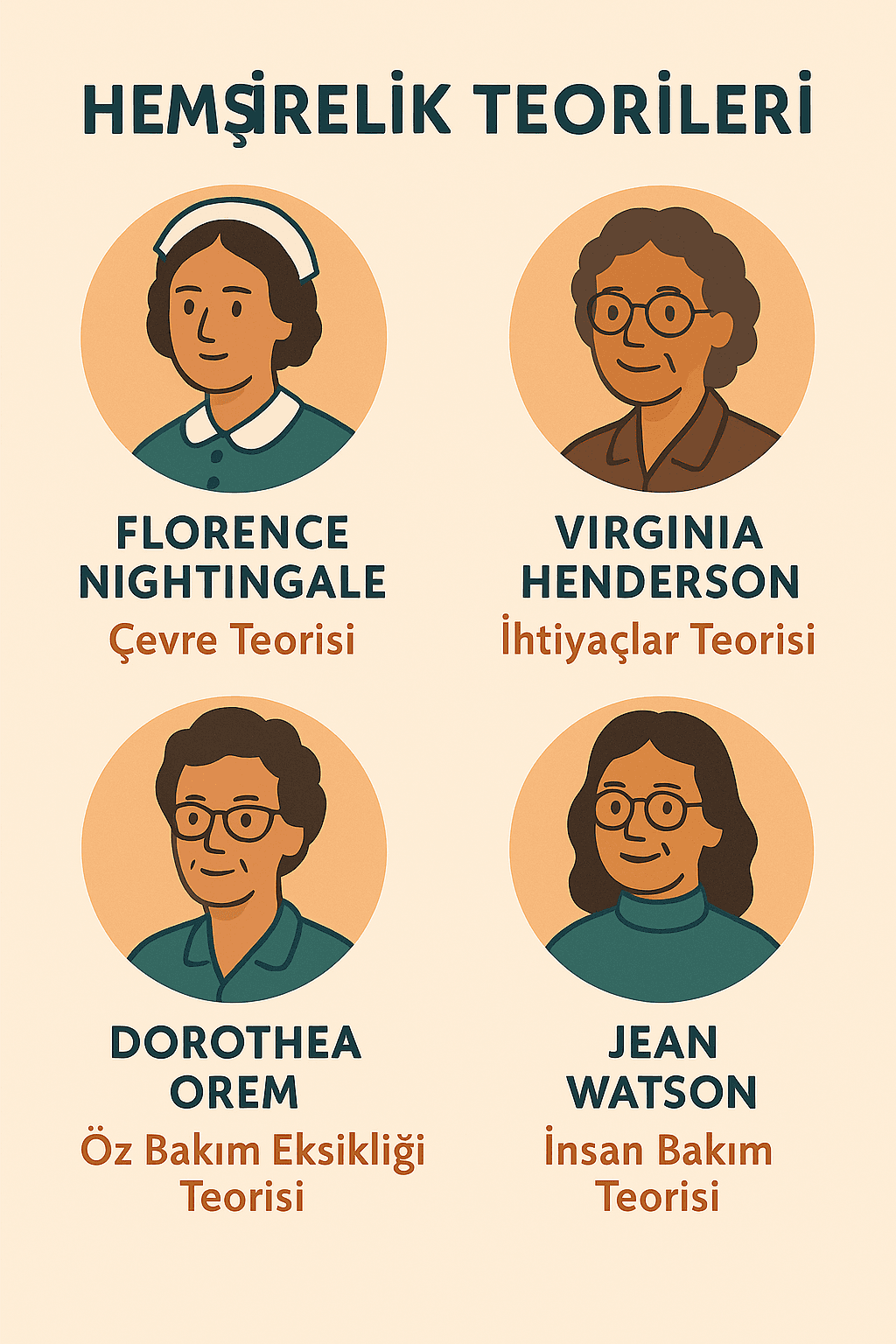
Nursing Theories
Origin(s) | The first foundations were laid by Florence Nightingale it acquired scientific character in the 20th century. | ||||||||
|---|---|---|---|---|---|---|---|---|---|
Classification(s) | Grand theories are divided into middle-range theories and practice-oriented theories. | ||||||||
Theorists | Theorists such as Peplau Orem Roy Henderson and Watson are pioneers. | ||||||||
Nursing theories are systematic bodies of knowledge that explain the fundamental concepts of the nursing profession, guide care practices, and support evidence-based decision-making processes. These theories are shaped around core concepts such as the individual, environment, health, and nursing, and serve as a framework to help nurses determine which approaches and methods to adopt in clinical practice.
Nursing theories do not merely provide practical knowledge; they also strengthen the scientific dimension of the profession, contribute to the design of research, and form the foundation of education. These theories, which vary in levels of abstraction, support nursing practice at multiple levels—from general principles to specific clinical applications.
The historical development of nursing theories is directly linked to the profession’s transition from a practice-based field to a scientific discipline. In early periods, nursing practices were largely based on traditional knowledge, personal experience, and observation. These practices lacked any scientific foundation and did not include a systematic theoretical framework. However, in the 19th century, Florence Nightingale’s work focusing on the impact of environmental conditions on health laid the first steps of theoretical thinking in nursing. Nightingale systematically examined the relationship between factors such as cleanliness, ventilation, lighting, and nutrition with health, thereby establishing the theoretical foundation of modern nursing.
By the mid-20th century, advancements in health services and the integration of nursing education into universities increased the demand for theories that could support the scientific dimension of the profession. During this period, nursing research gained momentum, and comprehensive theories began to emerge around the core concepts of the individual, environment, health, and nursing. Hildegard Peplau’s theory of interpersonal relations, Virginia Henderson’s basic needs model, and Dorothea Orem’s theory of self-care deficit were among the pioneering theoretical contributions of this era. These theories enabled nursing care to be conducted not merely as task-oriented activities but as conscious, planned processes.
From the 1970s onward, nursing theories began to be developed with greater abstraction, a systems-oriented perspective, and an interdisciplinary approach. Callista Roy’s adaptation model, Betty Neuman’s systems model, and Madeleine Leininger’s transcultural nursing theory are systematic frameworks that holistically address individual-environment interactions. These theories have helped nurses analyze problems encountered in the care process while also grounding practices in scientific principles.
In the 21st century, nursing theories have been reshaped in response to rapid changes in health technologies, patient rights, cultural diversity, and ethical sensitivities. Contemporary theories focus not only on the biological aspects of the individual but also on psychological, social, and spiritual dimensions. Jean Watson’s theory of human caring places ethical and humanistic values at the center, while Barbara Dossey’s Integral Nursing Theory fosters a multidimensional, holistic approach to nursing practice. These developments demonstrate that nursing is not merely a technical skill-based profession but a specialized field grounded in theoretical knowledge.
Nursing theories are conceptual systems that address the diverse aspects of the nursing profession. These theories are generally structured around four fundamental concepts: the individual, environment, health, and nursing.
These concepts can be addressed and interpreted in various ways within nursing theories. Theories are developed to explain the relationships among these core concepts, structure care processes, and establish a scientific basis for nursing practice. At this point, it is important to distinguish between theories and models: theories provide abstract and conceptual frameworks, while models are systematic structures and visual representations that operationalize these theories.
Nursing theories are categorized into three main groups based on their scope and level of abstraction:
This classification enables nursing theories to be utilized at different levels, both in academic settings and in clinical practice. Throughout their professional development, nurses build their knowledge and skills from broad theoretical frameworks toward middle-range and practice-level theories. For theories to be valid, they must possess certain scientific characteristics: they must be explanatory, consistent, testable, developable, and supportive of nursing practice.
One of the most recognized and widely applied nursing theories is the Self-Care Deficit Nursing Theory. This theory identifies the necessity of nursing intervention when individuals are unable to meet their own self-care needs. It determines self-care deficits based on the individual’s health status and emphasizes the nurse’s role in addressing these deficits through care.
One of the theory’s fundamental assumptions is that by enhancing the individual’s knowledge and skills related to their health condition, patients can participate more independently and effectively in their own care. Nurses provide education, support, and counseling to increase patients’ self-care capacity.
The Self-Care Deficit Theory has broad applications in the management of chronic illness, postoperative care, elderly care, and rehabilitation processes. It is widely regarded as a guiding model for nurses in planning and implementing patient-centered care.
Nursing theories play a crucial role in structuring and implementing care processes. Through theoretical frameworks, nurses understand which steps to follow, which assessment tools to use, and how to define the goals of care. Without theoretical knowledge, nursing practices often rely heavily on intuition and experience, potentially leading to inconsistent outcomes.
Effective application of theories in clinical practice leads to improved quality of care, increased patient satisfaction, and better health outcomes. However, practical challenges also exist. Nurses’ ability to translate theoretical knowledge into clinical practice varies. Moreover, demanding work conditions, time constraints, and resource limitations can hinder the effective use of theoretical knowledge.
In specialized clinical areas such as neonatal intensive care, the integration of nursing theories through non-pharmacological methods is recognized as a practice that enhances care quality. Such applications contribute to the development of a holistic and patient-centered approach in nursing.
Theoretical knowledge is a fundamental component in the professional development of nursing students. Theories equip students with the scientific foundations of the nursing profession while also fostering professional identity and perspective. Theory education supports nursing candidates in understanding care processes, developing clinical decision-making skills, and acquiring the capacity for scientific research.
However, just as important as teaching theories in education is the transfer of this knowledge into clinical practice. Nursing education programs must be structured to support the ability to translate theory into practice. During clinical placements and practical training, students should be encouraged to connect their theoretical knowledge with concrete patient care.
In recent years, nursing theories have become more comprehensive and holistic through multidisciplinary approaches. Enriched by insights from fields such as psychology, sociology, biology, and technology, these theories are adapting to the complex structure of modern health services.
New theoretical models are being developed and applied particularly in areas such as chronic disease management, nursing interventions in elderly care, the use of health technologies, and patient safety. These advancements strengthen the scientific dimension of the nursing profession and promote the adoption of innovative approaches in patient care.
Baykara, Zehra Göçmen, Nurcan Çalışkan, Deniz Öztürk, and Ayşe Karadağ. “Hemşirelikte Teori ve Model Kullanımı: Nitel Bir Çalışma.” *Cukurova Medical Journal* 44 (2019): 281–89. Accessed May 21, 2025. https://dergipark.org.tr/en/download/article-file/764934
Buldur, Emel., Yıldırım, Yasemin., and Fisun Şenuzur, Aykar. “İntegral Hemşirelik Teorisi ve Yenidoğan Yoğun Bakımlarda Uygulanan Non-Farmakolojik Yöntemlere Teorinin Entegre Edilmesi.” *İzmir Katip Çelebi Üniversitesi Sağlık Bilimleri Fakültesi Dergisi* 8, no. 1 (2023): 221–227. Accessed May 21, 2025. https://dergipark.org.tr/en/download/article-file/2384739.
Erdoğan, Esra Nur, Gülten Güvenç, and Emine İyigün. “Orem’in Öz Bakım Eksikliği Hemşirelik Teorisi’ne Göre Over Kanseri Nedeniyle Ameliyat Olan Hastanın Hemşirelik Bakımı: Olgu Sunumu.” *Ordu Üniversitesi Hemşirelik Çalışmaları Dergisi* 6, no. 3 (2023): 749–758. Accessed May 21, 2025. https://dergipark.org.tr/en/download/article-file/2825443
Kalkan, Nevra, and Mehtap Karadağ. “‘Hastalığımla Barışıyorum, Hastalığımla Yaşıyorum’: Periferik Arter Hastalığında Öz Bakım Eksikliği Hemşirelik Teorisi Doğrultusunda Hazırlanan Bir Algoritma Eğitim Kitapçığı.” *Kardiyovasküler Hemşirelik Dergisi* 12, no. 29 (2021): 196–206. Accessed May 21, 2025. https://jag.journalagent.com/kvhd/pdfs/KVHD_12_29_196_206.pdf

Nursing Theories
Origin(s) | The first foundations were laid by Florence Nightingale it acquired scientific character in the 20th century. | ||||||||
|---|---|---|---|---|---|---|---|---|---|
Classification(s) | Grand theories are divided into middle-range theories and practice-oriented theories. | ||||||||
Theorists | Theorists such as Peplau Orem Roy Henderson and Watson are pioneers. | ||||||||
Historical Development of Nursing Theories
Scope and Structure of Nursing Theories
Classification of Nursing Theories
Self-Care Deficit Nursing Theory
Implications for Clinical Practice
The Role of Theories in Nursing Education
Contemporary Nursing Theories and Research Areas