


This article was automatically translated from the original Turkish version.
+1 More
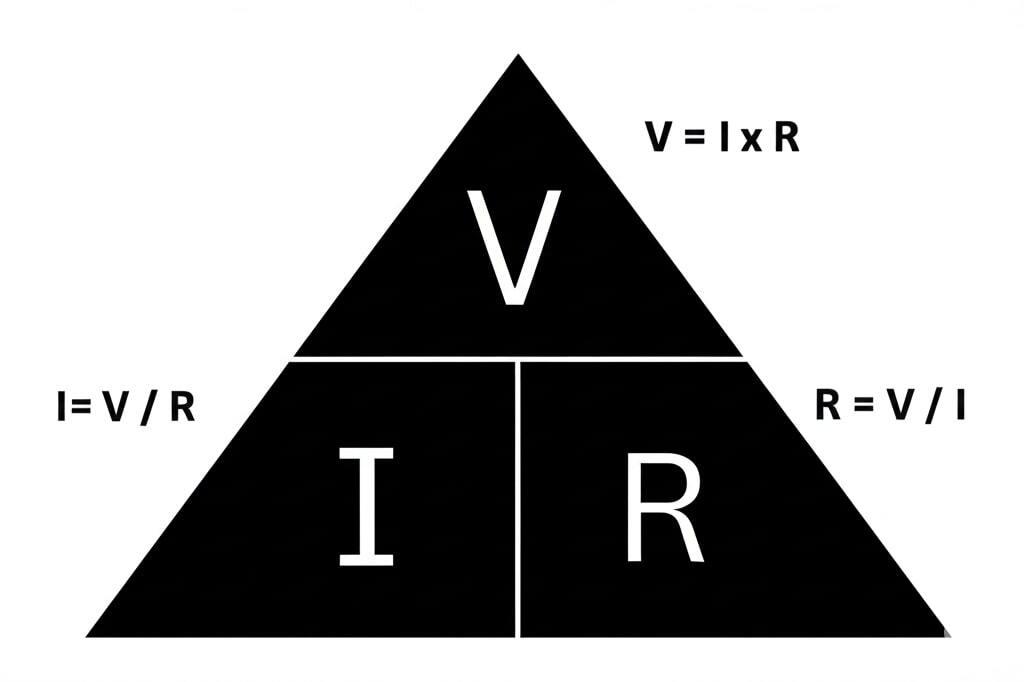
Ohm's Law (Generated with Artificial Intelligence)
Definition(s) | and resistance in an electric circuit current The law describing the linear relationship between voltage | ||||||||
|---|---|---|---|---|---|---|---|---|---|
Formula | V = I x R | ||||||||
Year of First Publication | 1827 | ||||||||
Formulator of the Law | George Simon Ohm | ||||||||
Application Area(s) | Power Engineering Electric and Electronic Circuits Resistance Calculations | ||||||||
Related Units | Ohm (Ω) Ampere (A) Volt (V) | ||||||||
Ohm’s Law is a fundamental physical law that expresses the basic linear relationship between voltage, current, and resistance in electrical circuits. Under specific conditions—particularly constant temperature and fixed material properties—it states that the potential difference applied across a conductor is directly proportional to the electric current flowing through it. In other words, the relationship between voltage and current in a circuit is directly proportional, and the constant of proportionality is called resistance. The most fundamental mathematical expression of the law is as follows:
In this formula:
This formula is one of the fundamental principles in electrical engineering and physics and is widely used in the analysis of simple electric circuits. However, the validity of Ohm’s Law applies only to linear and ohmic materials. Ohmic materials are substances that exhibit a linear relationship between voltage and current and possess a constant resistance value. In contrast, this linear relationship does not hold for certain semiconductor materials, diodes, and electrolytic solutions, where resistance may vary depending on the current or voltage.
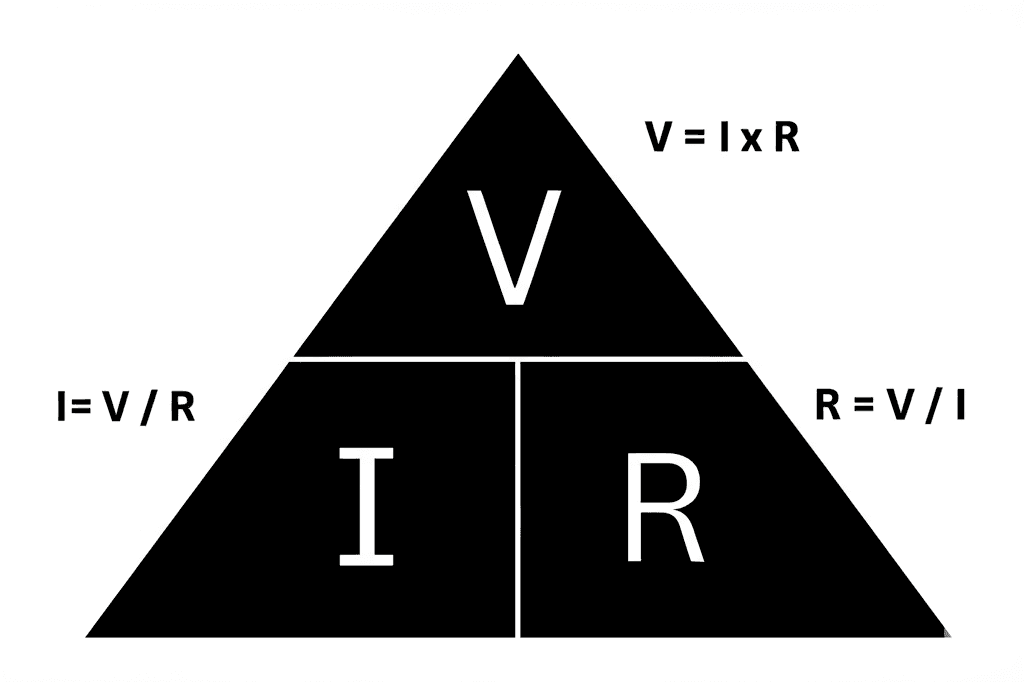
Ohm’s Law Triangle (Generated by Artificial Intelligence.)
According to this representation:
In addition, the concept of electric power (P) is used to understand energy transfer and losses in electric circuits. Electric power indicates the rate at which electrical energy is consumed over a given time interval and is expressed by the following fundamental formula:
Using the fundamental equations of Ohm’s Law above, power calculations can also be expressed in the following alternative forms:
or
These formulas enable the calculation of power loss due to resistance in circuits, which manifests as heat energy.
Georg Simon Ohm’s formulation of this law was shaped by intensive experimental and theoretical work between 1825 and 1827. Ohm initially drew inspiration from the concept of “loss” in electrostatic forces to observe the electrical behavior of circuit components. He began his experiments using voltaic piles but, due to their instability, later adopted the thermoelectric couple (thermocouple) developed by Seebeck.
Ohm’s experimental setup consisted of three key components: a power source (initially a voltaic pile, later a thermocouple), a conducting wire of varying lengths and cross-sections, and a torsion balance with a magnetized needle for measurement. Using this setup, he successfully measured the effects of the conductor’s length and cross-sectional area on electric current. These empirical observations formed the foundation of what Ohm termed the “law of conduction.”
In his 1826 publication, Ohm explained that the conductivity of metallic conductors could be described by a law. In his 1827 mathematical treatise, this law was presented within a general and abstract framework. In this work, Ohm adopted an approach describing electricity as spreading from a “voltage source” through “conducting channels.” When defining electrical quantities, Ohm used terms such as “electrostatic force,” “erregende Kraft” (exciting force), and “Kraftverlust” (force loss), reflecting how his terminology evolved alongside experimental advancements.
Today, Georg Simon Ohm’s name is remembered not only for the law bearing his name but also for the unit of electrical resistance, the “ohm” (). After his death, in the 1860s, the British Association for the Advancement of Science named the unit of electrical resistance the “ohmad,” which was later standardized as “ohm.” Ohm’s contribution is regarded in the history of physics as a symbol of individual observation, experimentation, and abstract reasoning.

George Simon Ohm (Picryl)
In electricity, resistance is defined as the opposition a conductor offers to the flow of electric current. The magnitude of resistance depends on the type of material, temperature, geometric dimensions, and other physical conditions. However, in many educational materials, Ohm’s Law is presented as the definition of resistance. In reality, the relationship expressed by the law is an empirical observation, and the concept of resistance must be treated separately from the law itself.
Resistance can be defined in cases where the ratio of current to voltage remains constant. This condition holds when the material is at a constant temperature and exhibits ohmic behavior. Therefore, interpreting the law as a definition of resistance may lead to conceptual confusion, because resistance and the law represent distinct entities: one is a definition, the other a physical relationship.
Although Ohm’s Law is a macroscopic physical law, it can be related to the motion of free electrons at the microscopic level. The classical Drude model explains that free electrons in metals accelerate under the influence of an electric field and undergo collisions with atomic nuclei, resulting in an average drift velocity. The frequency of these collisions between electrons and atoms is the primary determinant of a conductor’s resistance.
As temperature increases, atomic vibrations intensify, leading to more frequent collisions with electrons, which in turn increases resistance. On the other hand, the electrical behavior of semiconductors becomes more complex according to the band structure model. Electrons move within specific energy bands, and their carrier densities along with the structure of the energy bands cause the current–voltage relationship to deviate from linearity. Therefore, Ohm’s Law retains its validity only under specific material and temperature conditions.
Ohm’s Law is a fundamental topic in the study of electrical circuits. However, educational research has shown that students often fail to grasp its physical meaning and instead memorize only its formula. This leads to incorrect conclusions when students apply the law to practical problems, such as comparing the brightness of bulbs. Therefore, it is recommended that instructors teach Ohm’s Law not merely as a mathematical formula but also in connection with physical models and microscopic mechanisms.
Ohm’s Law is widely used in the design of electrical circuits, resistance calculations, analysis of energy losses, and characterization of electronic components. It is also one of the fundamental computational principles underlying electronic circuit simulation software. However, the law loses its validity in circuits containing nonlinear elements, in high-frequency applications, and at very low temperatures where quantum effects become significant. In such conditions, more complex electrical models are employed.
"Georg Simon Ohm." Picryl. Accessed July 15, 2025. https://picryl.com/media/georg-simon-ohm3-fafd49.
NASA Glenn Research Center. “Ohm’s Law.” *NASA Glenn Research Center Educational Resources*, Accessed July 4, 2025. https://www.grc.nasa.gov/www/k-12/airplane/ohms.html.
O'Sullivan, Colm. "Ohm's Law and the Definition of Resistance." Physics Education 15, no. 4 (1980): 237–243. Accessed July 7, 2025. https://www.researchgate.net/publication/231121516_Ohm's_law_and_the_definition_of_resistance
Tenny, Kevin M., and Michael Keenaghan. “Electrical Circuits and Ohm’s Law.” *StatPearls*, Accessed July 4, 2025. https://www.ncbi.nlm.nih.gov/books/NBK441875/.
The Engineering Mindset. "Ohms Law Explained - The basics circuit theory." YouTube, Accessed July 4, 2025. https://www.youtube.com/watch?v=HsLLq6Rm5tU.

Ohm's Law (Generated with Artificial Intelligence)
Definition(s) | and resistance in an electric circuit current The law describing the linear relationship between voltage | ||||||||
|---|---|---|---|---|---|---|---|---|---|
Formula | V = I x R | ||||||||
Year of First Publication | 1827 | ||||||||
Formulator of the Law | George Simon Ohm | ||||||||
Application Area(s) | Power Engineering Electric and Electronic Circuits Resistance Calculations | ||||||||
Related Units | Ohm (Ω) Ampere (A) Volt (V) | ||||||||
Ohm’s Law Triangle
Voltage:
Current:
Resistance:
Historical Development
Concept of Resistance
Microscopic Approaches and the Limits of the Law
Applications