

This article was automatically translated from the original Turkish version.
+1 More
Name(s) | Old Beyazıt Mosque (Old Bayezid Mosque / Cami-i Gevher-i Digar) | ||||||||
|---|---|---|---|---|---|---|---|---|---|
Location | Doğubayazıt Ağrı southern slopes of İç Kale | ||||||||
Construction Period | Probably 16th century (after Çaldıran, reign of Selim I) | ||||||||
Restoration Dates | 1687 (inscription), 2012 (restoration) | ||||||||
Plan Type | Square plan, single-domed, single-minaret, cut stone | ||||||||
Architectural Feature(s) | Octagonal drum-supported dome square + cylindrical minaret muqarnas-lined mihrab niche | ||||||||
Current Condition | Closed to worship, open for controlled visits | ||||||||
Cultural Function | Ottoman-era religious center; focus of faith and cultural tourism | ||||||||
Protection Status | Restored in 2012 under protection open to tourism | ||||||||
Old Beyazıt Mosque is one of the significant religious architectural examples from the Ottoman period, located in the Doğubayazıt district of Ağrı Province along the historic Silk Road route. Constructed in the early 16th century, during the period when Ottoman authority began to consolidate in eastern Anatolia, the structure bears traces of historical continuity both in its architectural character and its location. Considered one of the first stone mosques built by the Ottomans in the east, the mosque served for many years as both a place of worship and a center of social life. Today, it is preserved as both a cultural and archaeological heritage site.
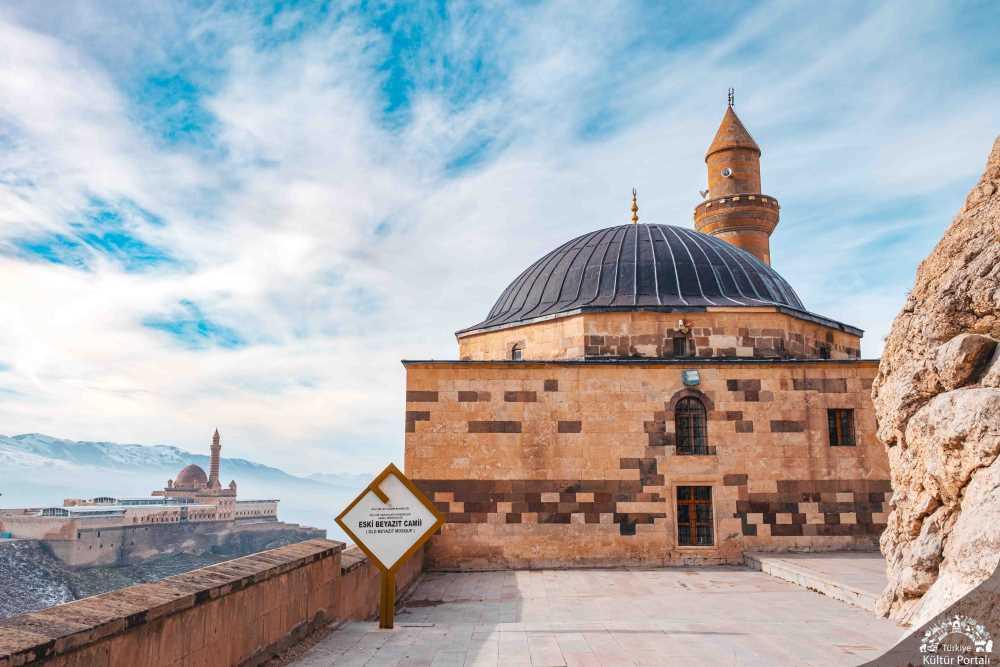
The Old Beyazıt Mosque is situated on the southern slope of the inner citadel of Doğubayazıt, on a terraced terrain extending toward İshak Paşa Palace. Built upon a stone terrace to adapt to the sloping terrain, the mosque fulfilled a dual function as both a defensive structure and a religious space integrated into the urban layout. Located in a strategic position in Eastern Anatolia, its domed form and single minaret create a silhouette harmonious with surrounding architectural elements; the visual dialogue it establishes with the citadel and palace integrates the building into the city’s historical identity.

Old Beyazıt Mosque
While there are discrepancies regarding the exact construction date, the prevailing consensus is that the mosque was built after the Battle of Chaldiran, during the reign of Sultan Selim I (1514–1517). Some sources refer to a restoration inscription dated 1687, but the architectural style and stonework generally point to the late 16th century. The mosque represents one of the earliest signs of Ottoman dominance in the east. In medieval Doğubayazıt, it was recognized as one of the central institutions combining political and religious functions. During this period, the mosque not only met the spiritual needs of the community but also served as a symbol of the permanence of Ottoman administration.

Old Beyazıt Mosque (Culture Portal)
The Old Beyazıt Mosque is an example of the classical Ottoman mosque type with a square plan and a single dome. Its interior measures approximately 15×15 meters and is constructed of cut stone. The dome rests on an octagonal drum, with the transition achieved through arches. Although the enclosed congregational hall has been partially destroyed over time, traces of the arches and supporting piers remain visible along the structure’s perimeter. The minaret is attached directly to the side walls and features a square base and cylindrical shaft. The mihrab niche on the northern wall is pentagonal in form and surrounded by ornamental columns with muqarnas capitals. Colorful cut stones — brown, yellow, red, and white — on the exterior façade impart a distinctive aesthetic and local character to the mosque.

Old Beyazıt Mosque (Culture Portal)
Throughout history, the mosque has been one of the central hubs of daily religious life in Doğubayazıt. During the Ottoman period, it hosted Friday and holiday prayers, educational lectures, and public gatherings. Its proximity to İshak Paşa Palace strengthened ties between palace officials and the local population. Although evidence of formal educational use is limited, it is believed that traditional conversations continued within the mosque and that the congregation engaged in knowledge exchange after prayers.
The mosque has undergone various repairs over time. The earliest documented repairs are dated to 1687, as recorded on an inscription. In 2012, a comprehensive restoration led by the General Directorate of Foundations strengthened the building’s structural system and restored the dome and minaret. Today, the mosque is closed for worship due to the risk of collapse of the dome; however, it is open to controlled visits, primarily for tourism purposes. Environmental management and conservation approaches are maintained during commercial tourism activities.
As one of the few early mosques reflecting Ottoman heritage in Eastern Anatolia, the Old Beyazıt Mosque draws attention for its architectural significance. Its use of cut stone, dome structure, and minaret present a regional variant of the classical Ottoman mosque model, offering valuable research material for both architects and historians. From a tourism perspective, it is a key stop visited by travelers to Doğubayazıt alongside İshak Paşa Palace, Ahmed-i Hani Türbesi, and Keşiş Bahçesi. This highly valuable structure is a unique work that unites religion, history, architecture, and cultural context within a single space.
Accessed November 26, 2025.
Ministry of Culture and Tourism. "Eski Bayezid Camii – Ağrı." Kültür Portalı. Accessed July 24, 2025.
Turizm Ansiklopedisi. "Beyazıt Eski Camii." Türkiye Turizm Ansiklopedisi. Çelik, Ramazan (2020). Accessed July 24, 2025.

Name(s) | Old Beyazıt Mosque (Old Bayezid Mosque / Cami-i Gevher-i Digar) | ||||||||
|---|---|---|---|---|---|---|---|---|---|
Location | Doğubayazıt Ağrı southern slopes of İç Kale | ||||||||
Construction Period | Probably 16th century (after Çaldıran, reign of Selim I) | ||||||||
Restoration Dates | 1687 (inscription), 2012 (restoration) | ||||||||
Plan Type | Square plan, single-domed, single-minaret, cut stone | ||||||||
Architectural Feature(s) | Octagonal drum-supported dome square + cylindrical minaret muqarnas-lined mihrab niche | ||||||||
Current Condition | Closed to worship, open for controlled visits | ||||||||
Cultural Function | Ottoman-era religious center; focus of faith and cultural tourism | ||||||||
Protection Status | Restored in 2012 under protection open to tourism | ||||||||
Location and Spatial Structure
Historical Background
Architectural Features
Usage and Social Function
Conservation and Restoration Processes
Cultural, Architectural, and Touristic Value