
This article was automatically translated from the original Turkish version.
Catalog Names | Sharpless 45 NGC 6618 Messier 17 | ||||||||
|---|---|---|---|---|---|---|---|---|---|
Constellation | Sagittarius | ||||||||
Type(s) | H II region (emission nebula) | ||||||||
Distance(s) | 5 000 light years 500 to 6 | ||||||||
Size(s) | Approximately 15 light years in diameter | ||||||||
Apparent Magnitude (V) | Approximately +6.0 magnitude | ||||||||
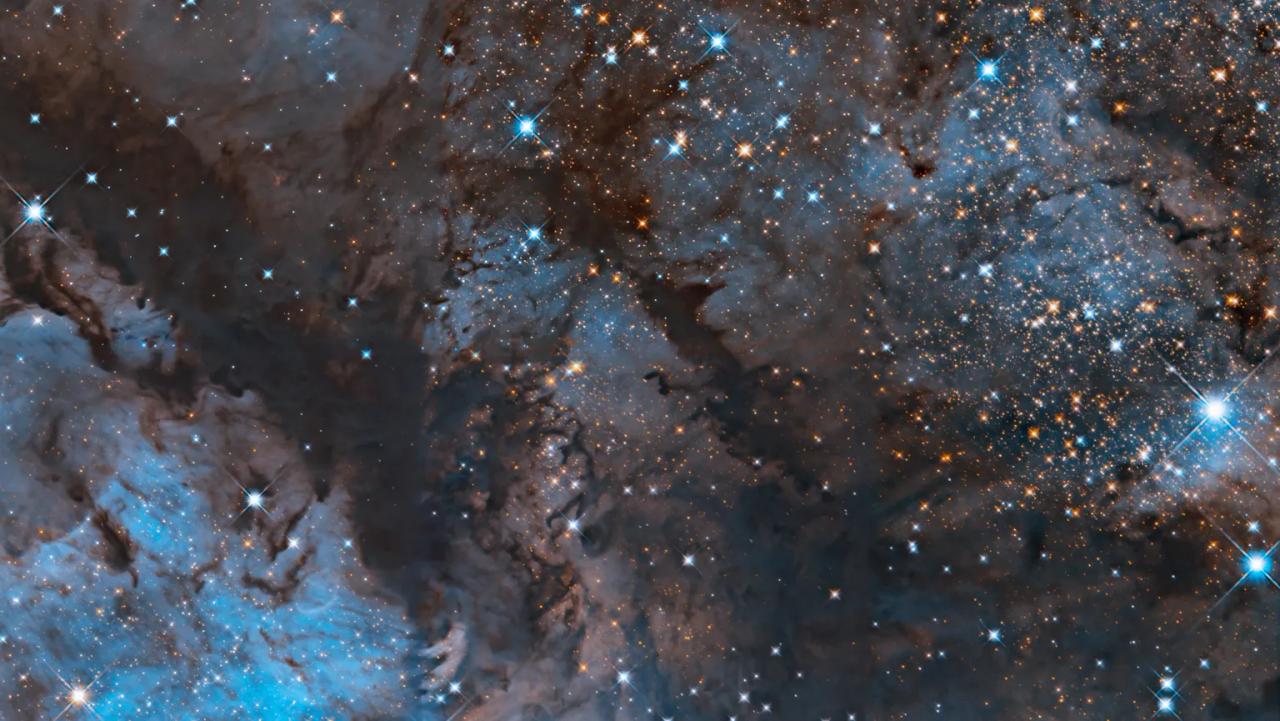
The Omega Nebula, also known as Messier 17 (M17), the Swan Nebula or the Horseshoe Nebula, is a large, bright, and active star-forming region located within the Milky Way Galaxy. It is observable through telescopes during summer months in the southern hemisphere and tropical regions of the northern hemisphere. The nebula is of significant astronomical interest due to its intense star formation, ionized gases, and complex internal structure.

Omega Nebula. (NASA)
The Omega Nebula is located in the direction of the constellation Sagittarius. Its position places it within a dense and star-rich region of the Milky Way. Under suitable observing conditions, it can be seen even with small telescopes. Due to its brightness and wide angular structure, it is one of the most frequently observed nebulae by amateur astronomers.
M17 is a region containing large amounts of ionized hydrogen (H II) gas where new stars are forming in the interstellar medium. The hydrogen gas within the nebula is highly ionized by young, hot O and B-type stars embedded within it, causing the nebula to glow in reddish and pinkish hues.
The structure of M17 is highly complex; dust clouds, gas filaments, and star clusters within it have been revealed through observations at different wavelengths. Optical observations highlight the bright central gas regions, while infrared and radio observations uncover star-forming areas obscured by dust.
The Omega Nebula attracts the attention of astronomers due to its active star-forming regions. It contains a cluster of very young and hot stars. These stars exert significant influence on the surrounding gas and dust through stellar winds and radiation pressure, shaping the nebula’s structure.
This open star cluster, designated NGC 6618, contains thousands of young stars, particularly massive O and B-type stars that are the primary source of ionization in the region. These stars not only illuminate the nebula but can also sweep away surrounding gas, triggering further star formation.
Observations across different wavelengths provide detailed information about the physical conditions within M17. X-ray observations reveal high-energy events and stellar winds, while infrared observations allow the detection of young stars hidden within dense dust clouds. Data collected by instruments such as the Hubble Space Telescope, Spitzer, and Chandra have contributed significantly to a better understanding of M17’s internal structure and star formation mechanisms.
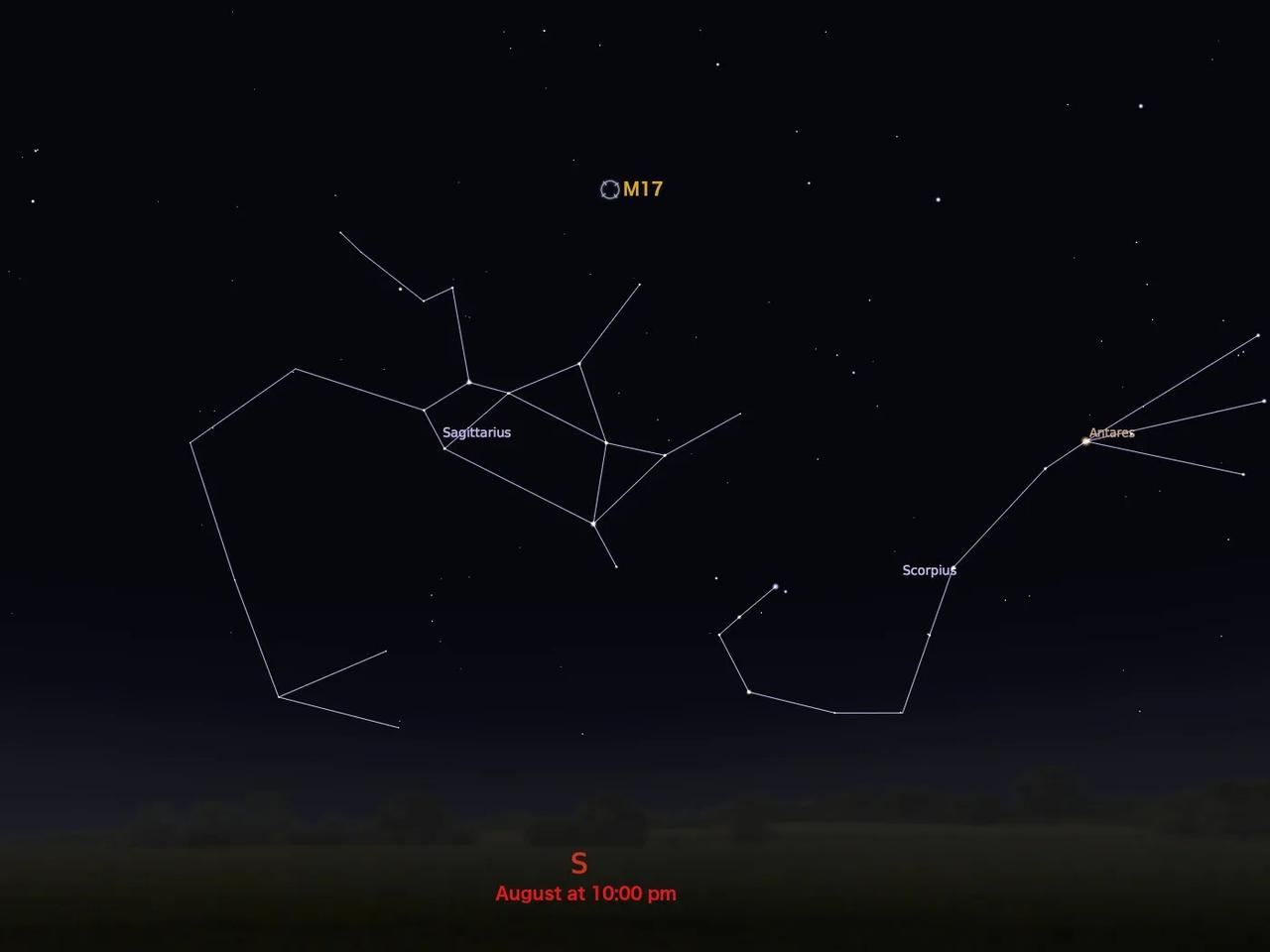
Location of M17. (NASA)
Spectral analyses have provided information on the chemical composition, temperature, and density of the gas within the nebula. Typical emission lines of hydrogen, helium, oxygen, sulfur, and nitrogen have been detected. This confirms M17’s classification as an H II region.
The Omega Nebula serves as an important example for understanding the birth, evolution, and interaction of stars with their environment. This nebula offers an opportunity to study how high-mass stars influence their surroundings during their short lifetimes and the resulting effects on the interstellar medium.
In addition, gas motions caused by supernova explosions and stellar winds in regions like M17 are critically important for galactic-scale matter circulation. Such regions also provide valuable data on the formation and distribution of organic molecules in the universe.
M17 was discovered in 1745 by Jean-Philippe de Cheseaux and observed and cataloged by Charles Messier in 1764. Messier included this nebula as object number 17 in his famous list of fixed celestial objects that interfered with comet observations. It was later studied by John Herschel.
Over time, its resemblance to a swan or a horse’s hoof led to alternative names, reflecting visual interpretations of its appearance.
The Omega Nebula has been the subject of extensive astronomical research as an active H II region where young stars are forming. Its population of young stars, ionized gas, and dust clouds sheds light on the dynamic processes of star birth. Observations across multiple wavelengths have enabled detailed analysis of the physical and chemical processes occurring in this region. Messier 17 maintains its place in the scientific literature as an important model region for studying star formation.
NASA. “IDL TIFF File 18.” *NASA Science*, https://science.nasa.gov/image-detail/idl-tiff-file-18/. Accessed July 16, 2025.
NASA. “Messier 17.” NASA Science, https://science.nasa.gov/mission/hubble/science/explore-the-night-sky/hubble-messier-catalog/messier-17/. Accessed July 16, 2025.
NASA. “The Omega Nebula (M17) with Outline of ACS Image.” NASA Science, https://science.nasa.gov/asset/hubble/the-omega-nebula-m17-with-outline-of-acs-image/. Accessed July 16, 2025.
NASA. “The Omega Nebula (Swan Nebula, M17).” *NASA Science*, https://science.nasa.gov/asset/hubble/the-omega-nebula-swan-nebulam17/. Accessed July 16, 2025.

Catalog Names | Sharpless 45 NGC 6618 Messier 17 | ||||||||
|---|---|---|---|---|---|---|---|---|---|
Constellation | Sagittarius | ||||||||
Type(s) | H II region (emission nebula) | ||||||||
Distance(s) | 5 000 light years 500 to 6 | ||||||||
Size(s) | Approximately 15 light years in diameter | ||||||||
Apparent Magnitude (V) | Approximately +6.0 magnitude | ||||||||
General Properties
Location and Observability
Physical Structure
Star Formation and Central Star Cluster
Observational Studies and Spectral Analysis
Scientific Significance
History and Cataloging