

This article was automatically translated from the original Turkish version.
+1 More
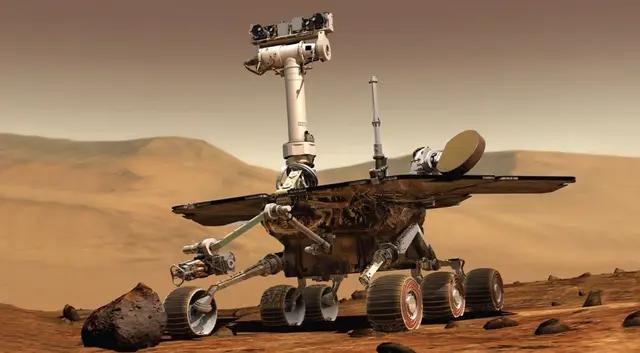
Mars Opportunity Exploration Vehicle
Launch Date | July 8, 2003 | ||||||||
|---|---|---|---|---|---|---|---|---|---|
Maximum Speed | 0.18 km/h | ||||||||
Cost | 400 million USD | ||||||||
Mission Duration | Planned: 90 Mars sols (92.5 Earth days) / Actual: 5,352 sols (8 Mars years) 5,498 days (15 Earth years) | ||||||||
Opportunity (MER-B) is a robotic rover developed as part of the Mars Exploration Program conducted by the United States National Aeronautics and Space Administration (NASA). It was designed to collect long-term data on the Martian surface, conduct geological investigations, and seek evidence of past water presence. The vehicle provided significant scientific data confirming that water existed on Mars in the past, particularly through findings accumulated during its mission.
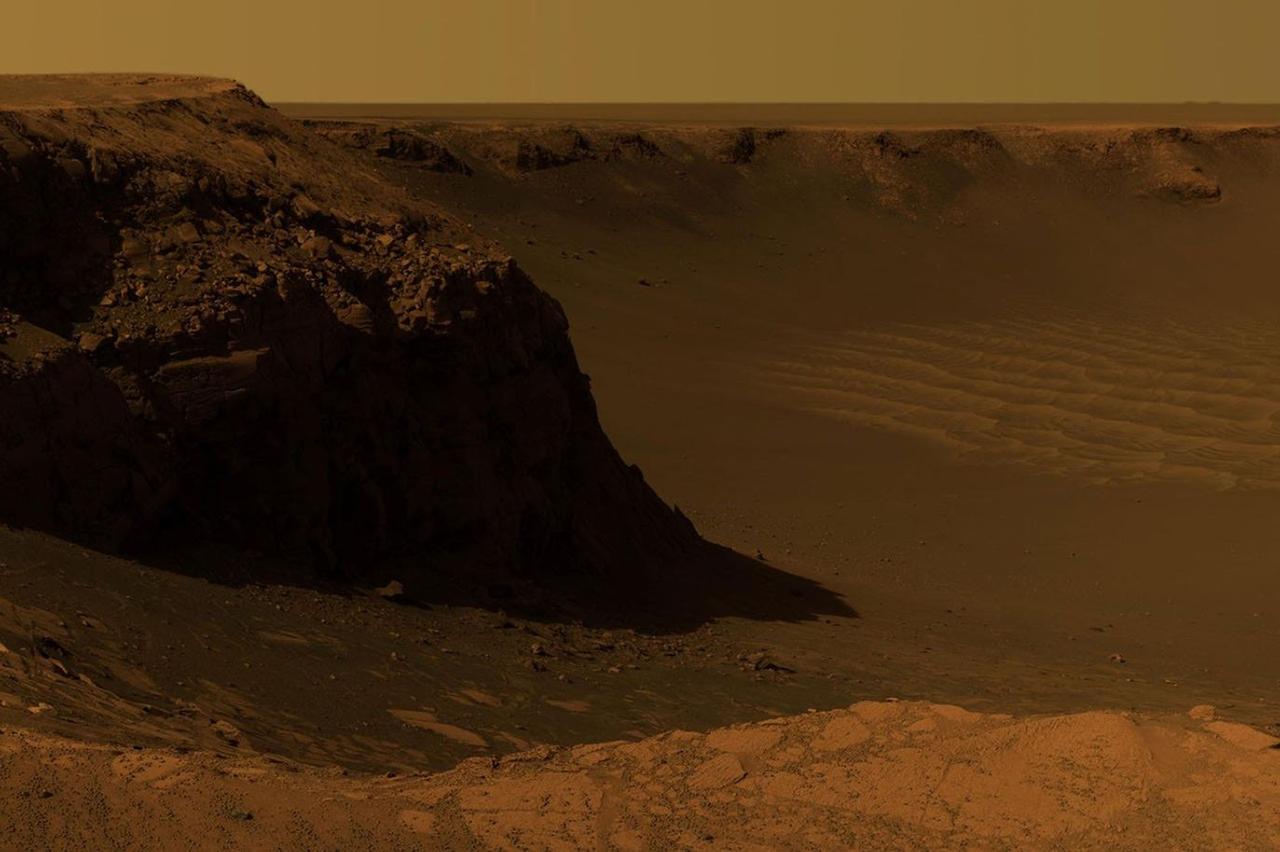
Victoria Crater as photographed by the Opportunity rover.
Opportunity is one of two rovers developed under NASA’s Mars Exploration Rover (MER) program. Developed jointly with its twin, Spirit (MER-A), by the Jet Propulsion Laboratory (JPL), it was launched on 7 July 2003 aboard a Delta II rocket from Cape Canaveral. Opportunity successfully landed on the Meridiani Planum region on 25 January 2004.
Opportunity weighed approximately 185 kg and measured 1.6 m in length, 2.3 m in width, and 1.5 m in height. It was equipped with a six-wheel suspension system and generated power through solar panels.

Artificial Intelligence-enhanced visualization of Opportunity’s technical data.
Powered by solar panels, Opportunity was able to sustain a long-duration mission. Its scientific instruments included:
Opportunity far exceeded its planned 90-Martian-day (Sol) mission, collecting data for a total of 5,111 Sol (approximately 15 Earth years). At its landing site, Eagle Crater, it identified layered sedimentary rocks, which were determined to have formed through interaction with water.
Meridiani Planum, Opportunity’s landing site, was selected due to its high content of crystalline hematite. On Earth, this mineral typically forms in the presence of water and was interpreted as strong evidence of past liquid water on Mars. The small spherical concretions discovered by the rover and nicknamed “blueberries” indicated past aqueous geological conditions.
During its mission, Opportunity examined numerous craters, with detailed investigations conducted at Victoria and Endeavour craters. Clay minerals identified in Endeavour Crater suggested the past presence of neutral-pH water, conditions considered potentially habitable for life.
Opportunity lost communication with Earth during a massive global dust storm in 2018. The storm covered its solar panels, halting power generation. After numerous recovery attempts, NASA officially ended the mission on 13 February 2019.
This event elicited an emotional response from the scientific community and the public. The phrase “My battery is low and it’s getting dark,” interpreted as Opportunity’s farewell message, reflects the symbolic significance the rover acquired during its mission.

Opportunity’s self-portrait.
The data collected by Opportunity during its mission established that:
The mission also provided significant engineering experience in robotics, space technologies, and long-duration planetary exploration. The data gathered continue to be used in scientific research.
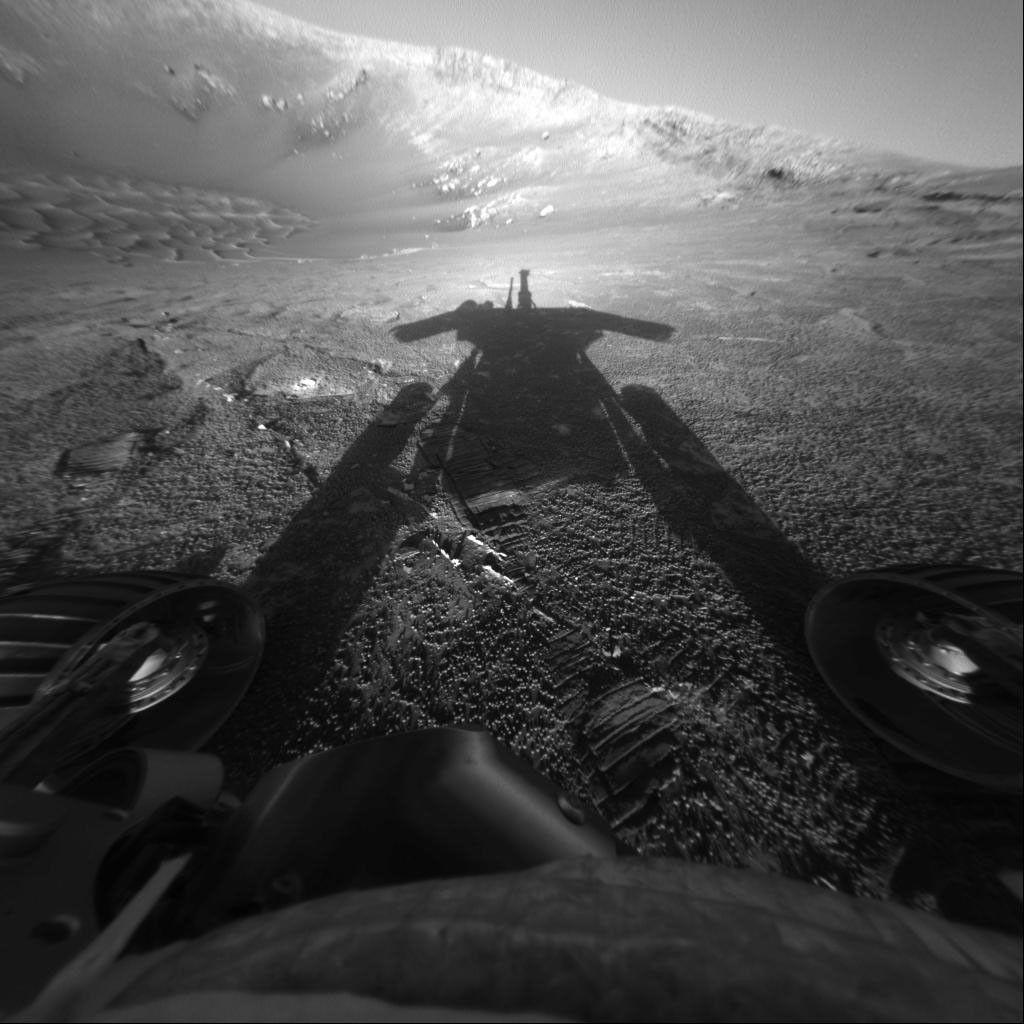
Opportunity entering Endurance Crater.
Opportunity established a pivotal milestone in Mars research through its long-duration surface mission and the scientific data it provided. The mission advanced understanding of the potential for life on Mars and laid the foundation for future exploration missions.
NASA. "MER Opportunity." NASA Science – Solar System Exploration. Accessed May 1, 2025.
NASA. "Opportunity Rover’s Full Marathon-Length Traverse." NASA Science: Solar System Exploration. Accessed May 1, 2025.
NASA. (2004). *Opportunity Rover Mission Overview*. Accessed May 1, 2025. https://mars.nasa.gov/mer/
NASA. “Location of Opportunity Rover.” NASA Science: Solar System Exploration. Accessed May 1, 2025.
NASA. “Mars Exploration Rover Mission Animation.” NASA Science: Solar System Exploration. Accessed May 1, 2025.

Mars Opportunity Exploration Vehicle
Launch Date | July 8, 2003 | ||||||||
|---|---|---|---|---|---|---|---|---|---|
Maximum Speed | 0.18 km/h | ||||||||
Cost | 400 million USD | ||||||||
Mission Duration | Planned: 90 Mars sols (92.5 Earth days) / Actual: 5,352 sols (8 Mars years) 5,498 days (15 Earth years) | ||||||||
No Discussion Added Yet
Start discussion for "Opportunity Discovery Tool" article
Mission Objectives and Development Process
Technical Specifications
Mission Progress and Key Discoveries
Mission Start and Initial Findings
Meridiani Planum and the Discovery of Hematite
Victoria and Endeavour Craters
End of Mission
Scientific and Technological Contributions