


This article was automatically translated from the original Turkish version.
+2 More
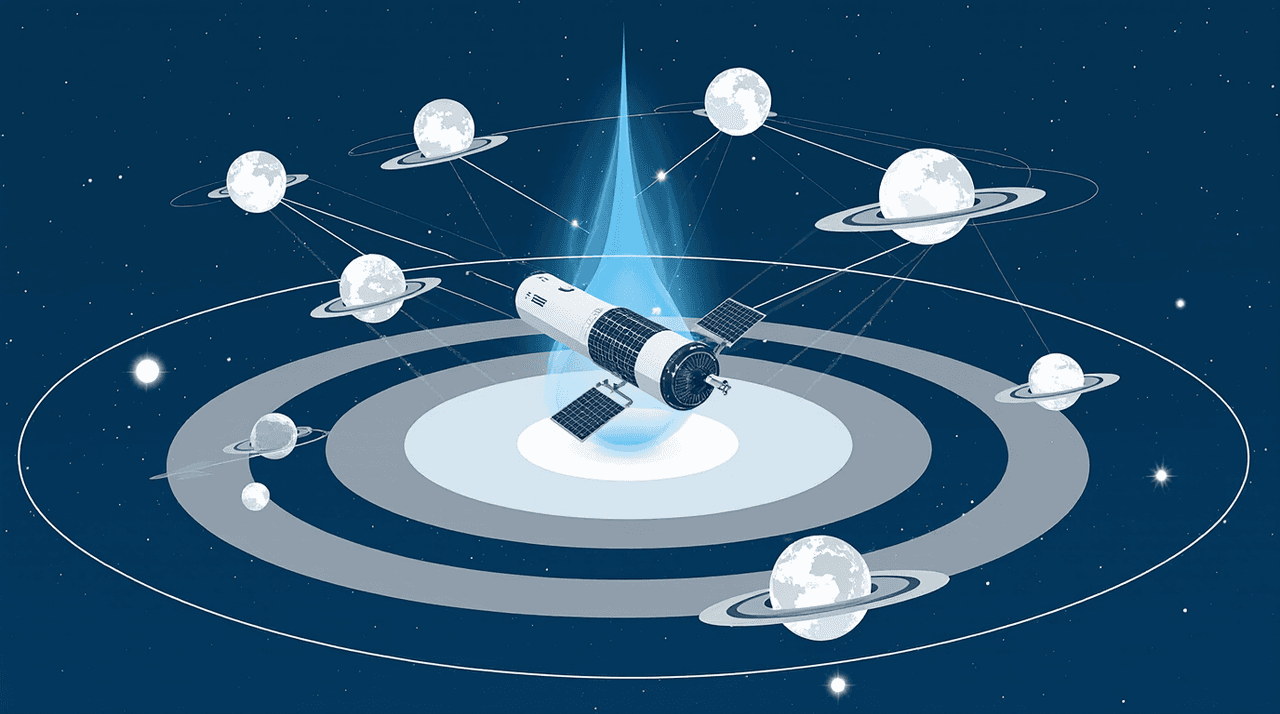
(Generated by Artificial Intelligence)
Orbital Transfer Vehicles
Main Subsystems | Propulsion module, power system, GNC units, docking mechanism, structure and thermal control, communication system | ||||||||
|---|---|---|---|---|---|---|---|---|---|
Task Types | LEO–GEO transfer, satellite positioning, backup satellite recovery, multiple payload deployment, debris removal and maintenance missions | ||||||||
Orbital Transfer Vehicles are spacecraft equipped with their own propulsion and attitude control systems, capable of transporting payloads or satellites from one orbit to another. These vehicles are used for purposes such as achieving precise orbital changes beyond the reach of launch vehicles, satellite maintenance and on-orbit servicing, space debris mitigation missions, and the development of low-cost multi-mission architectures.
The initial concepts formulated by NASA in the 1980s evolved into a broad design and mission domain following the proliferation of commercial satellite operations and low-thrust technologies. The most decisive factors in the evolution of the Orbital Transfer Vehicle (OTV) architecture have been the diversification of user requirements, the complexities of orbital dynamics, and the advancement of propulsion technologies capable of meeting high delta-V demands.

Orbital Transfer Vehicles (Generated by Artificial Intelligence)
The first systematic conceptualization of orbital transfer vehicles was shaped by NASA’s studies initiated in the 1970s. During this period, OTVs were defined as multi-purpose "space tugs" intended for satellite deployment and servicing between Low Earth Orbit (LEO) and Geostationary Earth Orbit (GEO). Subsequent conceptual design studies demonstrated that both cryogenic and storable chemical propulsion systems could provide high maneuverability in low-mass vehicles. However, unfavorable orbital dynamics and high energy requirements made it economically challenging for single-mission vehicles to offer advantages.
The 2000s marked the beginning of a new era with the integration of electric propulsion—offering low thrust but high specific impulse—into OTV architectures. Symmetric and Hamiltonian-based optimization methods for managing large orbital changes enabled long-duration low-thrust missions.
Orbital transfer vehicles possess a broad operational portfolio tailored to mission requirements. These include LEO–GEO satellite transfers, GEO backup satellite recovery, completion of failed apogee motor missions, debris removal, maintenance and servicing operations, and multi-point deployment missions. McManus and Schuman’s large-scale design space analyses revealed how design variables and benefit-parameter relationships vary across different mission types. This analysis identified total delta-V capacity, manipulator capability, and response time as the three key attributes determining user benefit.
In next-generation OTV systems, additional functions have emerged. Beyond payload transportation and distribution, these vehicles feature autonomous rendezvous and docking, modular service module carriage, and reusability for multiple mission cycles.
The design of an orbital transfer vehicle relies on the integrated operation of propulsion systems, power systems, payload interaction components, structure, GNC systems, and thermal-communication subsystems.
Propulsion selection is one of the most critical design variables in OTV architecture. NASA studies have shown that chemical propulsion offers advantages in missions requiring rapid response due to its high thrust, while electric propulsion excels in long-duration, high delta-V missions due to its high specific impulse. Electrically propelled vehicles compensate for low maneuvering rates through multi-revolution orbital spirals, achieving minimal fuel consumption. When supported by multi-revolution optimization algorithms, this approach enables highly accurate mission planning.
Structural design is optimized for temperature variations, radiation effects, and payload requirements in the space environment. The power system typically consists of solar panels and battery storage components. Thermal control is achieved through insulation blankets, radiators, and active heat regulation.
The GNC subsystem is used for precise orbital transfer calculations, rendezvous and docking operations, and thrust vectoring. It comprises inertial measurement units, star trackers, reaction wheels, and position-velocity estimation algorithms.
OTVs employ modular docking mechanisms to capture or release payloads. Current systems favor IDSS-compatible androgynous mechanisms and robotic manipulators. During docking, axial velocity, lateral alignment, and rotational rates are maintained within limits defined by international standards.
The performance of orbital transfer vehicles is evaluated under both two-body and realistic perturbed dynamics. For low-thrust vehicles, the Gauss Variational Equations (GVE), operating under continuous thrust, form the foundation of control laws. Barrier functions and Lyapunov-based feedback control ensure that constraints such as minimum periapsis radius, maximum thrust, and eccentricity limits are safely maintained throughout the mission.
In high-thrust vehicles using chemical propulsion, classical impulsive maneuver models, Lambert problems, and two-stage Hohmann–Bi-elliptic transfer solutions are employed. These two approaches produce a clear trade-off between mission duration and fuel efficiency.
Orbital transfer is among the most complex spacecraft trajectory optimization problems. Multiple scheduling constraints, high precision requirements, and long-duration low-thrust conditions render direct solution methods insufficient.
Convex optimization, successive convexification (SCP), and lossless convexification approaches enable fast and reliable solutions despite the nonlinear nature of vehicle dynamics. In particular, SOCP-based frameworks are increasingly adopted in real-time guidance systems for low-thrust orbital transfers.
Multi-revolution orbital optimization can be solved with high accuracy and lower computational burden using Hamiltonian-based symplectic methods.
Next-generation OTV systems are being designed with features such as reusability, autonomous servicing capability, modular payload architectures, and multi-mission cycles. Hybrid architectures combining high-thrust modules based on UDMH–N₂O₄ with electric propulsion generate vehicles capable of both rapid response and high total delta-V. This trend addresses a critical need in the commercializing LEO–MEO–GEO servicing market.
Dharun, M., P. Tirumal Abhishek, Punith M., R. P. Kumarswamy Hiremath, and A. Sakthivel. “Design of Orbital Payload Transfer Vehicle.” *International Research Journal of Modernization in Engineering Technology and Science* 6, no. 4 (April 2024). Accessed November 24, 2025. https://www.irjmets.com/uploadedfiles/paper//issue_4_april_2024/52792/final/fin_irjmets1714713117.pdf.
Dickman, Glen J. *Orbital Transfer Vehicle: Concept Definition and System Analysis Study, Volume II, Book 2, OTV Concept Definition*. MCR-86-2601, NAS8-36108. October 1985, Rev. 1 July 1987. Accessed November 24, 2025. https://ntrs.nasa.gov/api/citations/19890004078/downloads/19890004078.pdf.
E, ZhiBo and Davide Guzzetti. "Multi-Revolution Low-Thrust Trajectory Optimization Using Symplectic Methods." Science China Technological Sciences 63, no. 3 (2019): 506–519. Accessed November 24, 2025.
Kinnison, Douglas, Guy P. Brasseur, Steven L. Baughcum, Jung Zhang, and Donald Wuebbles. “The Impact on the Ozone Layer of a Potential Fleet of Civil Hypersonic Aircraft.” *Earth’s Future* 8 (2020): e2020EF001626. Accessed November 24, 2025. https://doi.org/10.1029/2020EF001626.
McManus, Hugh L., and Todd E. Schuman. “Understanding the Orbital Transfer Vehicle Trade Space.” *AIAA Space 2003 Conference*, Long Beach, CA, September 23–25, 2003. Accessed November 24, 2025. https://seari.mit.edu/documents/preprints/MCMANUS_AIAA03.pdf.
Peters, Adam B., D. Zhang, S. Chen, et al. “Materials Design for Hypersonics.” *Nature Communications* 15 (2024): 3328. Accessed November 24, 2025. https://doi.org/10.1038/s41467-024-46753-3.
Semeraro, Simone, Ilya Kolmanovsky, and Emanuele Garone. “On Constrained Feedback Control of Spacecraft Orbital Transfer Maneuvers.” arXiv preprint, 2024. Accessed November 24, 2025. https://arxiv.org/abs/2407.16389.
Sziroczak, David. “A Review of Design Issues Specific to Hypersonic Flight Vehicles.” *Progress in Aerospace Sciences* (2016). Accessed November 24, 2025. https://doi.org/10.1016/j.paerosci.2016.04.001.
Wang, Zhenbo. “A Survey on Convex Optimization for Guidance and Control of Vehicular Systems.” *Annual Reviews in Control* 57 (2024): 100957. Accessed November 24, 2025. https://doi.org/10.1016/j.arcontrol.2024.100957.
Yılmaz, A. “Orbit Transfer Optimization of a Spacecraft with Impulsive Thrusts Using Genetic Algorithm.” Master's thesis, Middle East Technical University, 2012. Accessed November 24, 2025. https://open.metu.edu.tr/handle/11511/21984.

(Generated by Artificial Intelligence)
Orbital Transfer Vehicles
Main Subsystems | Propulsion module, power system, GNC units, docking mechanism, structure and thermal control, communication system | ||||||||
|---|---|---|---|---|---|---|---|---|---|
Task Types | LEO–GEO transfer, satellite positioning, backup satellite recovery, multiple payload deployment, debris removal and maintenance missions | ||||||||
No Discussion Added Yet
Start discussion for "Orbital Transfer Vehicles" article
Historical Development and Conceptual Framework
Mission Profiles and Functional Scope
Design Features and System Subcomponents
Propulsion Systems
Structure, Power, and Thermal Systems
Guidance, Navigation, and Control (GNC)
Payload Interaction Systems and Docking Mechanisms
Orbital Dynamics and Maneuver Analysis
Optimization, Control, and Computational Methods
Future Trends and Next-Generation OTV Models