


This article was automatically translated from the original Turkish version.
+2 More
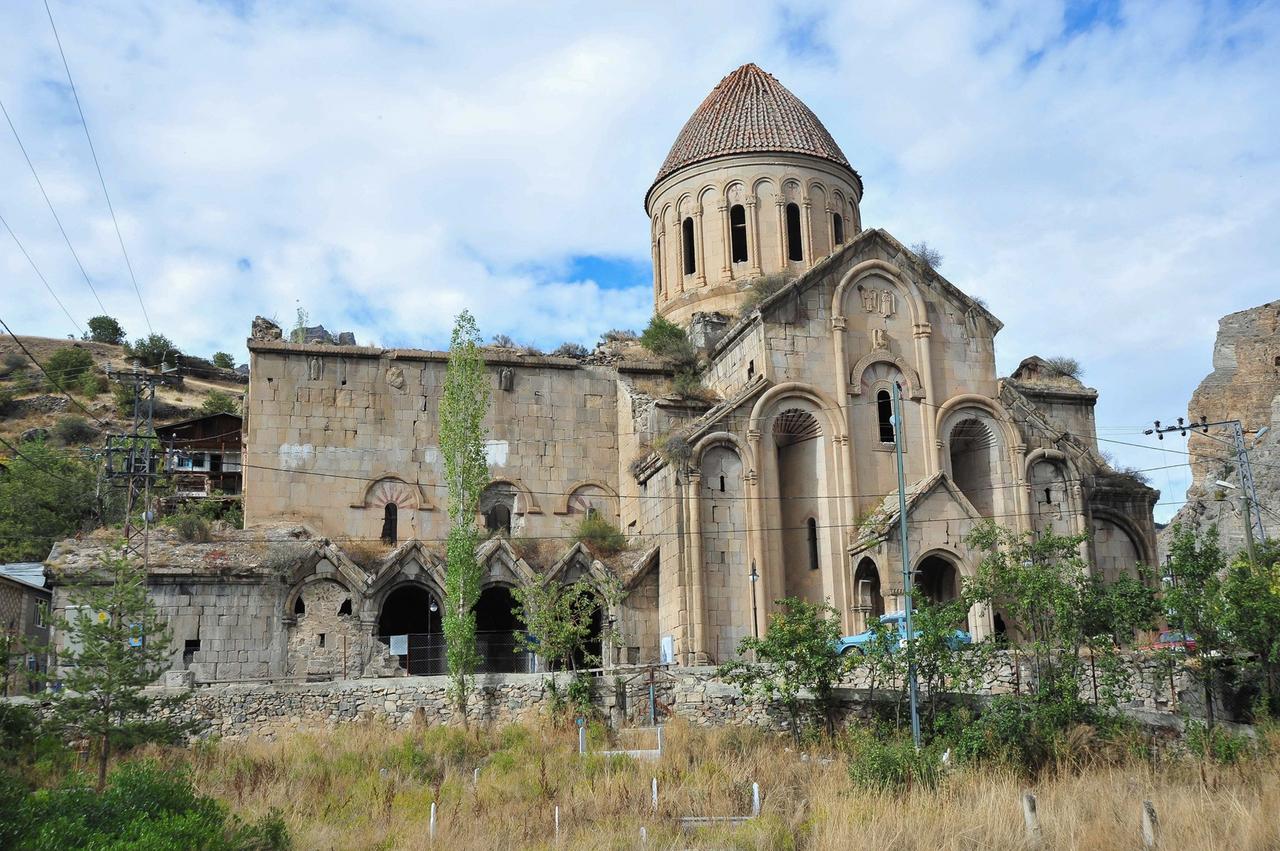
Öşvank Church
Location | Çamlıyamaç Village Türkiye Erzurum Uzundere | ||||||||
|---|---|---|---|---|---|---|---|---|---|
Construction Date(s) | 963–973 | ||||||||
Founder(s) | Magistras Bagrat (Georgian Bagratid Dynasty) | ||||||||
Architect(s) | Öşklü Grigor | ||||||||
Dedication | John the Baptist | ||||||||
Architectural Plan | Cruciform, three-apsidal | ||||||||
Architectural Style(s) | Georgian Orthodox architecture early Gothic window forms Byzantine influences | ||||||||
Dome | 12-window drum, Byzantine restoration between 1022 and 1028 | ||||||||
Fresco Date | Relief stone decorations, frescoes, botanical motifs | ||||||||
Öşvank Church is a historical church located in the village of Çamlıyamaç, in the Uzundere district of Erzurum Province, Türkiye. It is regarded as one of the most important examples of medieval Georgian architecture. Built in the second half of the 10th century, this monumental structure is significant both within the context of Georgian Orthodox Christian tradition and the artistic heritage of Anatolia, due to its architectural features, decorations, frescoes and religious importance.

Öşvank Church (Republic of Türkiye Erzurum Governorship)
The church was constructed between 963 and 973 by Magistras Bagrat, son of King Adarnase III and a prominent Georgian nobleman, during the reign of the Georgian Bagratid dynasty. According to an inscription, the architect was Öşklü Grigor, a renowned master builder of the period. The church was dedicated to John the Baptist. At the time, the region was under both political and cultural Georgian dominance, and Öşvank served as an important spiritual and cultural center for the dynasty.
Between 1022 and 1028, the church’s large dome was repaired with contributions from the Byzantine emperors Basil II and Constantine VIII. This restoration is one of the rare examples of Byzantine-Georgian architectural collaboration.

Öşvank Church (Republic of Türkiye, Erzurum Governorate)
Öşvank Church is designed in a cross-in-square plan and oriented along an east-west axis. Externally, the cruciform shape dominates, while internally, the three-aisled space formed by the three apses is particularly striking. At the center of the church stands a tall dome supported by a drum with twelve windows. The dome emphasizes the building’s central structure and allows natural light to illuminate the interior space.
Slender, pointed arch windows in the Gothic style are concentrated especially on the drum of the dome, and the exterior surfaces are adorned with carved reliefs. In this regard, Öşvank is one of the rare examples reflecting early Gothic aesthetics. The entrance areas, particularly the tympanum on the south arm of the cross, feature detailed ornamentation. These tympana contain inscriptions in Georgian detailing the construction process and honoring the donors.

Öşvank Church (Republic of Türkiye, Erzurum Governorship)
The church is richly decorated internally. The majority of the frescoes were commissioned in 1036 by Jojil Potrikios. These frescoes, located on the apses, vaults and arches, depict scenes from the Bible, portraits of saints and symbolic figures. Column bases adorned with vegetal motifs and iconographic elements on the walls contribute significantly to the artistic depth of the structure.
%2520kopya.jpg&w=1280&q=75)
Frescoes (Türkiye Culture Portal)
The church complex was designed not merely as a place of worship but as a comprehensive religious settlement accommodating monastic life. Within the complex are various functional spaces including a bathhouse, baptistery, priests’ chambers, a library, a kitchen and a dormitory. This multifunctional structure reflects the social and religious importance of monasteries in the medieval Christian world.
The western arm of the cross is surrounded by additional buildings on the north, south and west sides. The two-story structure on the north wing is original; the additions on the south and west were constructed in later periods. A column originally located on the façade has been lost over time and replaced by a symbolic tree trunk.
Today, Öşvank Church holds an important place in Erzurum’s cultural heritage and attracts both local and international visitors. Known as the “Hagia Sophia of the East,” the structure is a sacred pilgrimage site for Georgian Christians. In recent years, the Ministry of Culture and Tourism has initiated various projects to preserve and restore the building. Nevertheless, the roof system and certain structural elements have suffered serious damage, and comprehensive restoration remains urgently needed.
Anadolu Ajansı. “Doğu’nun Ayasofyası Öşvank.” Accessed May 20, 2025. https://www.aa.com.tr/tr/pg/foto-galeri/dogunun-ayasofyasi-osvank-.
KUDAKA (Northeastern Anatolia Development Agency). "Öşvank Kilisesi." Kuzeydoğu Anadolu Kalkınma Ajansı. Accessed May 20, 2025. https://kudaka.gov.tr/bolgemiz/erzurum/erzurum-gezilecek-yerler/osvank-kilisesi.
T.C. Erzurum Valiliği. "Öşvank Kilisesi." Accessed May 20, 2025. http://erzurum.gov.tr/osvank-kilisesi.
T.C. Ministry of Culture and Tourism. "Öşvank Kilisesi." *Kültür Portalı*. Accessed May 20, 2025. https://www.kulturportali.gov.tr/turkiye/erzurum/gezilecekyer/osvank-kilisesi.

Öşvank Church
Location | Çamlıyamaç Village Türkiye Erzurum Uzundere | ||||||||
|---|---|---|---|---|---|---|---|---|---|
Construction Date(s) | 963–973 | ||||||||
Founder(s) | Magistras Bagrat (Georgian Bagratid Dynasty) | ||||||||
Architect(s) | Öşklü Grigor | ||||||||
Dedication | John the Baptist | ||||||||
Architectural Plan | Cruciform, three-apsidal | ||||||||
Architectural Style(s) | Georgian Orthodox architecture early Gothic window forms Byzantine influences | ||||||||
Dome | 12-window drum, Byzantine restoration between 1022 and 1028 | ||||||||
Fresco Date | Relief stone decorations, frescoes, botanical motifs | ||||||||
Historical Background and Construction
Architectural Structure and Plan
Decorative Program and Frescoes
Functional Areas and Ancillary Structures
Current Condition and Conservation Efforts