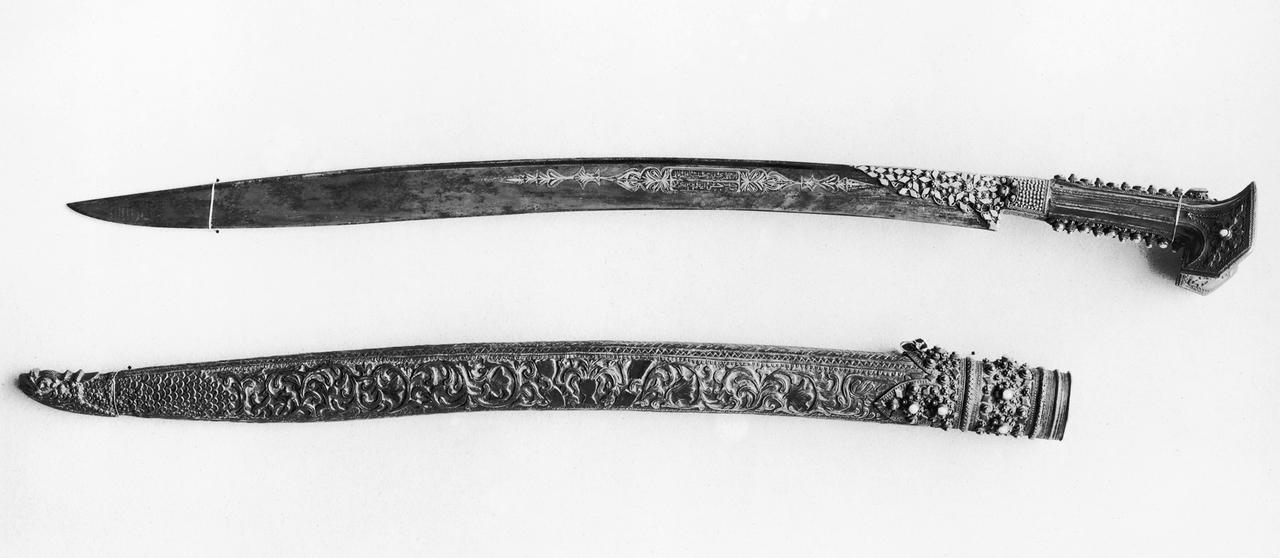
Yatağan is a short, slightly curved, single-edged close-combat weapon that was widely used in the Ottoman Empire from the 16th century until the end of the 19th century. Distinctive in form, it differs from both swords and polesarms. In addition to its function as an offensive weapon, it also held symbolic importance as an indicator of the owner’s social status and wealth. Capable of both cutting and thrusting, this weapon is particularly associated with the Janissaries.
Engraved Yatağan Blade – 19th Century (The Walters Art Museum)
Historical Development
A clear evolution in Ottoman sword forms can be observed from the second half of the 15th century onward. Starting with the reign of Fatih Sultan Mehmed (1451–1481), Ottoman swords began to develop a distinct character in both form and functionality. The yatağan, with its unique design, emerged in the second half of the 16th century and continued to be used with little change in form until the 19th century.
The popularity of the yatağan increased significantly due to its association with the Janissary Corps, from which it became recognized as one of their symbolic weapons. It was used not only within the Ottoman army but also across the empire’s vast territories including the Near East, the Balkans and the Caucasus. However, with the growing effectiveness of firearms, particularly muskets, from the 1800s onward, the importance and use of traditional swords such as the yatağan gradually declined.
Theoretical Approaches and Classification
Due to its distinctive shape, the yatağan does not fit neatly into either the sword or the polesarm category; as a result, it is studied as a separate category in scholarly literature. The name is believed to derive from the way the weapon was stored in its scabbard, as if lying down (“yatar gibi”). In classifications of Ottoman weapons, the yatağan is listed as a distinct type alongside curved, double-edged, straight and polesarm forms.
- Perception in Russian Literature: Within the context of Turkish-Russian wars of the 18th and 19th centuries, the yatağan gained prominent symbolic status in Russian literature as an emblem of the Turkish soldier, particularly the Janissary. In these works, the yatağan is portrayed as a reflection of the Turkish soldier’s fearsome and “savage” nature. M. N. Zagoskin’s novel Hopyor at Evening (1834) is the earliest known Russian literary text to mention the yatağan. It was followed in the same year by A. S. Pushkin’s Kirjali and in 1835 by N. F. Pavlov’s work titled Yatağan.
- Cultural Traces in the Balkans: The cultural influence of the yatağan is also evident in 15th and 16th century tombstones found in Bosnia and Herzegovina. These tombstones, known as “stećci,” feature carvings of swords and yatağans, demonstrating the weapon’s symbolic significance in the region.
Physical Characteristics and Construction
The yatağan consists of three main components: the blade, the hilt and the scabbard.
- Blade (Base): The most distinctive feature of the yatağan is its single-edged, inwardly curved (reverse-bent) blade. This design grants it superior capability for both cutting and thrusting. The back of the blade is thick and blunt, while the concave cutting edge is known as the “yalman.” Typically, one or more “fullers” (grooves) are present on the blade to facilitate blood flow and reduce weight.
- Hilt (Handle): The most characteristic feature of the yatağan is its hilt, often described as “ear-shaped” due to its resemblance to the letter Y. The two lateral protrusions of the hilt prevent the weapon from slipping from the hand and provide support to the wrist, enhancing handling. Hilts were crafted from bone, ivory, horn, wood and various metals. The shape of the hilt evolved over time: while it was relatively straight in the 15th century, it gradually developed a more pronounced curve and protrusion.
- Scabbard: Yatağan scabbards were typically constructed with a wooden core covered in leather or velvet. The mouthpiece, ferrule (metal tip), and carrying rings were made of metal.
Manufacturing Processes and Decoration
The production of the yatağan began with the forging of the blade from steel or iron using hammering techniques. The manufacture involved not only swordsmiths but also specialized artisans such as engravers (nakkaş), inlay craftsmen (zernişan), and scabbard makers (niyamgeran).
Various techniques were employed in the decoration of yatağans:
- Inlay (Kakma): Decorations created by embedding gold or silver wires into the blade and hilt. Floral motifs and inscriptions were commonly executed using this technique.
- Repoussé (Kabartma): A technique in which designs are raised on the front surface of a metal plate by hammering from the reverse side.
- Engraving (Kazıma): A method in which patterns are carved into the blade or hilt using cutting tools.
- Stone Inlay: The "murassa" technique, in which weapons are decorated with precious stones such as ruby, emerald, and turquoise.
Decorations frequently feature floral motifs (rumi, hatayi, leaf), geometric patterns, and inscriptions containing the names of masters, owners, or verses from the Quran.
Examples
- Sword of Kanuni Sultan Süleyman: This sword, housed in the Topkapı Sarayı Müzesi, is considered one of the most notable examples of its type. Its hilt is made of ivory, and its base bears inscriptions believed to commemorate the Battle of Mohács, listing the sultan’s titles.
The World’s Largest Sword Belonging to Kanuni Sultan Süleyman (117 cm) - Tarihte Yürüyen Adam (Man Walking Through History and Our Waqf Works)
- Koyunoğlu Museum Collection: The museum in Konya houses numerous swords dated from the 17th to the 19th century. The pieces in this collection are significant for demonstrating a variety of materials and decorative techniques.
- Azerbaijan National History Museum Collection: This museum also displays Ottoman-era swords, particularly those with steel barrels and hilts made of ivory or horn.