

This article was automatically translated from the original Turkish version.
+1 More
Discovery(ies) | 1991 | ||||||||
|---|---|---|---|---|---|---|---|---|---|
Type(s) | Natural ice mummy | ||||||||
Period(s) | Late Neolithic / Copper Age | ||||||||
Date(s) | 3370–3100 BCE | ||||||||
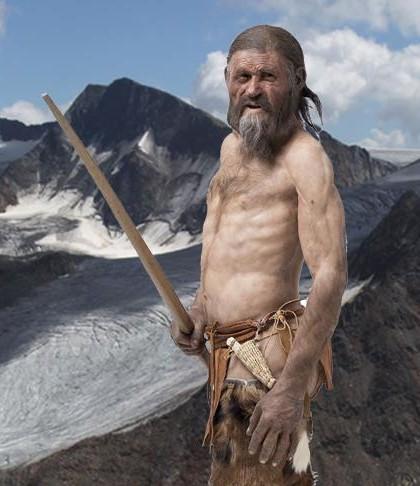
Ötzi (also known as the Iceman) is a naturally preserved human mummy approximately 5200–5300 years old, found in the European Alps under natural conditions. Due to its frozen state within ice, this prehistoric individual is also referred to as the Iceman and represents a significant archaeological find offering direct archaeological evidence of human life during the final stages of the Stone Age. His body and associated artifacts naturally mummified after death in a high-altitude glacial environment, preserving them to a remarkable degree. This exceptional state of preservation has enabled detailed scientific investigations into the living conditions, environment, and tools used by prehistoric people.

Ötztal Alps (AA)
Ötzi’s remains were accidentally discovered on 19 September 1991 by two hikers from Nuremberg, Germany, Erika and Helmut Simon, on a mountain ridge at an altitude of approximately 3210 meters in the Ötztal Alps.【1】 The discovery occurred in a region forming the border between Austria and Italy, where the upper part of a human body was seen protruding from a shallow, ice-filled depression.
Initially, it was thought that the body might belong to a recent mountaineer who had died in the Alps, as frozen human remains are occasionally found in glaciers. However, examination of the equipment and objects found with the body revealed that the remains belonged to a much older period.
A few days after the discovery, the body was removed from the ice and transported to the Institute of Forensic Medicine at the University of Innsbruck, where initial examinations suggested the find was of prehistoric origin. Subsequent measurements determined that the discovery site lay approximately 92 meters south of the Austria–Italy border, placing it within Italian territory. Consequently, Ötzi’s remains were later transferred to the South Tyrol Archeological Museum in Bolzano, Italy.【2】
To determine Ötzi’s age, radiocarbon (C-14) dating analyses were conducted on bone and tissue samples. These analyses were carried out at accelerator mass spectrometry (AMS) laboratories in Zurich, Switzerland, and Oxford, United Kingdom. Plant remains and environmental materials found alongside Ötzi were also examined using similar methods.【3】
Measurements yielded a radiocarbon age of approximately 4546 ± 17 years BP (before 1950).【4】 Calibration curves indicated that this corresponds to approximately 3370–3100 BCE.【5】 These results confirm that Ötzi lived during the final stages of the Neolithic Period in Europe. Furthermore, the tools and botanical remains found with Ötzi have been dated to the same period.
Anthropological examinations have established that Ötzi was an adult male who was middle-aged at the time of his death. The natural preservation of his body has enabled detailed analysis of the physical traits of a prehistoric individual.

Ötzi (AA)
Research on Ötzi’s body has revealed various details about his health. Analyses indicate he suffered from several illnesses and showed signs of parasitic infections. Additionally, high levels of arsenic detected in hair samples suggest he may have been exposed to copper-smelting activities during his lifetime.【6】
The tattoos on Ötzi’s body are among the most notable findings. Studies have identified a total of sixty-one tattoos arranged in nineteen distinct groups. These tattoos typically consist of short, parallel lines clustered on various parts of the body.【7】
Most tattoos are located on joint and muscle areas such as the lower back, knees, ankles, and wrists. Some researchers therefore suggest these markings may not have been decorative but instead related to therapeutic practices for pain or health conditions.【8】 Scientific analyses of Ötzi’s body have provided valuable insights into the health, living conditions, and cultural practices of prehistoric communities.
Various tools and equipment found alongside Ötzi’s body provide information about daily life and technological knowledge during the late Neolithic period. Among the artifacts recovered with the mummy are a copper axe, a bow and arrows, a stone knife, and several personal items.【9】
Ötzi’s copper axe is regarded as a significant discovery regarding prehistoric metal use. This tool represents a transitional artifact between the Stone Age and the advent of metallurgy and is considered one of the earliest examples of metalworking in Europe.【10】
Archaeological finds also include a bow and arrows. The fact that some arrows were unfinished suggests Ötzi carried equipment related to hunting activities during his travels. Additionally, a stone knife and its sheath were found with the mummy.
Ötzi’s clothing provides important data on prehistoric attire. He wore a grass cloak, a leather jacket, leggings made of goat hide, and a bearskin hat. These garments were designed to adapt to cold, mountainous environments and offer insight into the textile and leather-working techniques of the period.【11】
Ötzi’s cause of death has been the subject of extensive research and scientific investigation. Initial assessments suggested his death might have resulted from natural conditions or harsh alpine environments, but subsequent medical and forensic analyses revealed different findings.
During X-ray and computed tomography examinations of the mummy, an arrowhead was discovered lodged in Ötzi’s left shoulder. Research indicates the arrow penetrated beneath the left scapula and severed the subclavian artery, causing severe blood loss.【12】
In addition to the arrowhead, a significant blunt-force trauma was identified on Ötzi’s head. This finding suggests his death may have resulted not only from the arrow wound but also from a powerful blow to the head.【13】
Forensic and archaeological investigations indicate that Ötzi’s death resulted from a violent event. The presence of the arrowhead and trauma marks strongly suggests his death occurred during an attack or conflict.
The discovery of Ötzi has provided a major scientific resource for archaeology and anthropology studies of prehistoric human communities. Due to its exceptional preservation in glacial conditions, his body, clothing, and associated artifacts have been examined in great detail.
Ötzi is considered one of the oldest human mummies preserved in glacial environments. He has enabled researchers to obtain direct data on the physical characteristics, dietary habits, and daily practices of prehistoric Europeans.
Examinations of the mummy have also yielded important insights into prehistoric health conditions and diseases. Scientific analyses of tattoos, bone structure, and tissue residues have contributed to understanding ancient societies’ medical practices and living conditions.
The tools and garments found with Ötzi provide information about early technologies and cultural practices. These artifacts have aided in understanding the production techniques, hunting activities, and environmental adaptations of late Neolithic and early Copper Age communities in Europe.
Brizzi, Vittorio. “Otzi, The Iceman: Murder Victim, Thaws Out but Whodunit and Why?” *Bulletin of Primitive Technology* 29 (2005): 52–58. Accessed March 9, 2026. https://www.academia.edu/17404701/Otzi_The_Iceman_Murder_Victim_Thaws_Out_But_Whodunit_And_Why
Deter-Wolf, Aaron, Benoît Robitaille, Danny Riday, Aurélien Burlot, and Maya Sialuk Jacobsen. “Chalcolithic Tattooing: Historical and Experimental Evaluation of the Tyrolean Iceman's Body Markings.” *European Journal of Archaeology* 27, no. 3 (2024): 267–288. Accessed March 9, 2026. https://www.sciencedirect.com/science/article/pii/S0168583X99011969?via%3Dihub
Dickson, James H. “Ötzi, the Tyrolean Iceman.” In *Encyclopedia of Geoarchaeology*, 1–4. Cham: Springer International Publishing, 2022. Accessed March 9, 2026. https://link.springer.com/content/pdf/10.1007/978-3-030-44600-0_116-1.pdf
Doğru, İslam. “Buz Adam Ötzi Son Yemeğinde Yoğun Yağ Tüketmiş.” Anadolu Ajansı. July 13, 2018. Accessed March 9, 2026. https://www.aa.com.tr/tr/bilim-teknoloji/buz-adam-otzi-son-yemeginde-yogun-yag-tuketmis/1202974
Kutschera, Walter, and Werner Rom. “Ötzi, the Prehistoric Iceman.” *Nuclear Instruments and Methods in Physics Research Section B: Beam Interactions with Materials and Atoms* 164–165 (2000): 12–22. Accessed March 9, 2026. https://www.sciencedirect.com/science/article/pii/S0168583X99011969?via%3Dihub
Maderspacher, Florian. “Ötzi.” *Current Biology* 18, no. 21 (2008): R990–R991. Accessed March 9, 2026. https://www.chimia.ch/chimia/article/view/2010_315
Püntener, Alois G., and Serge Moss. “Ötzi, the Iceman and His Leather Clothes.” *Chimia* 64, no. 5 (2010): 315. Accessed March 9, 2026. https://www.chimia.ch/chimia/article/view/2010_315
Türkoğlu Oğuz, Gamze. “Ötzi’nin Midesinde Ülser Bulundu.” Anadolu Ajansı. January 8, 2016. Accessed March 9, 2026. https://www.aa.com.tr/tr/yasam/otzinin-midesinde-ulser-bulundu/502442
Vidale, Massimo, Luca Bondioli, David W. Frayer, Margherita Gallinaro, and Andrea Vanzetti. “Ötzi the Iceman: Examining New Evidence from the Famous Copper Age Mummy.” *Expedition* 58, no. 2 (2016): 13–17. Accessed March 9, 2026. https://www.penn.museum/documents/publications/expedition/58-2/otzi_iceman.pdf
[1]
Walter Kutschera ve Werner Rom, “Ötzi, the Prehistoric Iceman,” Nuclear Instruments and Methods in Physics Research Section B: Beam Interactions with Materials and Atoms 164–165 (2000): 13, https://doi.org/10.1016/S0168-583X(99)01196-9
[2]
Walter Kutschera ve Werner Rom, “Ötzi, the Prehistoric Iceman,” 13.
[3]
Walter Kutschera ve Werner Rom, “Ötzi, the Prehistoric Iceman,” 19.
[4]
Walter Kutschera ve Werner Rom, “Ötzi, the Prehistoric Iceman,” 19.
[5]
Walter Kutschera ve Werner Rom, “Ötzi, the Prehistoric Iceman,” 18.
[6]
Florian Maderspacher, “Ötzi,” Current Biology 18, no. 21 (2008):R991. https://www.cell.com/current-biology/fulltext/S0960-9822(08)01194-9.
[7]
Aaron Deter-Wolf, Benoît Robitaille, Danny Riday, Aurélien Burlot ve Maya Sialuk Jacobsen, “Chalcolithic Tattooing: Historical and Experimental Evaluation of the Tyrolean Iceman's Body Markings,” European Journal of Archaeology 27, no. 3 (2024): 268. https://doi.org/10.1017/eaa.2024.5.
[8]
James H. Dickson, “Ötzi, the Tyrolean Iceman,” in Encyclopedia of Geoarchaeology (Cham: Springer International Publishing, 2022), 2. https://link.springer.com/content/pdf/10.1007/978-3-030-44600-0_116-1.pdf.
[9]
Florian Maderspacher, “Ötzi,” Current Biology 18, no. 21 (2008): R991.
[10]
Massimo Vidale, Luca Bondioli, David W. Frayer, Margherita Gallinaro ve Andrea Vanzetti, “Ötzi the Iceman: Examining New Evidence from the Famous Copper Age Mummy,” Expedition 58, no. 2 (2016): 14. https://www.penn.museum/documents/publications/expedition/58-2/otzi_iceman.pdf
[11]
Florian Maderspacher, “Ötzi,” Current Biology 18, no. 21 (2008): R991.
[12]
James H. Dickson, “Ötzi, the Tyrolean Iceman,” in Encyclopedia of Geoarchaeology (Cham: Springer International Publishing, 2022), 1-2.
[13]
Florian Maderspacher, “Ötzi,” Current Biology 18, no. 21 (2008): R991.


Discovery(ies) | 1991 | ||||||||
|---|---|---|---|---|---|---|---|---|---|
Type(s) | Natural ice mummy | ||||||||
Period(s) | Late Neolithic / Copper Age | ||||||||
Date(s) | 3370–3100 BCE | ||||||||
Discovery
Dating and Period
Physical Characteristics and Health Status
Artifacts Found with Ötzi
Cause of Death
Scientific and Historical Significance