


This article was automatically translated from the original Turkish version.
+2 More
The Özsoy Opera, regarded as a turning point in Turkish artistic life during the Republic era, is the first lyric stage work produced as part of Türkiye’s cultural modernization process. Commissioned by Mustafa Kemal Atatürk in 1934 on the occasion of the visit of Iranian Shah Reza Pahlavi, its music was composed by Ahmet Adnan Saygun and its libretto written by Münir Hayri Egeli. The opera fulfilled artistic, ideological, and diplomatic functions.
The historical context of the Özsoy Opera is as closely tied to the Republic’s cultural transformation as it is to its status as the first national opera in Turkish art history. During the Ottoman Empire, the art of opera was performed in major cities like Istanbul by Italian opera troupes in the 19th century, but these events remained confined to the palace circle and a narrow segment of society. Interest in Western musical genres increased from the reign of Mahmud II onward, leading to the establishment of court bands and orchestras with contributions from foreign musicians such as Giuseppe Donizetti. The widespread social adoption of polyphonic music and its transformation into a form embodying national identity occurred as a result of the cultural reforms carried out during the Republic period.
With the proclamation of the Republic, Mustafa Kemal Atatürk regarded culture and art as fundamental pillars of the state. Direct state support was provided to fields such as polyphonic music, conservatory education, theater, and opera. The Mûsikî Muallim Mektebi established in Ankara in 1924 and the State Conservatory opened in 1936 formed the institutional foundations of this transformation. The return of musicians sent abroad for education—such as Ahmet Adnan Saygun, Necil Kâzım Akses, and Ulvi Cemal Erkin—brought qualitative advancement to the fields of art and education.
During the 1934 visit of Iranian Shah Reza Pahlavi to Türkiye, it was decided to complement the diplomatic occasion with an artistic event. Atatürk commissioned an opera that would reflect Türkiye’s artistic and cultural development. The work was intended to embody a synthesis of Eastern and Western elements and to address the historical ties between Türkiye and Iran. In this framework, the Özsoy Opera served not only artistic production but also diplomatic, ideological, and cultural objectives.

Ankara Halkevi (Ankara State Museum of Painting and Sculpture)
The Özsoy Opera is built on a mythological narrative. The libretto was written by Münir Hayri Egeli and draws inspiration from the Persian poet Ferdowsi’s epic Shahnameh. The story revolves around the tale of the king Feridun and his two sons, Tûr and İraç. Tûr represents the Turks, while İraç represents the Iranians. The character Selm does not appear in the libretto; the structure is centered on these two figures. The narrative unfolds within a framework that references the historical and cultural connections between Türkiye and Iran.
The structure of the work spans a timeline extending from mythological times to the founding years of the Republic. In the first act, a bard introduces the epic narrative, portraying a land of justice and unity under Feridun. The arrival of the character Ahriman threatens this order. This conflict is shaped through dualities such as ignorance versus enlightenment and evil versus good. The second act takes place in a village in Anatolia, featuring scenes that represent the Republic’s values of education, equality, and populism. The character Ayşim symbolizes women’s rights and freedom, while Köse Ağa embodies traditional structures. The characters Teacher Mehmet and his father Tûr represent progressive approaches.
The third act consists of scenes referencing the 10th anniversary of the Republic. Topics such as the establishment of factories, the role of women in social life, and the return of educated youth to the homeland are addressed. Themes range from personal relationships to nation-building. In the finale, Tûr and İraç reconcile; the narrative concludes with their ancestors descending from the heavens to bless this unity. The opera encompasses themes of peace, modernization, populism, the social role of women, and national unity.
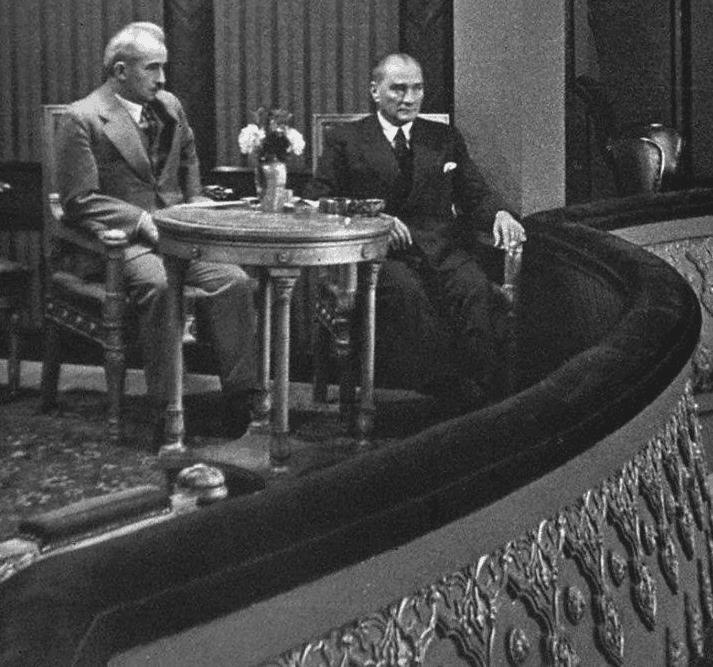
At Atatürk’s Halkevi (Ankara State Museum of Painting and Sculpture)
The Özsoy Opera was completed in approximately one month. Composer Ahmet Adnan Saygun and librettist Münir Hayri Egeli worked under Atatürk’s guidance. For the staging, a string instrument ensemble was brought from Istanbul and combined with the Presidency’s Harmony Orchestra. The chorus was formed from students of the Gazi Education Institute and various girls’ high schools. The rehearsal process encountered various material and logistical challenges. The premiere took place on the night of 19 June 1934 at the Ankara Halkevi, in the presence of Atatürk and Reza Pahlavi.

Ahmet Adnan Saygun (Anadolu Agency)
The Özsoy Opera was designed as a politically charged artistic work. Through this piece, Atatürk aimed to enable the Turkish nation to express itself through art. Strengthening diplomatic relations with Iran was also a key objective. The unity of Feridun’s sons in the opera alludes to the historical ties between Türkiye and Iran. Themes such as public education, the social role of women, and the transformation of youth are closely linked to the modernization process.
Musically, the Özsoy Opera exemplifies Ahmet Adnan Saygun’s early compositional style. The work integrates pentatonic scales and Anatolian melodies with Western harmony. The dramatic structure is divided into three acts: the first presents a mythological narrative, the second unfolds in a village setting and explores the impact of Republican reforms on the populace, and the third depicts scenes representing the future of modern Türkiye. Elements such as choreography, costume, and set design are also integral to the production.
Anadolu Ajansı. "İlk Türk operasını kaleme alan sanatçı: Ahmet Adnan Saygun." Anadolu Ajansı Web Sitesi. Accessed May 29, 2025. https://www.aa.com.tr/tr/kultur/ilk-turk-operasini-kaleme-alan-sanatci-ahmet-adnan-saygun/2781167
Ankara Resim ve Heykel Müzesi. "Türk Ocağı Salonu." Ankara Resim ve Heykel Müzesi Web Sitesi. Accessed May 29, 2025. https://arhm.ktb.gov.tr/MuseumSaloons/Detail/3/turk-ocagi-salonu
Baltacan, Mehmet. *Ahmet Adnan Saygun’un “Özsoy” Operasının İncelenmesi, Reji Çalışması ve Sahnelenmesi.* Master's thesis, Selçuk Üniversitesi, 2006. Accessed May 29, 2025. https://acikerisim.selcuk.edu.tr/items/732b0cdf-f1a0-46a0-bb43-a0c7ba9fa997
Beyarslan, Ardan. *Türk Operası’nın Ulusal Kimliği ve Ahmed Adnan Saygun’un Özsoy Operası.* Master's thesis, İstanbul Üniversitesi, 2018. Accessed May 29, 2025. https://nek.istanbul.edu.tr/ekos/TEZ/60448.pdf
Tuçdemir, İlknur. “Cumhuriyet’in Kurulmasından Sonra Bestelenen İlk Türk Operası: Özsoy Destanı”. Atatürk Kültür Dil ve Tarih Yüksek Kurumu Web Sitesi. Accessed May 29, 2025. https://www.ayk.gov.tr/wp-content/uploads/2015/01/TUN%C3%87DEM%C4%B0R-%C4%B0lknur-CUMHUR%C4%B0YET%E2%80%99%C4%B0N-KURULMASINDAN-SONRA-BESTELENEN-%C4%B0LK-T%C3%9CRK-OPERA.SI-%C3%96ZSOY-DESTANI.pdf


Historical Context
Plot and Theme
Production Process
Human and Political Impacts of the Work
Musical and Dramatic Structure