


This article was automatically translated from the original Turkish version.
+2 More
Paraphasia is a language error commonly observed in individuals with aphasia【1】 and characterized by the involuntary substitution of an incorrect word for the intended word during speech. This type of error can occur in both spoken and written expression and may affect the semantic, phonological, or structural levels of language. Paraphasias are associated with disruptions in the word production process and are frequently observed in fluent types of aphasia.
Paraphasias are classified into three main types:
Paraphasic errors are more frequent and varied in fluent aphasias (e.g., Wernicke’s aphasia, conduction aphasia, and transcortical sensory aphasia). Although speech in these types of aphasia is fluent, it is often filled with nonsensical or irrelevant words. In particular, Wernicke’s aphasia is frequently associated with semantic and neologistic paraphasias. In contrast, nonfluent aphasias (e.g., Broca’s aphasia) exhibit a lower rate of paraphasia; in these cases, articulatory difficulties and production problems are more prominent.
The frequency of paraphasias varies between naming tasks (identifying objects or actions by name) and repetition tasks. Studies have shown that individuals with fluent aphasia produce more paraphasic errors during naming than during repetition. Furthermore, neologistic paraphasias are more common in naming tasks, while phonemic paraphasias predominate in repetition tasks. The distribution of these errors is linked to the nature of the brain damage, particularly lesions in the temporo-parietal and posterior temporal regions, which are associated with paraphasia production.
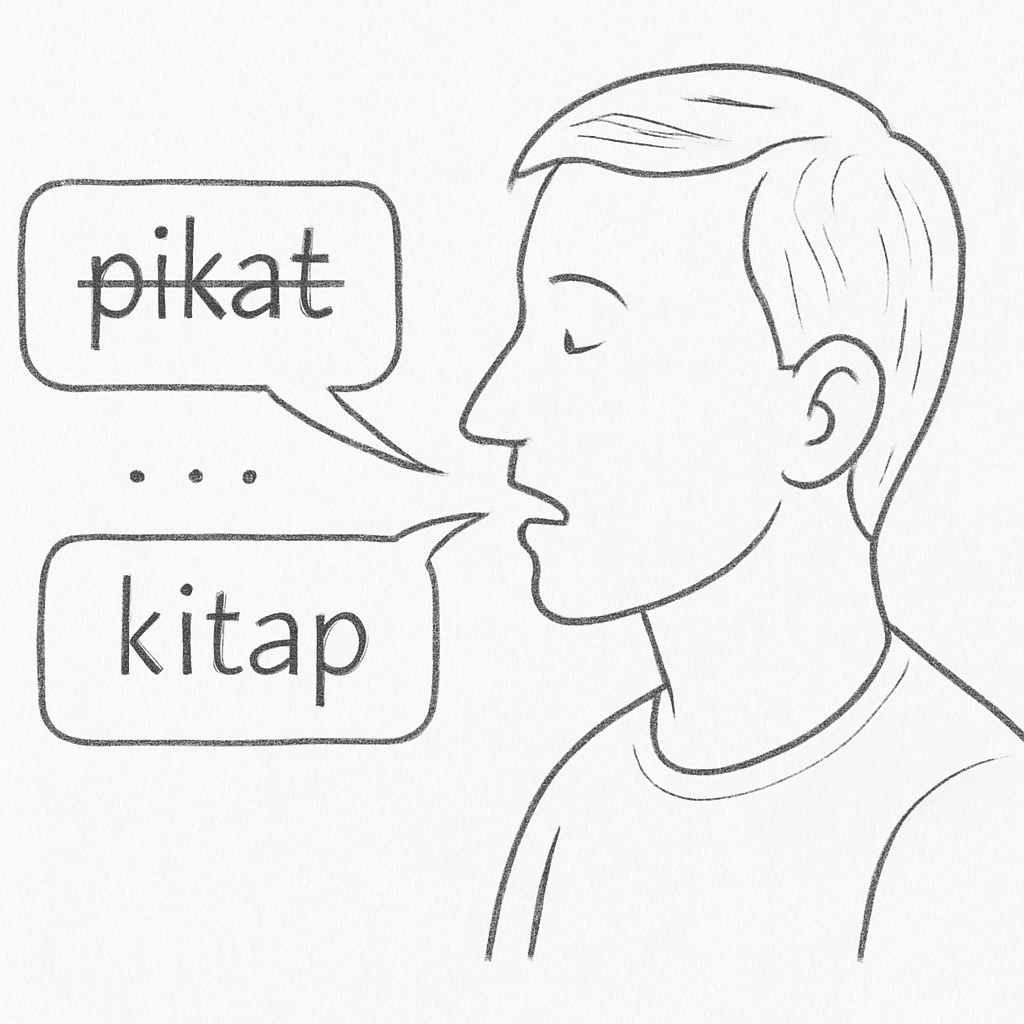
Representative image of paraphasia. (Generated by artificial intelligence.)
Paraphasias tend to cluster in the final portions of words. This pattern suggests a possible disruption in sublexical language processing. Such disturbances in the phonological stages of word production can prevent the accurate articulation of the target word. When examining the frequency of paraphasia types, phonemic (sound-level) and semantic (meaning-level) paraphasias are the most common. These two types are regarded as typical error patterns in speech production. In contrast, mixed-type paraphasias involving both phonological and semantic confusion occur less frequently.
Paraphasic errors provide valuable information for both diagnosis and the development of individualized therapy plans in language assessment and treatment. The type, frequency, and contextual features of paraphasias offer important clues about the type, extent, and severity of aphasia. Systematic analysis of these errors enables more accurate targeting of therapeutic interventions.
Çıtav, Nezihe. *Anadili Türkçe Olan Akıcı Tip Afazili Bireylerin Tekrarlama ve Adlandırma Etkinliklerinde Parafazi Kullanımlarının Değerlendirilmesi.* Master's thesis,Anadolu Üniversitesi, 2004. Accessed May 16, 2025. Özcan, Ayşegül. *Beyindilbilimi Açısından Afazili Hastalarda Perseverasyon.* Master's thesis, Dokuz Eylül University, 2009. Accessed May 16, 2025. Ulusoy, Sevim. *Afazili Türk Hastalarda Adlandırma Sorunu.* Master's thesis, Dokuz Eylül University, 2010. Accessed May 16, 2025.
[1]
Afazi: Genellikle inme (felç) veya beyin kanaması gibi serebrovasküler hastalıklar sonucunda, beynin dil ve konuşmadan sorumlu bölgelerinde meydana gelen hasara bağlı olarak ortaya çıkan bir dil bozukluğu.

Classification
Aphasia Types Associated with Paraphasia
Naming and Repetition Tasks
Error Location and Type
Clinical Significance of Paraphasia