


This article was automatically translated from the original Turkish version.
+2 More
Passive Radar
Definition(s) | A radar system that detects and tracks targets by using existing electromagnetic signals in the environment without emitting its own signal. | ||||||||
|---|---|---|---|---|---|---|---|---|---|
Field of Use | Civil Security and Surveillance Air Traffic Monitoring Air Defense Systems Intelligence Use Electronic Warfare | ||||||||
Feature(s) | and does not emit its own signal. has low visibility can be used alongside active radars It typically operates with a multi-sensor structure | ||||||||
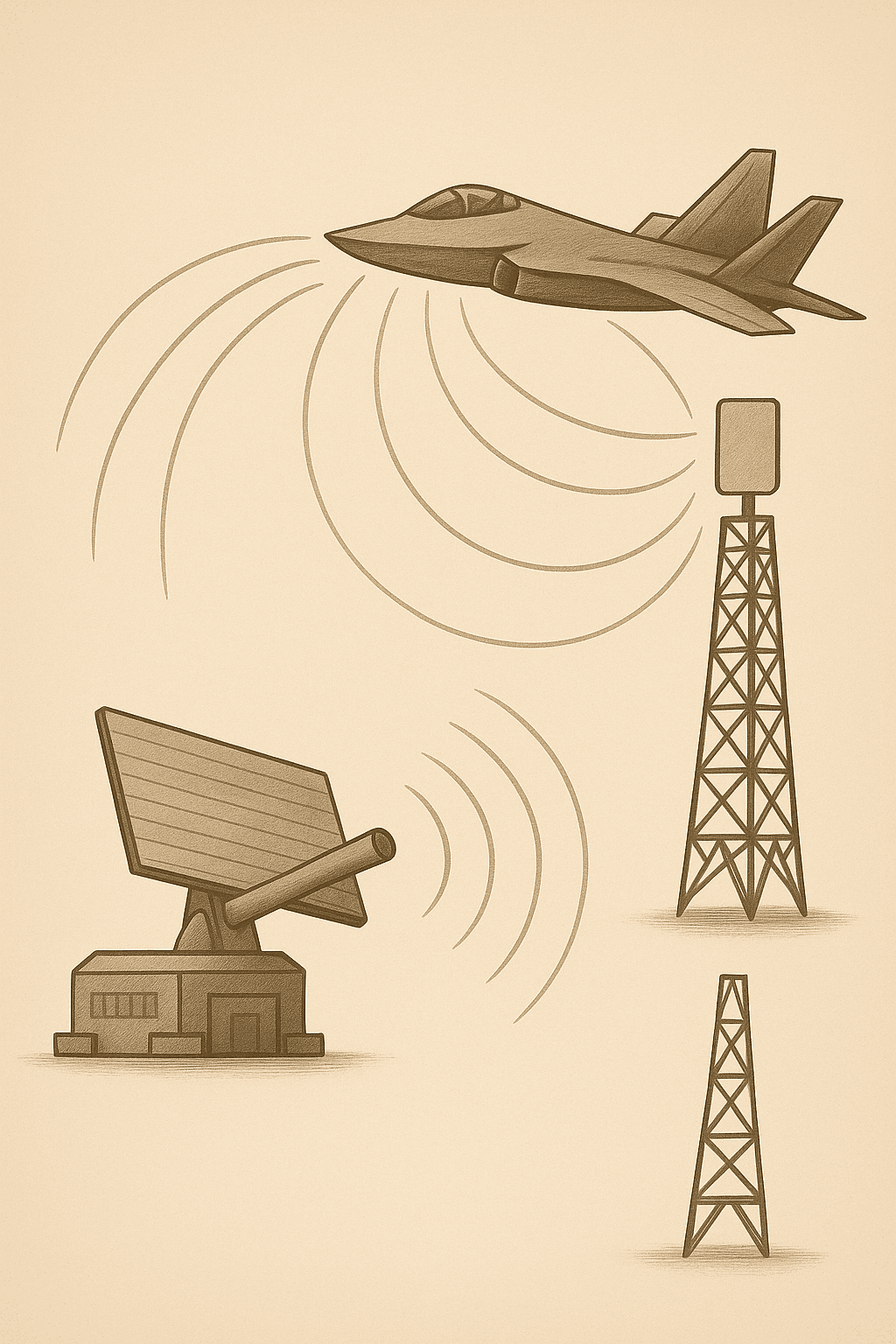
Passive radar systems are a type of radar that detect and track targets by listening to signals emitted by environmental sources, without actively transmitting electromagnetic signals. A sub-application of these systems is Bearing Only Tracking (BOT), a method designed to track targets using only directional (azimuth) information and preferred especially in low-observable (stealth) operations. Due to its ability to monitor targets without emitting active signals, BOT holds critical importance in both military and defense industry applications.
The concept of passive radar first emerged theoretically during World War II in the United Kingdom, where radio broadcasts were monitored to detect aircraft. With technological advancements, BOT techniques became practically feasible from the 1970s onward, thanks to more sophisticated sensor systems and signal processing algorithms. In the 2000s, the development of electronic warfare systems made direction-based passive tracking both more necessary and more achievable.
In the Bearing Only Tracking method, the sensor measures only the direction (azimuth angle) of received electromagnetic signals without transmitting any signal toward the target. These directional measurements are recorded over time and used to estimate the target’s position, velocity, and other dynamic parameters.

Passive Radar (MilitaryEmbedded)
Bar-Shalom, Yaakov, and Xiao-Rong Li. Estimation and Tracking: Principles, Techniques and Software. Norwood, MA: Artech House, 1993.
Howland, Peter E. “Target Tracking Using Television-Based Illuminators of Opportunity.” IEE Proceedings – Radar, Sonar and Navigation 152, no. 3 (2005): 153–160. DOI: . Accessed June 13, 2025.
Keysight Technologies. *An Introduction to Passive Radar Systems: A Test and Measurement Perspective.* All About Circuits, 2021. Accessed June 13, 2025. https://www.allaboutcircuits.com/industry-white-papers/an-introduction-to-passive-radar-systems-a-test-and-measurement-perspective/
Li, Xiaodong, and Vesselin Jilkov. “Survey of Maneuvering Target Tracking: I. Dynamic Models.” *IEEE Transactions on Aerospace and Electronic Systems* 39, no. 4 (2003): 1333–1364. DOI: . Accessed June 13, 2025.
Zhang, Tong, Fei Liu, Hongwei Liu, and Qingchun Meng. “Bearing-Only Target Tracking Based on Improved Particle Filter.” *Sensors* 18, no. 1 (2018): 54. DOI: . Accessed June 13, 2025.

Passive Radar
Definition(s) | A radar system that detects and tracks targets by using existing electromagnetic signals in the environment without emitting its own signal. | ||||||||
|---|---|---|---|---|---|---|---|---|---|
Field of Use | Civil Security and Surveillance Air Traffic Monitoring Air Defense Systems Intelligence Use Electronic Warfare | ||||||||
Feature(s) | and does not emit its own signal. has low visibility can be used alongside active radars It typically operates with a multi-sensor structure | ||||||||
History
Basic Principles and Methods
Bearing Only Tracking
Key Steps in BOT Systems
Single Sensor vs. Multi-Sensor Use
Applications
Advantages
Limitations
Technical Developments and Trends