This article was automatically translated from the original Turkish version.
Type of Geographical Indication | Mahreç Sign | ||||||||
|---|---|---|---|---|---|---|---|---|---|
Registration Number | 10 | ||||||||
Registration Date | 14.11.1997 | ||||||||
Product / Product Group(s) | Rugs and Kilims | ||||||||
Province(s) | Afyonkarahisar | ||||||||
Applicant/Registrant(s) | Sandıklı Municipality | ||||||||
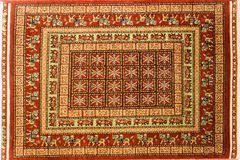
Afyonkarahisar’s Sandıklı district is associated with a traditional handicraft whose origin and production technique reflect regional characteristics. It has been officially registered as a geographical indication by the Turkish Patent and Trademark Office. This type of carpet is an important representative of the region’s traditional weaving culture. The registration process began with an application dated 21 June 1996 and was completed on 14 November 1997, granting it official status.
The Pazırık hand-knotted carpet adheres to defined technical standards. The carpet type is designated as Pazırık, with quality measured at 6.25 knots per square centimetre (25×25). The total weight per square metre is approximately 5910 grams. The primary materials are yarns: for the pile, 1.5/2 Wool yarn is used; for the warp, 6/11 Wool yarn; for the thick weft, 6/14 Wool yarn; and for the fine weft, 12/5 Wool yarn. The pile height is set between 8 and 10 millimetres.
The production of the Pazırık hand-knotted carpet employs the Turkish knot (double knot) technique. This knotting style contributes to the carpet’s durability and the clarity of its patterns. The material consumption per square metre during production is as follows:
The geographical boundary of the Pazırık hand-knotted carpet is defined in the registration certificate as Türkiye. However, the entity that applied for registration is the Sandıklı Municipality, and the origin of production is linked to the Afyonkarahisar/Sandıklı region.
Continuous monitoring is conducted to ensure compliance with the product’s technical specifications. The monitoring process is carried out in accordance with Article 20 of the Decree-Law on the Protection of Geographical Indications. Both the production stages and marketing processes are subject to inspection. The institutions responsible for monitoring are Regional Directorates, Factory Directorates, and the Quality Control Commission. Carpets that do not meet the established technical specifications are not permitted to bear the geographical indication.
Turkish Patent and Trademark Office. "Pazırık El Halısı (Mahreç İşareti) Sicil Belgesi." Accessed October 24, 2025. https://ci.turkpatent.gov.tr/Files/GeographicalSigns/83890cac-3282-4995-84ad-81f5a56f25ec.pdf.
Turkish Patent and Trademark Office. "Pazırık El Halısı." Geographical Indications Portal. Accessed October 24, 2025. https://ci.turkpatent.gov.tr/cografi-isaretler/detay/37873.

Type of Geographical Indication | Mahreç Sign | ||||||||
|---|---|---|---|---|---|---|---|---|---|
Registration Number | 10 | ||||||||
Registration Date | 14.11.1997 | ||||||||
Product / Product Group(s) | Rugs and Kilims | ||||||||
Province(s) | Afyonkarahisar | ||||||||
Applicant/Registrant(s) | Sandıklı Municipality | ||||||||
Product Characteristics
Production Method
Geographical Boundary
Monitoring