

+2 More

Period(s) | 1st century AD | ||||||||
|---|---|---|---|---|---|---|---|---|---|
Place of Birth | City of Anazarbos in the Cilicia Region (near modern-day Adana) | ||||||||
Profession(s) | Military Physician | ||||||||
Areas of Interest | Botany, Pharmacology, Medicine | ||||||||
Famous Work | De Materia Medica | ||||||||
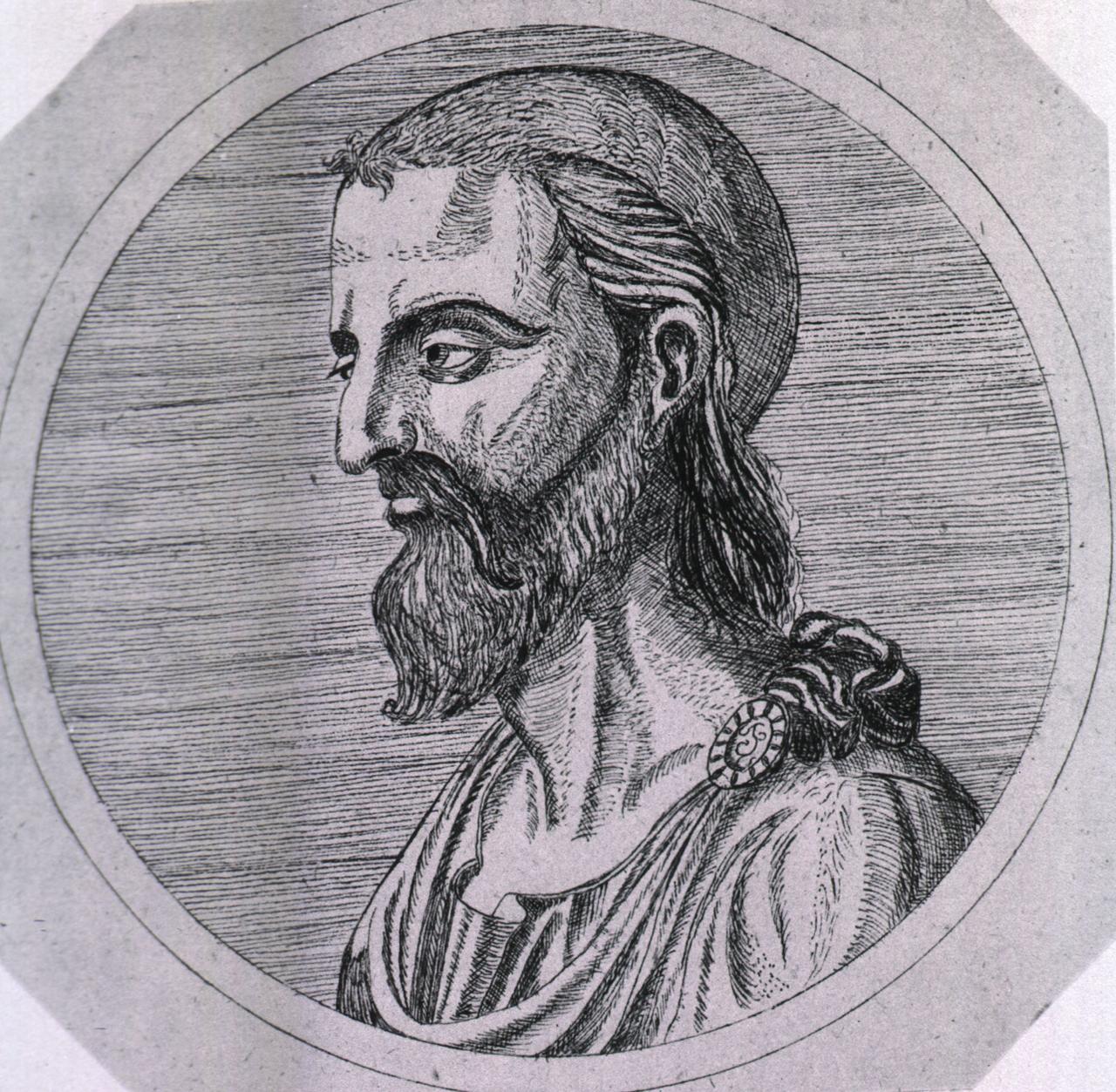
Pedanius Dioscorides, a Greek physician, botanist, and one of the founding figures of the pharmacological tradition, was born in the 1st century CE in Anazarbos, one of the important cities of Cilicia. During his years of service as a military physician in the Roman army, he had the opportunity to travel extensively across the empire’s vast territories, examining plants in regions such as Anatolia, Greece, Arabia, Iran, Egypt, North Africa, Gaul, and the Caucasus. He compiled his observations in a five-volume work titled Peri Hyles Iatrikes (De Materia Medica), meticulously documenting the botanical characteristics, medical effects, methods of use, and storage techniques of plant, animal, and mineral substances. This work served as a foundational reference for both Eastern and Western medicine for centuries.【1】

Depiction of Dioscorides’ Mandrake by Ernest Board, 1909 (rawpixel)
Information about Dioscorides’ early life is limited, but it is known that he was born in Anazarbos. During this period, under Roman administration, the city was one of the major centers of Cilicia. It is believed that Dioscorides may have been born during the reigns of Tiberius (CE 14–37) or Caligula (CE 37–41).【2】 Frequent references to his attachment to Cilicia suggest that he spent his formative years immersed in the region’s rich botanical diversity.
Dioscorides is thought to have received his education in Tarsus and Alexandria. He is reported to have been a student of Arius of Tarsus, a renowned physician of the time, in the preparation of medicines from plant and animal substances. In Alexandria, he received comprehensive training in drug formulations, botanical properties, and medical applications, and is said to have made use of the great libraries in Tarsus.
Dioscorides’ professional life unfolded as a military physician in the Roman army, serving during the reigns of Caligula, Claudius, and Nero. This position enabled him to travel widely across the empire’s territories, studying plants from the cities and mountains of Anatolia to Greece, from Syria to Egypt, from Italy to Spain, and from Africa to Iran. The more than 600 substances described in his work reflect the breadth of these journeys. His military service provided him with opportunities for observation, experimentation, and access to a wide variety of materials, forming the foundation of De Materia Medica.
Dioscorides’ most important work is the five-volume pharmacological encyclopedia Peri Hyles Iatrikes (De Materia Medica), believed to have been written between CE 60 and 78. In this work:
Dioscorides classified plants according to their form and medicinal effects, explaining their botanical descriptions alongside their therapeutic properties. For each substance, he provided information on its name, definition, effect, methods of use, side effects, methods of distinguishing adulterants, conditions for collection and storage, optimal times for harvesting, techniques for preserving the plants, methods of extracting juices, and appropriate container choices.

Illustration from the Italian Translation of Dioscorides (Wellcome Collection)
De Materia Medica was translated into Syriac, Arabic, Hebrew, Persian, and Latin in early centuries and remained the primary medical reference text throughout the Middle Ages and the Renaissance in both the Islamic and Western worlds. Hunayn ibn Ishaq’s Arabic translation, titled Kitabü’l-Haşayiş, further enhanced its influence within Islamic medicine. During the Ottoman period, the work became one of the most frequently consulted primary sources; Matthioli’s commentary was translated into Ottoman Turkish, and references to Dioscorides appeared frequently in medical texts.
Information regarding Dioscorides’ family and private life is extremely scarce. In the preface to his work, he dedicated his studies to his teacher Arius. It is clear that he spent long periods traveling in nature to collect plants and devoted his life to observation and study.
No primary sources provide information on the date or place of Dioscorides’ death. While some modern interpretations suggest he died during the reigns of Nero or Vespasian, no definitive date is established. The most reliable information about his life comes from his own observations in his work and limited references by ancient authors.
Dioscorides is recognized as one of the founders of pharmacology. His systematic description of plants, his evidence-based explanation of their medical effects, and his classification method served as a model for medical texts for centuries. Islamic scholars such as Ibn Sina, Al-Razi, Ibn al-Baytar, and Al-Biruni drew upon his work in their own writings. In Ottoman medicine, De Materia Medica remained among the foundational texts, and physicians extensively used the information transmitted from it in compound drug manuals. Modern ethnobotanical studies have demonstrated that many of the plants described by Dioscorides are still used today for similar purposes.
Ataç, Adnan, and R. Vedat Yıldırım. “OSMANLI HEKİMLERİ VE DIOSKORIDES’İN ‘DE MATERIA MEDICA’SI”. *OTAM Ankara Üniversitesi Osmanlı Tarihi Araştırma ve Uygulama Merkezi Dergisi* 15, no. 15 (2004): 257-69. Accessed November 14, 2025. https://dergipark.org.tr/tr/download/article-file/114158
Ayteş Canevello, Sevim. “Erken Hıristıyanlık Döneminde Cilicialı Şifavericiler: Dioscorides, Cosmas ve Damianus”. *Seleucia*, no. 3 (2013): 217-33. Accessed November 14, 2025. https://dergipark.org.tr/tr/download/article-file/1146480
Büyüknisan, Emra. “Dioskurides Pedanius’un ‘De Materia Medica’ Adlı Eseri”. *Mersin Üniversitesi Tıp Fakültesi Lokman Hekim Tıp Tarihi ve Folklorik Tıp Dergisi* 1, no. 1 (2011): 55–60. Accessed November 14, 2025. https://dergipark.org.tr/en/download/article-file/643290
Demirci Kayıran, Serpil. “Dioskorides’in De Materia Medica Adlı Eserindeki Tıbbi Bitkilerin Doğu Akdeniz’de Günümüzdeki Kullanımlarının Araştırılması”. *Mersin Üniversitesi Tıp Fakültesi Lokman Hekim Tıp Tarihi Ve Folklorik Tıp Dergisi* 9, no. 2 (2019): 189–202. Accessed November 14, 2025. https://dergipark.org.tr/en/download/article-file/665591
Kavalalı, Gülsel. “MATERIA MEDICA’DAN GÜNÜMÜZE UZANAN TIBBİ BİTKİ: ISIRGAN.” *Mersin Üniversitesi Tıp Fakültesi Lokman Hekim Tıp Tarihi Ve Folklorik Tıp Dergisi* 1, no. 2 (2011): 35–37. Accessed November 14, 2025. https://dergipark.org.tr/en/download/article-file/643311
National Library of Medicine. “[Pedanius Dioscorides].” NIH. Accessed November 14, 2025. https://collections.nlm.nih.gov/catalog/nlm:nlmuid-101413723-img
Rawpixel. “Dioscorides describing the mandrake. Oil painting by Ernest Board, 1909.” Accessed November 14, 2025. https://www.rawpixel.com/image/13967748/dioscorides-describing-the-mandrake-oil-painting-ernest-board-1909
Wellcome Collection. “P. Mattioli, I discorsi ...nelli sei libri.” Wellcome Collection. Accessed November 14, 2025. https://wellcomecollection.org/works/wzkk96pv/images?id=jppf8m6q
Yıldırım, R. Vedat. "Anadolulu Hekim, Herbalist ve Materia Medica Yazarı." *Anadolu Tıbbı Dergisi* 1, no. 1 (2022): 1-6. Accessed November 14, 2025. https://dergipark.org.tr/tr/download/article-file/2790582
[1]
Adnan Ataç, ve R. Vedat Yıldırım, “OSMANLI HEKİMLERİ VE DIOSKORIDES’İN ‘DE MATERIA MEDICA’SI”, OTAM Ankara Üniversitesi Osmanlı Tarihi Araştırma ve Uygulama Merkezi Dergisi 15, no, 15 (2004), syf 257, https://dergipark.org.tr/tr/download/article-file/114158
[2]
Canevello Sevim Ayteş, "Erken Hıristıyanlık Döneminde Cilicialı Şifavericiler: Dioscorides, Cosmas ve Damianus", Seleucia ad Calycadnum, 3 (2013), syf 227, https://dergipark.org.tr/tr/download/article-file/1146480

Period(s) | 1st century AD | ||||||||
|---|---|---|---|---|---|---|---|---|---|
Place of Birth | City of Anazarbos in the Cilicia Region (near modern-day Adana) | ||||||||
Profession(s) | Military Physician | ||||||||
Areas of Interest | Botany, Pharmacology, Medicine | ||||||||
Famous Work | De Materia Medica | ||||||||
No Discussion Added Yet
Start discussion for "Pedanius Dioscorides" article
Childhood and Youth
Educational Background
Career
Major Works
Structure of the Work
Characteristics of the Work
Dissemination and Influence
Personal Life
Later Years and Death
Legacy and Influence