

This article was automatically translated from the original Turkish version.
+2 More
Protection Status | Registered in 1976 last restoration in 2023 | ||||||||
|---|---|---|---|---|---|---|---|---|---|
Location | Erzurum Yakutiye Ayaz Pasha Neighborhood | ||||||||
Architectural Type | Square plan, single dome | ||||||||
Patron | Pervizoğlu Hacı Mehmet | ||||||||
Located in the Yakutiye district of Erzurum, it is an important religious and educational structure reflecting the local influences of 18th-century Ottoman architecture.
It is situated in Erzurum’s Ayaz Paşa neighbourhood, east of the Rüstem Paşa Bedesten (Taş Han) and north of the Erzurum Inner Castle. Although no foundation inscription survives on the building, it is known from its endowment deed dated 1128 AH / 1715–1716 CE that it was commissioned by Pervizoğlu (Pervizzade) Hacı Mehmet. The structure was placed under protection by the High Council for Immovable Historical Monuments on 13 November 1976 and underwent comprehensive restoration in 2023.
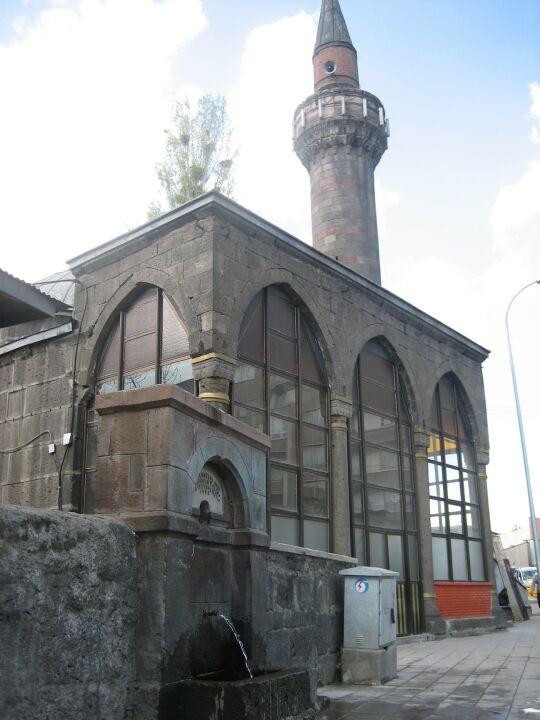
The mosque has a square plan with a single dome and is regarded as a miniature example of Erzurum mosque architecture due to its modest dimensions. Basalt stone was used for the load-bearing walls while brick was employed for the dome and pendentives. The final congregational space on the north façade is covered by three domes resting on four stone columns whose capitals are decorated with muqarnas.
The prayer hall is crowned by a central dome resting on an octagonal drum and supported by pendentives. The interior is illuminated by a total of eight windows: the lower row features rectangular openings while the upper row has round-arched mazgals. The stone mihrab with muqarnas niches and the wooden minbar inside the prayer hall exhibit a simple and original design. A wooden gallery for women is located on the north side of the prayer hall, while the interior walls are currently clad with modern tiles and the dome bears late-period penwork decorations.

Visual Related to Pervizoğlu Mosque (Erzurum Portalı)
The cylindrical minaret, located at the northwestern corner of the mosque and rising from the load-bearing walls, is constructed of basalt stone. The shaft of the minaret’s balcony is composed of half cut stone and half brick, and the structure is crowned with a pointed cap. Access to the minaret and the women’s gallery, as seen in other mosques in Erzurum, is provided through a window opening on the right side of the entrance. On the outer face of the northern wall of the mosque courtyard stands a single-spout fountain from the late period.
The medrese, located east of the mosque and known as İhlâsiye and Muhammediye, was constructed simultaneously with the mosque in 1715–1716. Originally it had a U-shaped plan surrounding the mosque on three sides, but most of it was demolished during urban development projects associated with the construction of Menderes and Ayaz Paşa avenues during the Republican era. Only four to six rooms, built of basalt stone with barrel-vaulted ceilings and a rectangular plan, have survived to the present day. These rooms were restored in 1997 according to their original form and are currently used as a café by a private enterprise.
Efeler Belediyesi. "Ramazan Paşa Camii." Erişim tarihi: 5 Şubat 2026. https://www.efeler.bel.tr/efeler/tarihi-ve-turistik-bolgeler/ramazan-pasa-camii.
Erzurum Ansiklopedisi. "Pervizoğlu Camii ve Medresesi." Accessed February 5, 2026. http://erzurumansiklopedi.com/pervizoglu-camii-ve-medresesi/.
Erzurum Portalı. "Pervizoğlu Cami." Erişim tarihi: 5 Şubat 2026. https://erzurumportali.com/shf/328/Pervizoglu-Cami.
Erzurum İl Directorate of Culture and Tourism. "Camiler." Accessed February 5, 2026. https://erzurum.ktb.gov.tr/TR-56081/camiler.html.

Protection Status | Registered in 1976 last restoration in 2023 | ||||||||
|---|---|---|---|---|---|---|---|---|---|
Location | Erzurum Yakutiye Ayaz Pasha Neighborhood | ||||||||
Architectural Type | Square plan, single dome | ||||||||
Patron | Pervizoğlu Hacı Mehmet | ||||||||
Location and History
Architectural Features
Minaret and Fountain
Pervizoğlu Medrese