


This article was automatically translated from the original Turkish version.
+1 More
Phantom limb phenomenon is the continued sensation of a limb or organ as still being part of the body following its amputation or surgical removal. This phenomenon encompasses various sensations that may be painful or painless and is often confused with stump pain but is considered a distinct condition. It is reported that approximately 60 to 80 percent of individuals who undergo amputation experience phantom limb pain.
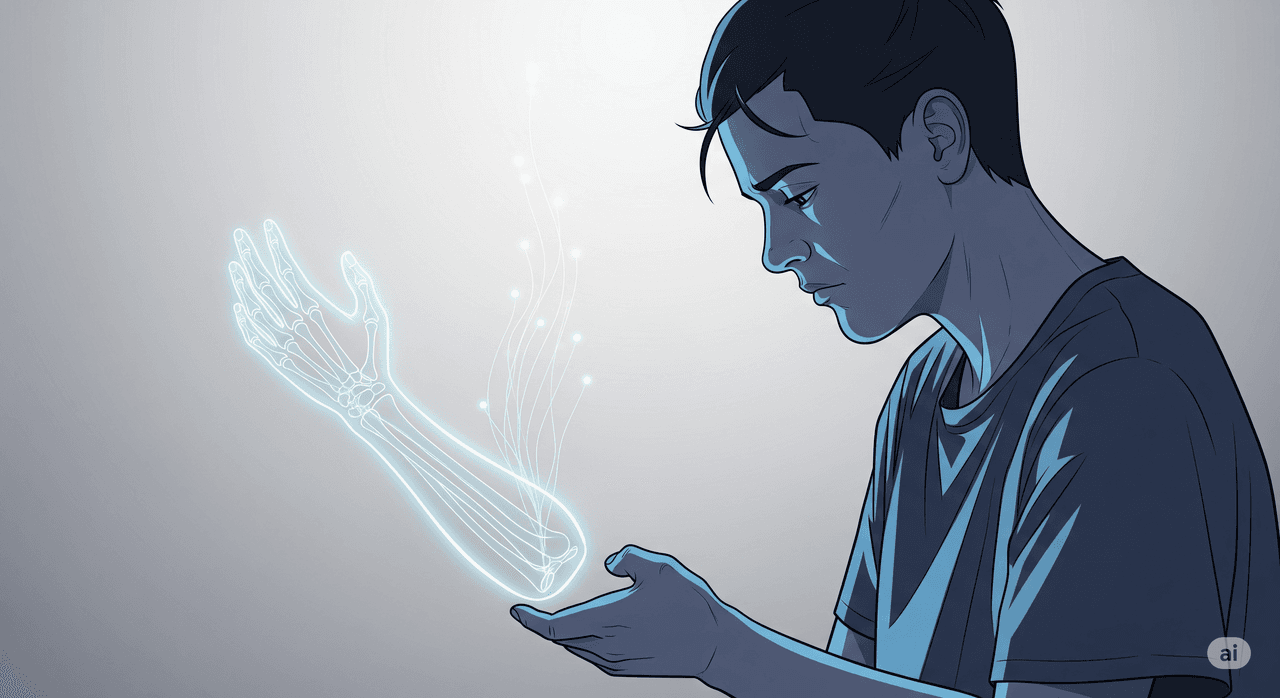
Phantom Limb: The Brain’s Real Perception (Generated by Artificial Intelligence)
The phantom limb phenomenon consists fundamentally of three distinct components:
The onset of phantom limb pain typically occurs early, with 75 percent of patients beginning to experience this pain within the first few days after amputation. However, the onset may also occur months or even years later. The long-term course of pain is variable; some studies report a slight decline in the proportion of patients affected over time while others have documented high rates even in long-term amputees. The intensity and frequency of pain can be triggered or exacerbated by physical factors such as changes in weather or pressure on the stump, as well as psychological factors such as emotional stress.
In some patients, a phenomenon known as “telescoping” is observed. In this condition, the distal part of the phantom limb such as the hand or foot gradually appears to retract toward the stump and may even be perceived as being inside it. Although historically it was assumed that telescoping reflected beneficial central nervous system adaptations and was associated with less phantom limb pain, current evidence indicates a positive association between telescoping and increased pain.
The first medical description of sensations persisting in a non-existent limb after amputation was made by the 16th-century French military surgeon Ambroise Paré. Paré noted that patients reported severe pain in their lost limbs following amputation.
The term “phantom limb” was first used between 1871 and 1872 by American physician Silas Weir Mitchell to describe this phenomenon observed in soldiers injured during the American Civil War. Mitchell was so disturbed by the phenomenon that he published his first article on the subject under a pseudonym in a popular magazine rather than a medical journal.
In early periods, explanations for the phenomenon focused on theories such as a form of wishful thinking stemming from the patient’s desire to regain the limb or the idea that abnormal activity from damaged nerve endings (neuromas) in the stump misled the brain.
Although the underlying mechanisms of the phantom limb phenomenon have not been fully elucidated, both peripheral and central nervous system factors are accepted as playing a role. Psychological factors are generally considered not direct causes but modulators that influence the intensity and course of pain.
Changes in the peripheral nervous system, particularly pathologies in the stump region, are regarded as a significant component of phantom limb pain.
Neuroplastic changes in the central nervous system play a fundamental role in the development and persistence of phantom limb pain. These changes occur at both spinal and brain levels.
The loss of a limb leads to reduced sensory input to the spinal cord (deafferentation). This triggers a process known as “central sensitization,” characterized by hyperexcitability of dorsal horn neurons, reduction of inhibitory processes, and structural alterations. NMDA receptors play a key role in this sensitization. Additionally, A-beta fibers, which normally transmit non-painful touch signals, may sprout into regions previously innervated by degenerated C-fibers, leading to the perception of touch as pain (allodynia).
The most prominent change in the brain is the reorganization of the somatosensory cortex, the region responsible for processing touch and body sensations.
Older assumptions that the phantom limb phenomenon is a psychological disorder or a consequence of unresolved grief are not supported by current empirical studies. Patients experiencing phantom limb pain typically exhibit normal psychological profiles. However, factors such as stress, anxiety, and inadequate pain coping strategies can trigger pain episodes and increase pain intensity.
Chronic pain in the limb prior to amputation is considered a risk factor for postoperative phantom limb pain. Some patients report that their phantom limb pain resembles the pre-amputation pain in quality and location. This supports the idea that long-term pain may create an “pain memory” in the brain that can be reactivated after amputation.
Treatment of phantom limb pain is challenging and the efficacy of most interventions is limited. Treatments generally include pharmacological, surgical, physiotherapeutic, and psychological approaches.
Medications commonly used for neuropathic pain are frequently preferred. These include tricyclic antidepressants, sodium channel blockers (e.g., carbamazepine), anticonvulsants, opioids, calcitonin, and NMDA receptor antagonists (e.g., ketamine).
Procedures such as stump revision, neurectomy (removal of a nerve), or nerve blocks may be attempted. However, these surgical interventions often yield poor outcomes and carry a risk of pain recurrence.
“Pre-emptive analgesia” administered before and during amputation aims to prevent the development of phantom limb pain. The underlying principle is to block peripheral pain signals from reaching the central nervous system during surgery, thereby preventing central sensitization and the formation of a “pain memory.” Methods such as epidural anesthesia have been used for this purpose. However, studies on this approach have yielded inconsistent results; some report reduced pain incidence while well-controlled studies have found no significant benefit.
Demir, Onurhan. *Hayalet Uzuv*. İzmir: Dokuz Eylül Üniversitesi Edebiyat Fakültesi Dilbilim Bölümü. Accessed August 16, 2025. https://www.academia.edu/5900165/Hayalet_Uzuv_Dr_Onurhan_Demir.
Flor, Herta. "Phantom-Limb Pain: Characteristics, Causes, and Treatment." *The Lancet Neurology* 1, no. 3 (2002): 182–89. Accessed August 16, 2025. https://citeseerx.ist.psu.edu/document?repid=rep1&type=pdf&doi=751af14b4e469b99b08a10f9b877b887e2084316.
Kaur, Amreet, and Yuxi Guan. "Phantom Limb Pain: A Literature Review." *Chinese Journal of Traumatology* 21, no. 6 (2018): 366–68. Accessed August 16, 2025. https://doi.org/10.1016/j.cjtee.2018.04.006.
Nikolajsen, L., and T. S. Jensen. "Phantom Limb Pain." *British Journal of Anaesthesia* 87, no. 1 (2001): 107–16. Accessed August 16, 2025. https://www.bjanaesthesia.org/article/S0007-0912(17)36348-1/fulltext.

No Discussion Added Yet
Start discussion for "Phantom Limb Phenomenon" article
Definition and Clinical Features
Historical Development
Etiology and Theoretical Approaches
Peripheral Nervous System Factors
Central Nervous System Factors
Spinal Level Changes (Spinal Cord)
Supraspinal Changes (Brain)
Psychological Factors and Pre-Amputation Pain
Treatment and Intervention Methods
Pharmacological Treatments
Surgical and Anesthetic Interventions
Neuromodulation and Physiotherapy:
Psychological and Behavioral Approaches:
Prevention