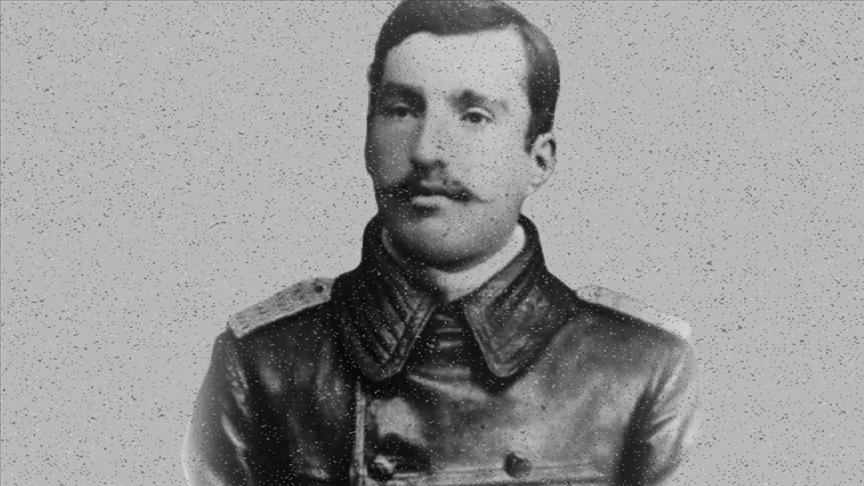
Education | France Buc (Bucq) Flight School – pilot training Mühendishane-i Berr-i Hümayun (Harbiye) – military education | ||||||||
|---|---|---|---|---|---|---|---|---|---|
Death | 11 March 1914, Jaffa | ||||||||
Place of Duty | Yeşilköy Aircraft School | ||||||||
Notable Activities | Edirne–Istanbul flight, first postal flight, Istanbul–Cairo route | ||||||||
Cause of Death | Airplane accident during takeoff from Jaffa | ||||||||
Birth | 1890, Boyabat | ||||||||
Aircraft Flown | Deperdussin type 'Prens Celalettin' | ||||||||
Burial Place | Damascus, Syria | ||||||||
Rank | First Lieutenant | ||||||||
Profession(s) | Ottoman pilot officer | ||||||||
Tayyareci Nuri Bey, a pilot officer who served during the early period of Ottoman military aviation, was born in Boyabat in 1890. He received pilot training in France, continued his flights at the Yeşilköy Aircraft School, completed the first long-distance flight between Edirne and Istanbul, participated in the Istanbul-Cairo mission, and lost his life in a crash during takeoff from Jaffa on 11 March 1914.
Tayyareci Nuri Bey is recorded as one of the pilots who carried out the first long-distance flight in Turkish aviation history, from Edirne to Istanbul (Anadolu Ajansı)
Nuri Bey was born in Boyabat in 1890. In 1907 he entered the military academy then known as Mühendishane-i Berr-i Hümayun and graduated in 1910 with the rank of second lieutenant, after which he was assigned to the Second Army. This period coincided with the Ottoman State’s initial efforts to integrate aviation into its military organization.
The institutionalization of Ottoman military aviation accelerated shortly after the Wright brothers’ flight, as the Ottoman administration began to focus on aviation. On 1 June 1911, the Aircraft Commission was established to systematically address issues such as pilot, observer, and technical personnel training, aircraft procurement, and the establishment of training facilities and equipment. Nuri Bey’s aviation training took place within this new organizational framework.
In line with the emphasis placed on aviation by War Minister Mahmud Şevket Pasha, it was decided to send eight officers fluent in foreign languages to Europe for aircraft acquisition and pilot training; Nuri Bey was among these officers. After graduating from the Bucq Flight School in France, he returned home and continued his training and flights at the Yeşilköy Aircraft School.
During his flights in Yeşilköy, he reached an altitude of 1,500 meters over Hadımköy once and over Istanbul twice, earning a certificate of merit for this achievement. This demonstrates that Nuri Bey was not merely a trainee officer but an experienced pilot who actively gained practical experience in the early days of Ottoman aviation. At the same time, Ottoman aviation training activities were centered in Yeşilköy.
During the period when Nuri Bey was assigned to the Western Army, the aircraft brought to Thessaloniki were set on fire by the Greeks. The aviators, including Nuri Bey, changed into civilian clothes and boarded a ship sent by Prince Omar Pasha of Egypt, returning to Istanbul. After his return, he conducted reconnaissance flights by following the movements of the Ottoman army using the aircraft assigned to him.
During this period, Nuri Bey’s name was also associated with awards given to encourage young and talented officers to join aviation. He became the first pilot to receive the 5,000 kurush prize awarded to any aviator who remained airborne for more than one hour, having flown for over an hour multiple times over Istanbul and Çatalca. Thus, Nuri Bey became one of the pilots recognized in early Ottoman aviation for endurance and flight duration.
One of the most significant milestones in Nuri Bey’s aviation career was the Edirne–Istanbul flight, undertaken after he was summoned from the Edirne Aircraft Detachment. On 24 October 1913, he took off together with Second Lieutenant Hami Bey. Shortly after takeoff, they entered dense fog; they climbed to a higher altitude to continue the flight and managed to land despite a piston failure in the engine. This flight, following the route Edirne–Babaeski–Çorlu–Çatalca–Yeşilköy, was recorded as the first long-distance flight in Turkish aviation history; Nuri Bey was awarded 10 gold coins for this achievement.
This flight held a special place among the long-distance trials conducted by Turkish aviators after the Balkan Wars. While Ottoman military aviation was still in its foundational and training phase, Nuri Bey’s flight exemplified the transition of training activities centered in Yeşilköy into practical operational use.
The Istanbul–Cairo mission was planned to boost public morale, reinforce confidence in the state, and sustain public interest in aviation following the Balkan Wars. Inspired by French aviators’ flights from Paris to Istanbul to Cairo, the Ottoman State decided to organize a similar long-distance air journey, leading to the planning of the Istanbul–Cairo flight. The mission was designed with 14 takeoff and landing stages; the route was set as Istanbul, Eskişehir, Afyon, Konya, Ulukışla, Adana, Aleppo, Homs, Beirut, Damascus, Jerusalem, El-Arish, Port Said, Cairo, and Alexandria. The total distance was 2,515 kilometers, with an estimated flight time of approximately 25 hours.
For the mission, two aircraft were assigned: the Blériot-type “Muavenet-i Milliye,” piloted by Fethi Bey and observer Sadık Bey; and the Deperdussin-type “Prens Celalettin,” piloted by Nuri Bey and observer Major İsmail Hakkı Bey. On 8 February 1914, following a state ceremony held in Yeşilköy, Nuri Bey’s aircraft took off at 09:10.
The mission began under rainy conditions. Due to deteriorating weather, Nuri Bey returned to Yeşilköy via Bursa. Later that afternoon, he took off again; however, he suffered an engine failure over Karamürsel and was forced to land in İznik. After repairs, he reached Osmaneli. From there, he carried mail to Bilecik and Eskişehir, thereby completing the first airmail flight in Turkish aviation history.
Nuri Bey arrived in Eskişehir on 12 February. On 14 February, after taking off again, he was forced to land in Bolvadin due to dense fog, then proceeded to Akşehir. On 15 February, an engine failure forced him to land in Osmaniye, and adverse weather conditions compelled him to land in Karakaya village; he only reached Konya on 17 February. This phase demonstrated the series of technical and meteorological difficulties encountered by the “Prens Celalettin.”
The most challenging section after Konya was crossing the Taurus Mountains. On 18 February, after passing Karaman and reaching the foothills of the Taurus, Nuri Bey could not gain sufficient altitude due to headwinds and was forced to return to Karaman. It became clear that the aircraft could not carry two people across the mountains; on 19 February, Nuri Bey departed Karaman alone, while his observer, İsmail Hakkı Bey, was sent by train to Tarsus. The two reunited in Tarsus and reached Adana on 22 February. Shortly after departing Adana, a spark plug failure forced a landing in Misis; the next day, they resumed flight and arrived in Aleppo on 23 February.
Fethi and Sadık Bey, flying the other aircraft, crashed into the rocky terrain of Küfrüharib southeast of the Sea of Galilee on 27 February 1914 while flying from Damascus toward Jerusalem. Both aviators lost their lives before completing the journey. Their bodies were buried on 28 February in the courtyard of the Tomb of Saladin inside the Umayyad Mosque in Damascus. When Nuri Bey and İsmail Hakkı Bey arrived in Damascus on the same day, they encountered their friends’ coffins.
Following this tragedy, the original plan to fly from Jerusalem to El-Arish was abandoned, and the coastal route was adopted instead. Nuri Bey followed the coast to Beirut and then reached Jaffa on 9 March 1914. A one-day pause was made in Jaffa for rest and aircraft maintenance. Meanwhile, preparations were underway in Egypt to welcome the Turkish aircraft.

Infographic on Tayyareci Nuri Bey (Anadolu Ajansı)
On 11 March 1914, a large crowd gathered at Jaffa’s airfield. Although the wind was blowing against the intended takeoff direction, the decision to proceed was made due to the mission’s proximity to completion. Nuri Bey attempted to change the takeoff direction to face the wind; however, due to the unsuitable layout of the airfield, the aircraft failed to gain sufficient speed. After flying briefly near sea level, it lost momentum and crashed into the sea.
After the crash, İsmail Hakkı Bey remained aboard the aircraft. Nuri Bey, wearing his leather flight gear, attempted to swim toward shore. However, the weight of his soaked clothing and the large amount of water he swallowed caused him to lose strength. He was pulled from the sea injured and unconscious and taken to a hospital, where despite medical efforts, he could not be saved. İsmail Hakkı Bey survived unharmed.
Individuals who participated in the rescue operation in Jaffa were later awarded medals. Among them, Jaffa’s mayor Ömer, shipowner Mehmed Ebül-lisân, Mahmud Ebül-lisân, and harbor official Hasan were commended for their rescue efforts.
Nuri Bey’s body was buried alongside those of Fethi and Sadık Bey, who had previously died during the Istanbul–Cairo mission, in Damascus. Thus, the three casualties of the Istanbul–Cairo mission were laid to rest in the same city. The Turkish Aviation Martyrs’ Monument and graves in Damascus continued to be remembered in subsequent periods.
Anadolu Ajansı. "24 Yıllık Hayatına İlkleri ve Kahramanlıkları Sığdıran Türk Pilot Tayyareci Nuri Bey." Accessed March 9, 2026. https://www.aa.com.tr/tr/yasam/24-yillik-hayatina-ilkleri-ve-kahramanliklari-sigdiran-turk-pilot-tayyareci-nuri-bey/3505959.
Anadolu Ajansı. "Tayyareci Nuri Bey." Anadolu Ajansı Infographic. Accessed March 9, 2026. https://www.aa.com.tr/tr/info/infografik/45051
Anadolu Ajansı. "Türk Havacılık Tarihinin Öncüsü Tayyareci Nuri Bey." Accessed March 9, 2026. https://www.aa.com.tr/tr/gundem/turk-havacilik-tarihinin-oncusu-tayyareci-nuri-bey/2531499
Beyoğlu, Süleyman. “Osmanlı Havacılığı ve İlk Havacılık Teşkilâtı.” Türk Kültürü İncelemeleri Dergisi 1 (1999): 139–150. Accessed March 9, 2026. https://dergipark.org.tr/en/download/article-file/3173335
Kurt, Emin. “Türk Sivil Havacılık Tarihinde Unutulmuş Bir Girişim: Aero Kulüp ve Türk Basınındaki Yankısı.” Atatürk Yolu Dergisi 68 (2021): 531–572. Accessed March 9, 2026. https://dergipark.org.tr/en/pub/ankuayd/article/943776
Köksal, Orhan. “Türk Askerî Havacılık Tarihine Dair Bir Kaynak İncelemesi: Uçan Süvariler.” Journal of Aviation Research 4, no. 1 (2022): 164–176. Accessed March 9, 2026. https://dergipark.org.tr/en/pub/jar/article/1067463
Yalçın, Osman. “Osmanlı İmparatorluğu Dönemi Türk Askeri Havacılığı.” *bilig* 96 (2021): 147–176. Accessed March 9, 2026. https://dergipark.org.tr/tr/pub/bilig/article/868093
Zamacı, Ayşe. “Onlar da Şehit Oldu Demek Ah... Meşrutiyet Dönemi Çocuk Mecmualarında Osmanlı’nın İlk Hava Şehitleri.” Tarihin Peşinde – Uluslararası Tarih ve Sosyal Araştırmalar Dergisi 19 (2018): 61–84. Accessed March 9, 2026. https://www.academia.edu/36578500/Onlar_da_%C5%9Eehit_Oldu_Demek_Ah_Me%C5%9Frutiyet_D%C3%B6nemi_%C3%87ocuk_Mecmualar%C4%B1nda_Osmanl%C4%B1n%C4%B1n_%C4%B0lk_Hava_%C5%9Eehitleri

Education | France Buc (Bucq) Flight School – pilot training Mühendishane-i Berr-i Hümayun (Harbiye) – military education | ||||||||
|---|---|---|---|---|---|---|---|---|---|
Death | 11 March 1914, Jaffa | ||||||||
Place of Duty | Yeşilköy Aircraft School | ||||||||
Notable Activities | Edirne–Istanbul flight, first postal flight, Istanbul–Cairo route | ||||||||
Cause of Death | Airplane accident during takeoff from Jaffa | ||||||||
Birth | 1890, Boyabat | ||||||||
Aircraft Flown | Deperdussin type 'Prens Celalettin' | ||||||||
Burial Place | Damascus, Syria | ||||||||
Rank | First Lieutenant | ||||||||
Profession(s) | Ottoman pilot officer | ||||||||
Life and Military Education
French Training and Yeşilköy Period
Post-Balkan Wars Assignments
Edirne–Istanbul Flight
Context of the Istanbul–Cairo Mission
Initial Stages of the Mission and the First Airmail Flight
After the Martyrdom of Fethi and Sadık Bey
Jaffa Crash and Death
Burial
Firsts Achieved by Tayyareci Nuri Bey